
Context:
Recently, Prime Minister Narendra Modi inaugurated Kumar Bhaskar Varma Setu is a newly six‑lane road bridge over the Brahmaputra River in Guwahati, Assam, marking a significant development in the infrastructure landscape of Northeast India. The bridge is named after Kumar Bhaskar Varma, a celebrated 7th‑century ruler of the ancient Kamarupa Kingdom, known for his contributions to the political and cultural heritage of Assam.
Key Features of the bridge:
-
-
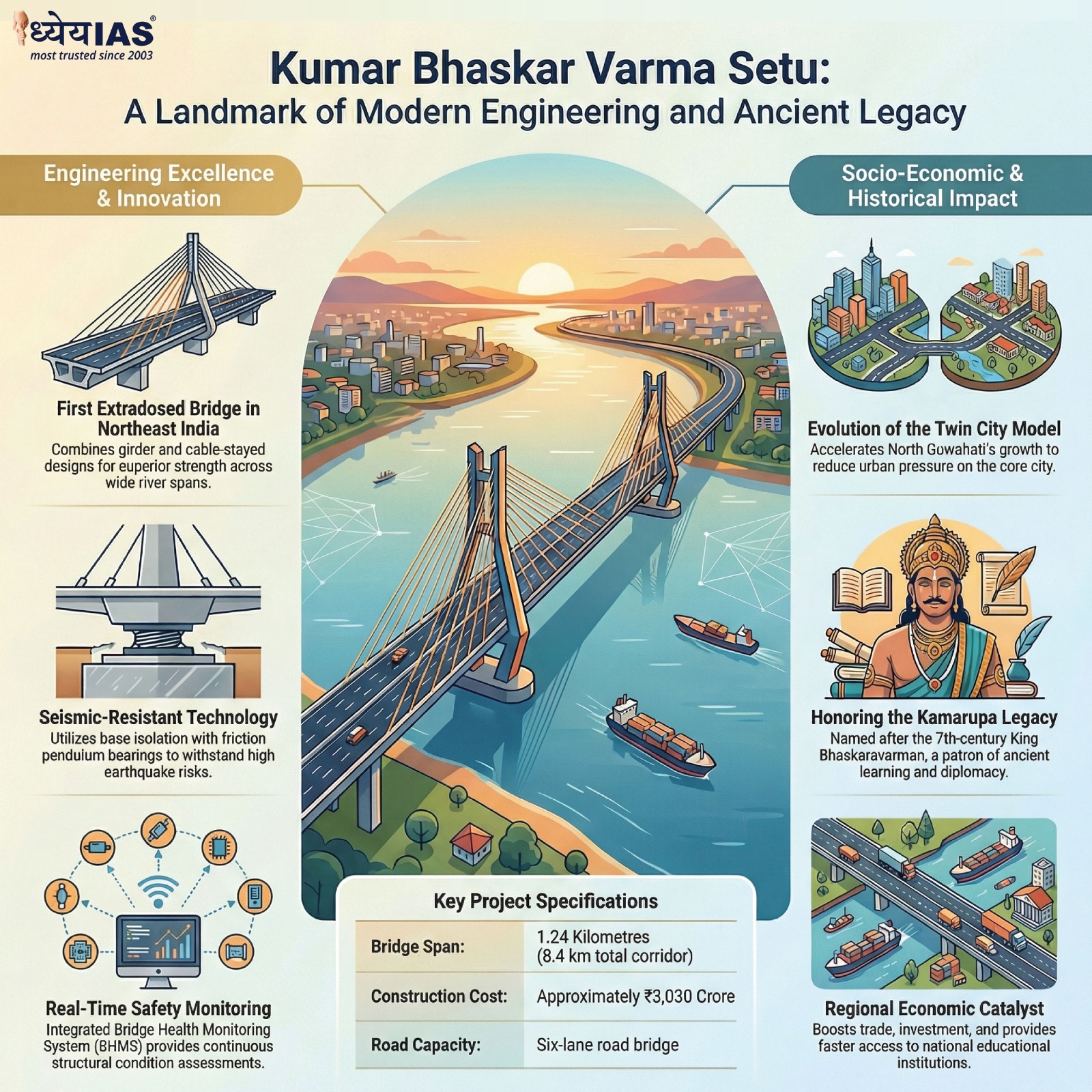
- The setu spans approximately 1.24 kilometres across the Brahmaputra and forms part of an 8.4 km connectivity corridor linking Guwahati with North Guwahati.
- Constructed at an estimated cost of around ₹3,030 crore, it is a six‑lane extradosed Prestressed Concrete (PSC) bridge — the first of its kind in Northeast India.
- The extradosed design combines attributes of girder and cable‑stayed bridges, providing enhanced structural strength and durability while accommodating wide river spans.
- Advanced engineering features such as base isolation technology with friction pendulum bearings have been incorporated to address the region’s high seismic vulnerability. A Bridge Health Monitoring System (BHMS) facilitates real‑time safety and condition assessments.
- The setu spans approximately 1.24 kilometres across the Brahmaputra and forms part of an 8.4 km connectivity corridor linking Guwahati with North Guwahati.
-
Key Benefits of Kumar Bhaskar Varma Setu:
-
-
- Improved Connectivity: The bridge ensures smooth movement between Guwahati and North Guwahati, significantly reducing travel time and traffic congestion.
- Access to National Institutions and Cultural Sites: It provides convenient access to important educational, cultural, and administrative centres in North Guwahati, enhancing tourism, education, and governance.
- Development of North Guwahati as a Twin City: The bridge supports North Guwahati’s growth as a complementary urban centre, reducing pressure on the core city and promoting planned urban expansion.
- Boost to Regional Economy: Improved connectivity encourages trade, investment, and real estate development, while creating employment opportunities during construction and operational phases.
- Improved Connectivity: The bridge ensures smooth movement between Guwahati and North Guwahati, significantly reducing travel time and traffic congestion.
-
About Bhaskaravarman:
-
-
- Bhaskaravarman ruled Kamarupa (ancient Assam) during the 7th century A.D.
- He was a major patron of Sanskrit and Vedic learning, supporting scholars and promoting literary culture.
- His reign is remembered for fostering education, arts, and administrative organization in the region.
- Bhaskaravarman ruled Kamarupa (ancient Assam) during the 7th century A.D.
-
Alliances and Diplomacy:
-
-
- Formed a strategic alliance with King Harshavardhana of Thaneshwar to defeat Shashanka of Bengal, strengthening Kamarupa’s political position.
- Maintained diplomatic relations with China and is recorded to have hosted the Chinese traveler Xuanzang (Hiuen Tsang), showcasing his kingdom’s international engagement.
- Formed a strategic alliance with King Harshavardhana of Thaneshwar to defeat Shashanka of Bengal, strengthening Kamarupa’s political position.
-
Administrative Contributions:
-
-
- Issued the Nidhanpur and Dubi copper plate grants, crucial historical records that provide insight into Kamarupa’s governance, land grants, and social organization.
- Issued the Nidhanpur and Dubi copper plate grants, crucial historical records that provide insight into Kamarupa’s governance, land grants, and social organization.
-
Legacy in Education:
The Kumar Bhaskar Varma Sanskrit and Ancient Studies University (KBVSASU) in Nalbari, Assam, honors him today.
The university specializes in Sanskrit, literature, and ancient studies, continuing his vision of promoting knowledge.
Conclusion:
The Kumar Bhaskar Varma Setu represents a blend of engineering innovation, strategic planning, and cultural homage. Its inauguration marks a new chapter in Assam’s development trajectory by vastly improving connectivity, reducing travel friction, and potentially spurring socio‑economic growth across the region.



