
Context:
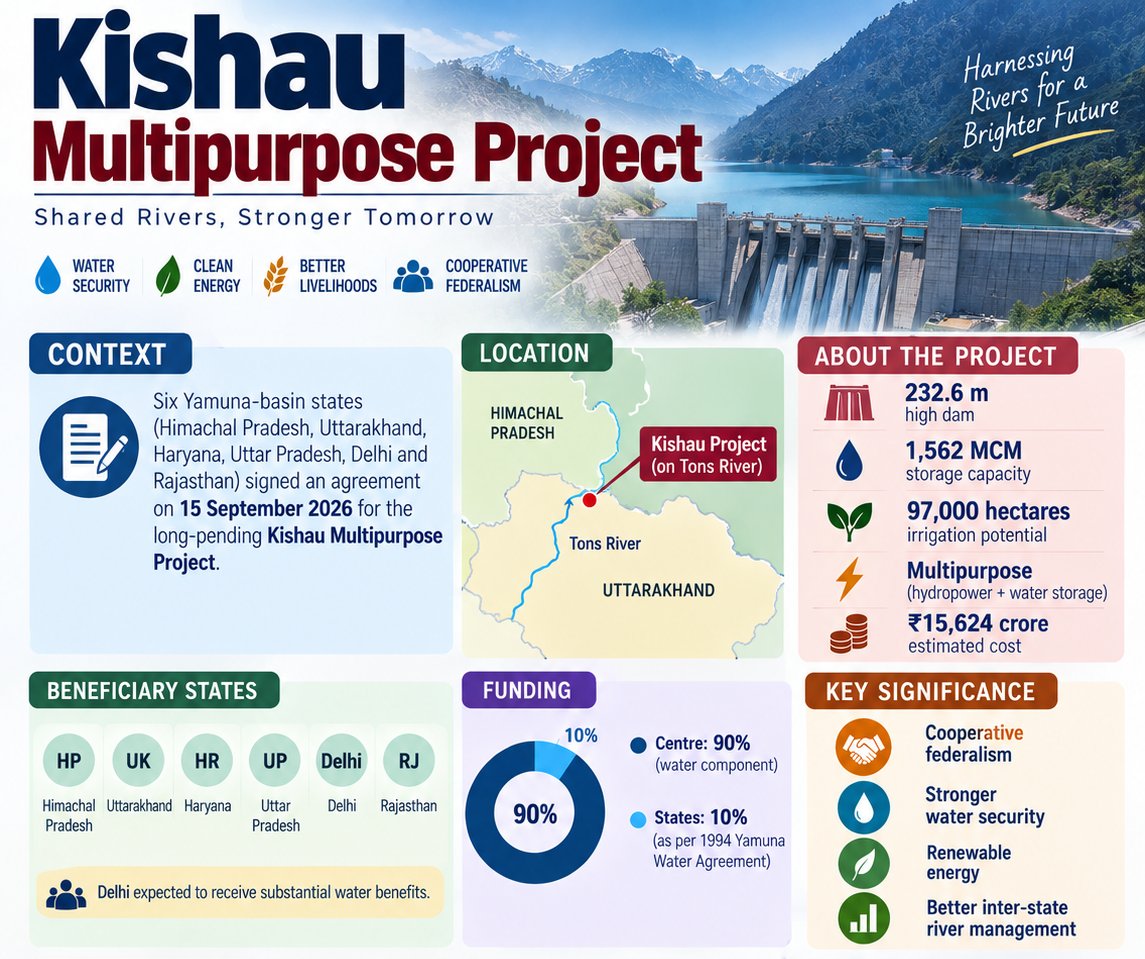
Recently, six Yamuna-basin states, Himachal Pradesh, Uttarakhand, Haryana, Uttar Pradesh, Delhi and Rajasthan signed an agreement for the long-pending Kishau Multipurpose Project. The agreement was signed on 15 September 2026, bringing the project closer to implementation after an eight-year deadlock.
About the Project:
The Kishau project is proposed on the Tons River, a major tributary of the Yamuna, along the Himachal Pradesh–Uttarakhand border.
Key features include:
-
-
- Dam: About 232.6-metre-high concrete gravity dam
- Storage capacity: 1,562 million cubic metres (MCM)
- Irrigation potential: Around 97,000 hectares
- Estimated cost: ₹15,624 crore
- Hydropower: The project is designed as a multipurpose water-storage and hydropower project.
- Beneficiaries: Six Yamuna-basin states, with Delhi expected to receive substantial water benefits.
- Location: Border of Sirmaur district (Himachal Pradesh) and Dehradun district (Uttarakhand).
- Dam: About 232.6-metre-high concrete gravity dam
-
Funding and Power Sharing:
-
-
- The Centre will bear around 90% of the water-component cost, while the remaining 10% will be shared by the participating states according to the 1994 Yamuna Water Agreement.
- A major issue concerned Himachal Pradesh's financial liability. The state argued that it should not bear the entire cost of the power component because it would also bear environmental and social costs associated with the project. The arrangement reportedly provides for beneficiary states to bear the relevant power-component burden.
- The Centre will bear around 90% of the water-component cost, while the remaining 10% will be shared by the participating states according to the 1994 Yamuna Water Agreement.
-
Environmental Significance:
-
-
- The project has implications beyond irrigation and power generation.
- The Yamuna has faced severe challenges relating to pollution and inadequate environmental flows, particularly downstream. Regulation of water flows through storage can potentially improve lean-season flows, although ecological benefits will depend on actual reservoir-operation practices.
- The project therefore highlights the need to balance water utilisation with ecological flow requirements.
- The project has implications beyond irrigation and power generation.
-
Significance for India:
-
-
- Cooperative Federalism: The agreement demonstrates the importance of Centre-State and inter-State cooperation in managing shared river basins.
- Water Security: It can strengthen water availability for drinking, irrigation and other uses across the Yamuna basin.
- Renewable Energy: Hydropower can contribute to India's renewable-energy and grid-balancing requirements.
- Inter-State River Management: The project illustrates the complexities of managing rivers whose basins cross multiple political boundaries.
- Cooperative Federalism: The agreement demonstrates the importance of Centre-State and inter-State cooperation in managing shared river basins.
-
Key Challenges:
-
-
- Displacement and rehabilitation of affected communities
- Environmental impacts in Himalayan ecosystems
- Financing and equitable distribution of costs and benefits
- Inter-State disagreements over water and power
- Ensuring adequate environmental flows in the Yamuna
- Geological and disaster risks associated with large Himalayan infrastructure
- Displacement and rehabilitation of affected communities
-
Constitutional provisions:
-
-
- Water is primarily a State List subject under the Constitution, while Parliament can legislate on inter-State river disputes under Article 262. The Inter-State River Water Disputes Act, 1956 provides a mechanism for adjudicating such disputes.
- The Kishau agreement represents a negotiated/cooperative approach, rather than relying solely on judicial adjudication.
- Water is primarily a State List subject under the Constitution, while Parliament can legislate on inter-State river disputes under Article 262. The Inter-State River Water Disputes Act, 1956 provides a mechanism for adjudicating such disputes.
-
Conclusion:
The Kishau Multipurpose Project reflects the complex intersection of water security, federalism, hydropower, agriculture and environmental sustainability. Its implementation can provide significant benefits to the Yamuna basin, but long-term success will depend on balancing developmental objectives with ecological and social concerns.



