
Context:
Recently, The Kigali Amendment to the Montreal Protocol marks its 10th anniversary on 15 October 2026. Adopted in 2016, it aims to phase down hydrofluorocarbons (HFCs), powerful greenhouse gases used in refrigeration and air-conditioning. It could prevent up to 0.5°C of global warming by 2100. With India's cooling demand projected to more than double by 2035, energy-efficient appliances and better refrigerant management are crucial.
Background:
-
-
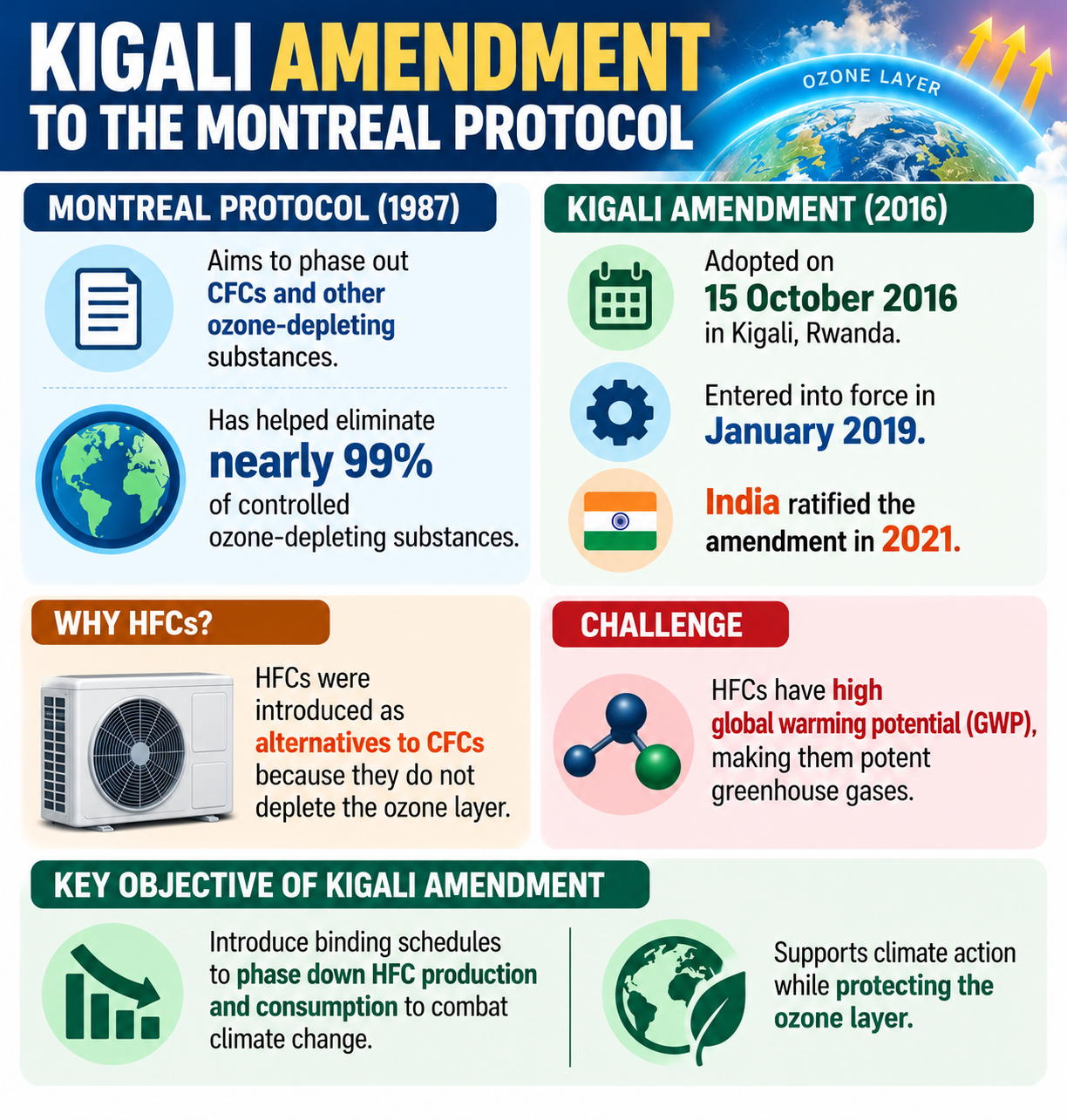
- The Kigali Amendment to the Montreal Protocol was adopted in Kigali, Rwanda, on 15 October 2016, and entered into force in January 2019. The Montreal Protocol, adopted in 1987, aims to phase out chlorofluorocarbons (CFCs) and other ozone-depleting substances and has helped eliminate nearly 99% of controlled ozone-depleting substances.
- Hydrofluorocarbons (HFCs) were introduced as alternatives to CFCs because they do not deplete the ozone layer; however, their high global warming potential (GWP) makes them potent greenhouse gases. Therefore, the Kigali Amendment introduced binding schedules to phase down HFC production and consumption to combat climate change. India ratified the amendment in 2021.
- The Kigali Amendment to the Montreal Protocol was adopted in Kigali, Rwanda, on 15 October 2016, and entered into force in January 2019. The Montreal Protocol, adopted in 1987, aims to phase out chlorofluorocarbons (CFCs) and other ozone-depleting substances and has helped eliminate nearly 99% of controlled ozone-depleting substances.
-
Key Provisions and India's Commitments:
-
-
- HFC phase-down: Gradually reduce HFC production and consumption according to differentiated national schedules.
- India's targets: Freeze HFC production and consumption in 2028, reduce them by 10% below the agreed baseline in 2032, and achieve an 85% reduction by 2047.
- Financial assistance: The Multilateral Fund supports developing countries in adopting alternative technologies and meeting compliance costs.
- Technology transition: Encourage climate-friendly refrigerants and improved cooling efficiency.
- HFC phase-down: Gradually reduce HFC production and consumption according to differentiated national schedules.
-
Significance for India:
-
-
- India's rising temperatures, urbanisation and growing incomes are increasing demand for air-conditioners and refrigeration. Efficient appliances can reduce electricity consumption, household expenditure and pressure on power infrastructure.
- The transition also offers opportunities for green manufacturing, technological innovation and employment. Better refrigerant recovery and recycling can further reduce greenhouse gas emissions.
- India's rising temperatures, urbanisation and growing incomes are increasing demand for air-conditioners and refrigeration. Efficient appliances can reduce electricity consumption, household expenditure and pressure on power infrastructure.
-
Major Challenges:
-
-
- Rapidly increasing demand for affordable cooling.
- High initial costs of energy-efficient equipment.
- Safety and technical requirements associated with alternative refrigerants.
- Leakage of refrigerants during servicing and disposal.
- Financing and technology-access constraints for manufacturers and small enterprises.
- Rapidly increasing demand for affordable cooling.
-
Way Forward:
-
-
- India should strengthen minimum energy-performance standards, promote efficient cooling technologies and expand refrigerant recovery, recycling and safe disposal. Skill development for technicians, financial support for small businesses and investment in sustainable cooling infrastructure are essential.
- Passive cooling, improved building design, urban green spaces and district cooling can reduce dependence on energy-intensive air-conditioning.
- India should strengthen minimum energy-performance standards, promote efficient cooling technologies and expand refrigerant recovery, recycling and safe disposal. Skill development for technicians, financial support for small businesses and investment in sustainable cooling infrastructure are essential.
-
Conclusion:
The Kigali Amendment demonstrates how international cooperation can address environmental challenges through binding targets, technological innovation and financial assistance. For India, combining HFC phase-down with energy-efficient cooling and responsible refrigerant management can reconcile rising cooling needs with climate commitments.



