
Context:
Recently, protests against the Ken-Betwa Link Project (KBLP) turned violent in Chhatarpur district, Madhya Pradesh. Demonstrators, primarily tribal villagers, clashed with the police near the Bijawar tehsil office, hurling stones and obstructing government work. The police responded with a lathi charge and water cannons, leading to the registration of three FIRs against around 40 villagers. The agitation arose from demands for adequate compensation, fair rehabilitation, and the release of detained activists, highlighting ongoing tensions surrounding the project.
About the Project:
-
-
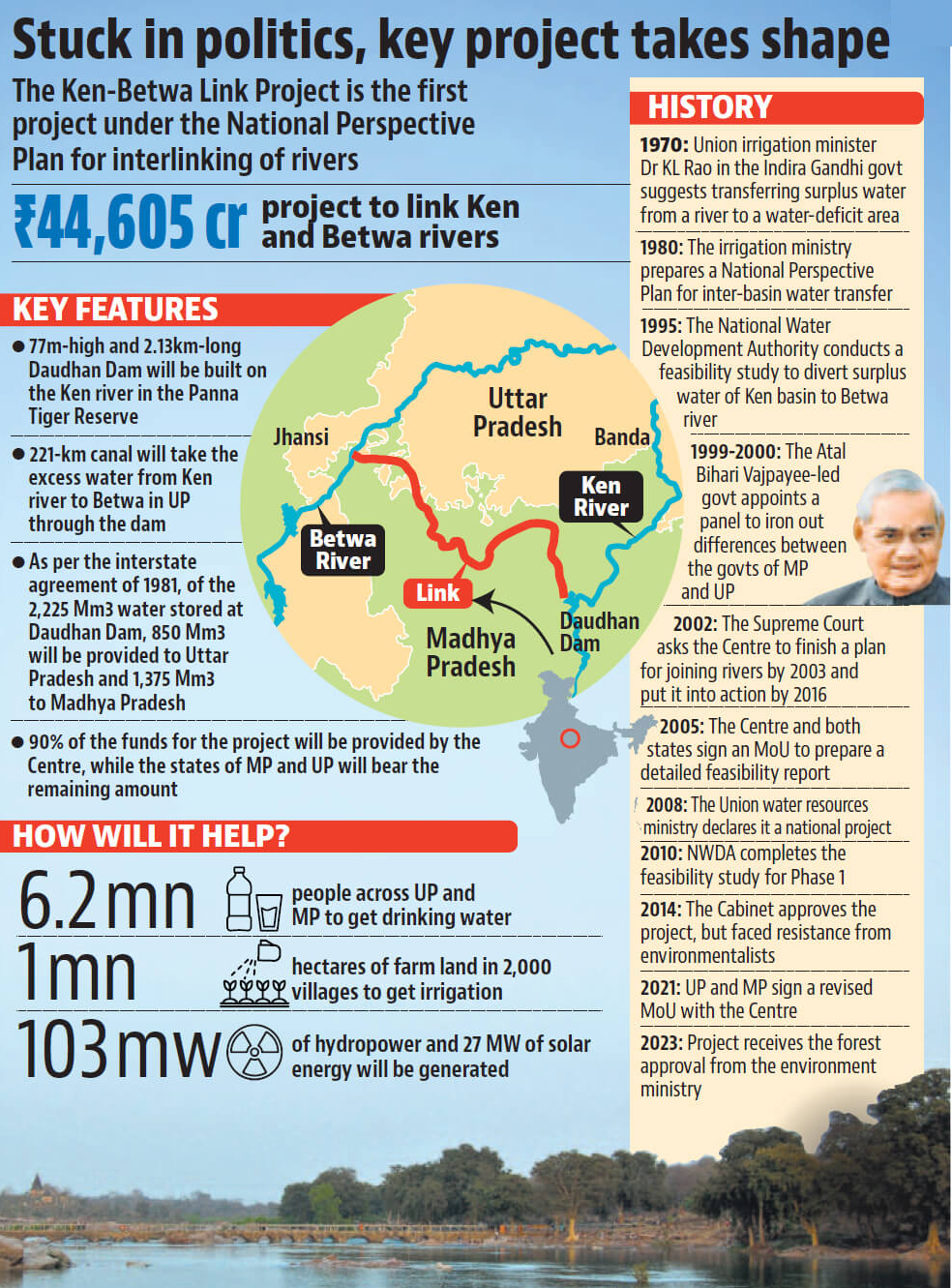
- The Ken-Betwa Link Project is India’s first major national river-linking initiative under the National Perspective Plan. It aims to transfer surplus water from the Ken River in Madhya Pradesh to the Betwa River in drought-prone Uttar Pradesh, particularly benefiting the Bundelkhand region. Estimated to cost ₹44,650 crore, it plans to:
- Irrigate 10.62 lakh hectares of agricultural land
- Provide drinking water to 62 lakh people
- Generate 130 MW of power (103 MW hydro + 27 MW solar)
- Irrigate 10.62 lakh hectares of agricultural land
- Key features include the 77-meter-high Daudhan Dam, a 221 km canal with a 2 km tunnel, and a phased implementation strategy covering both states. Water-sharing agreements allocate 2,350 MCM to Madhya Pradesh and 1,700 MCM to Uttar Pradesh annually.
- The Ken-Betwa Link Project is India’s first major national river-linking initiative under the National Perspective Plan. It aims to transfer surplus water from the Ken River in Madhya Pradesh to the Betwa River in drought-prone Uttar Pradesh, particularly benefiting the Bundelkhand region. Estimated to cost ₹44,650 crore, it plans to:
-
What are the Concerns of the Project:
-
-
- The project has raised significant environmental and social concerns:
- Ecological Impact: Over 9,000 hectares of forest land, including 10% of the Panna Tiger Reserve, will be submerged, threatening wildlife habitats and biodiversity.
- Displacement: Several villages in Chhatarpur and Panna districts face displacement, raising issues of land acquisition, compensation, and livelihood restoration.
- Local Resistance: A lack of consultation and perceived delays in rehabilitation have fueled protests and occasional violence.
- Ecological Impact: Over 9,000 hectares of forest land, including 10% of the Panna Tiger Reserve, will be submerged, threatening wildlife habitats and biodiversity.
- The project has raised significant environmental and social concerns:
-
Benefits of the Project:
-
-
- Despite concerns, the project offers major socio-economic advantages:
- Drought Mitigation: Provides water security for 13 districts in Bundelkhand, enhancing agricultural productivity.
- Energy Generation: Supports renewable energy generation with 103 MW of hydro and 27 MW of solar capacity.
- Socio-Economic Development: Improves livelihoods, access to drinking water, and regional cooperation between Madhya Pradesh and Uttar Pradesh.
- Drought Mitigation: Provides water security for 13 districts in Bundelkhand, enhancing agricultural productivity.
- Despite concerns, the project offers major socio-economic advantages:
-
Conclusion:
The Ken-Betwa Link Project exemplifies the development versus environment and social equity challenge in India. While it promises water security, irrigation, and renewable energy benefits, its successful implementation depends on transparent rehabilitation, environmental safeguards, and participatory governance. The recent violent protests highlight the urgent need for inclusive planning, proactive stakeholder engagement, and ethical conflict resolution to ensure that both developmental objectives and the rights of affected communities are protected.



