
Why in News?
Recently, Tribal villagers, predominantly women, have intensified their protests against the Ken-Betwa Link Project (KBLP) in Chhatarpur district, Madhya Pradesh, demanding enhanced rehabilitation and compensation for families affected by the project and associated irrigation schemes.
About the Ken-Betwa Link Project (KBLP):
-
-
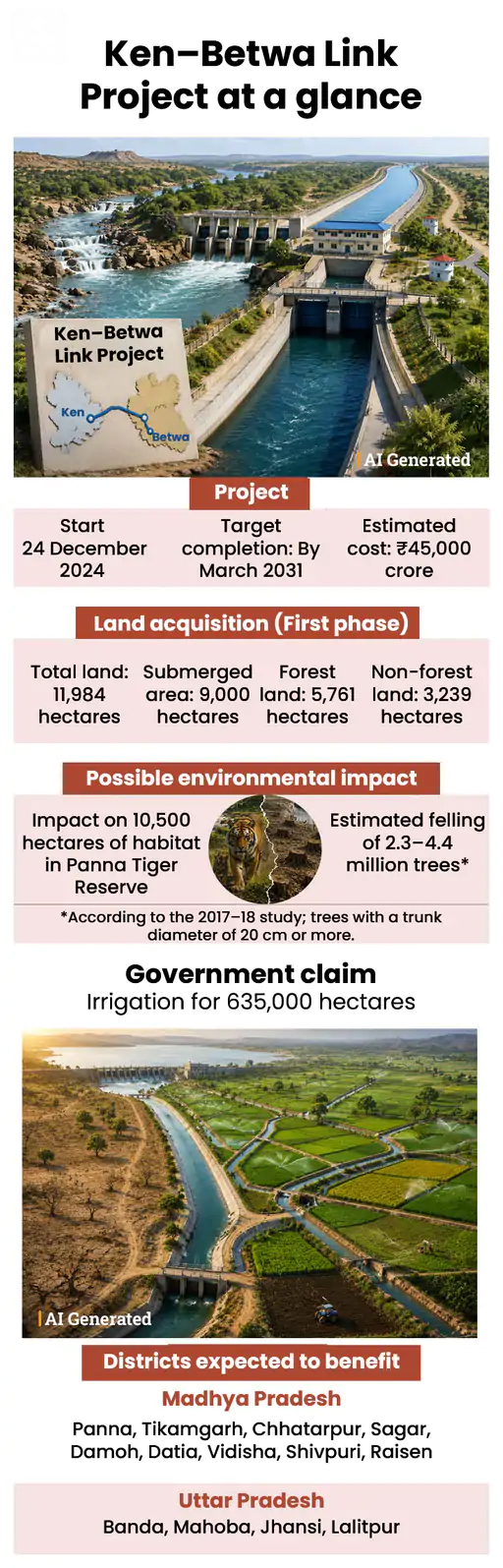
- The Ken-Betwa Link Project is India's first river interlinking project under the National Perspective Plan (NPP) for river interlinking. It was inaugurated by Prime Minister Narendra Modi on 25 December 2024.
- The project aims to transfer surplus water from the Ken River in Madhya Pradesh to the Betwa River, both tributaries of the Yamuna, to address chronic water scarcity in the drought-prone Bundelkhand region of Madhya Pradesh and Uttar Pradesh.
- The Ken-Betwa Link Project is India's first river interlinking project under the National Perspective Plan (NPP) for river interlinking. It was inaugurated by Prime Minister Narendra Modi on 25 December 2024.
-
Project Components:
-
-
- Phase I: Construction of the Daudhan Dam, a 221-km link canal, powerhouses, and a tunnel.
- Phase II: Development of the Lower Orr Dam, Bina Complex, and Kotha Barrage.
- Phase I: Construction of the Daudhan Dam, a 221-km link canal, powerhouses, and a tunnel.
-
Expected Benefits:
The project is expected to generate significant socio-economic gains:
-
-
- Irrigation: Water for 10.62 lakh hectares of agricultural land.
- Drinking Water: Supply to around 62 lakh people.
- Power Generation: 103 MW of hydropower and 27 MW of solar power.
- Regional Development: Improved agricultural productivity, reduced drought vulnerability, and enhanced water security in Bundelkhand.
- Irrigation: Water for 10.62 lakh hectares of agricultural land.
-
Reasons Behind the Protests:
The protesters argue that:
-
-
- Several affected families have been excluded from rehabilitation plans.
- Compensation remains inadequate compared to the loss of land and livelihoods.
- Tribal communities dependent on forests and rivers face displacement and socio-economic insecurity.
- Several affected families have been excluded from rehabilitation plans.
-
They seek fair rehabilitation and implementation of the Right to Fair Compensation and Transparency in Land Acquisition, Rehabilitation and Resettlement Act, 2013.
Major Demands:
-
-
- Increase rehabilitation compensation from ₹12.5 lakh to ₹25 lakh.
- Inclusion of all affected families in the rehabilitation package.
- Fair compensation for those affected by the Majhgaon and Runjh irrigation projects.
- Transparent land acquisition and rehabilitation process.
- Increase rehabilitation compensation from ₹12.5 lakh to ₹25 lakh.
-
Environmental Concerns:
The project has attracted criticism from environmentalists because the Daudhan Dam will submerge nearly 6,000 hectares of the Panna Tiger Reserve, affecting critical tiger habitat and biodiversity. Concerns include habitat fragmentation, impact on river ecology, loss of forests, and threats to species such as tigers, gharials, vultures, and endemic fish. Critics also question the long-term sustainability of transferring so-called "surplus" water in the context of climate change.
Way Forward:
The project's success depends on balancing development with environmental conservation and social justice through fair rehabilitation, adequate compensation, protection of tribal and forest rights, and robust environmental safeguards, supported by active participation of Gram Sabhas and local communities.



