
Context:
Recently, Karnataka has raised concerns over the proposed implementation of the Kasturirangan Committee recommendations on the Western Ghats, arguing that the proposed ecological restrictions could affect the livelihoods of farmers and residents across several districts.
Background:
-
-
- The High-Level Working Group (HLWG) headed by Dr. K. Kasturirangan was constituted by the Ministry of Environment, Forest and Climate Change (MoEFCC) to examine the recommendations of the Western Ghats Ecology Expert Panel (WGEEP) headed by Madhav Gadgil.
- The Western Ghats are spread across Gujarat, Maharashtra, Goa, Karnataka, Kerala and Tamil Nadu and are recognised as a major biodiversity hotspot and an important source of several rivers.
- The High-Level Working Group (HLWG) headed by Dr. K. Kasturirangan was constituted by the Ministry of Environment, Forest and Climate Change (MoEFCC) to examine the recommendations of the Western Ghats Ecology Expert Panel (WGEEP) headed by Madhav Gadgil.
-
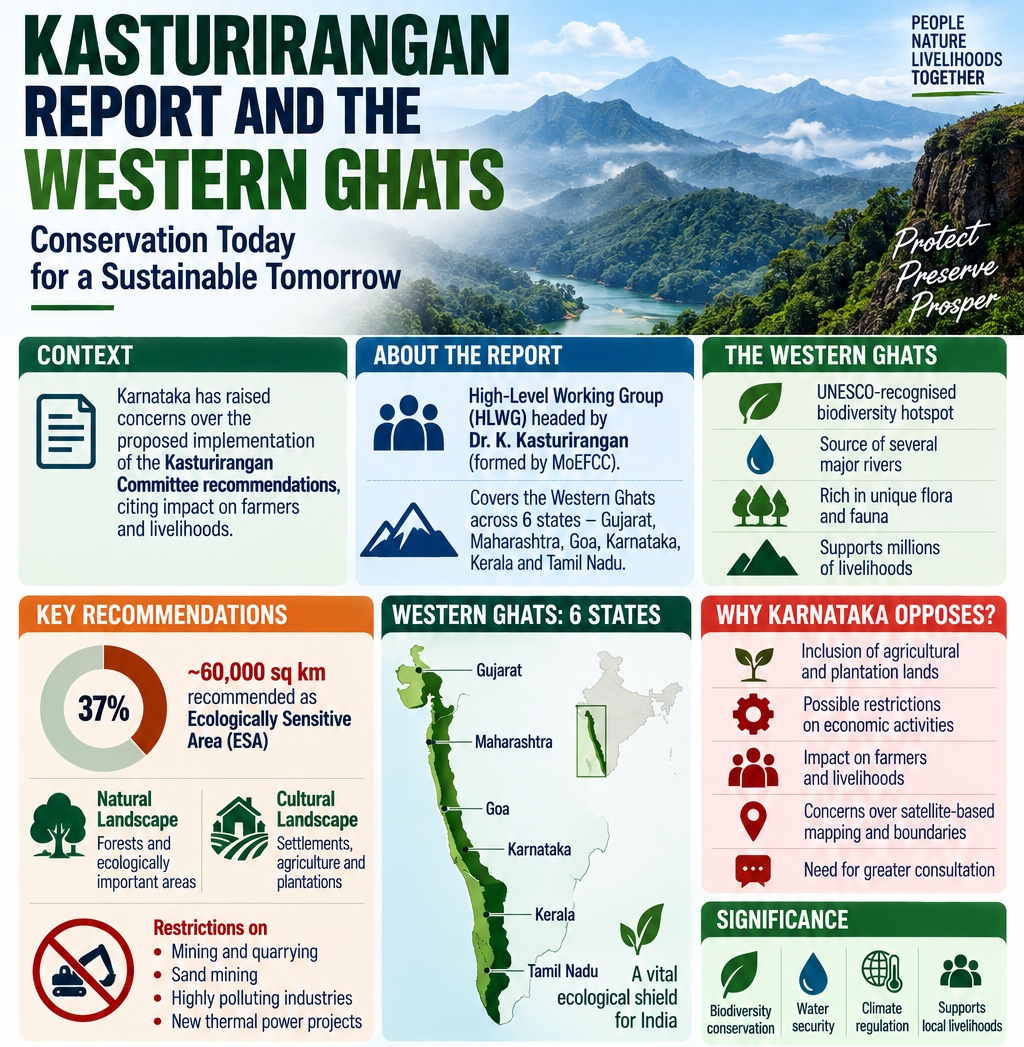
Key Recommendations:
37% Area as ESA:
Natural and Cultural Landscape:
· Natural Landscape: Forests and areas of high ecological value requiring stronger conservation.
· Cultural Landscape: Areas containing settlements, agriculture and plantations, where livelihood considerations are important.
Regulation of Activities:
The report proposed restrictions on activities with high ecological impact, including:
· Mining and quarrying
· Sand mining
· Highly polluting industries
· New thermal power projects
Certain development activities, including hydropower, were proposed to be subject to environmental safeguards and assessment.
Why is Karnataka Opposing It?
The State government and sections of local communities have expressed concerns regarding:
· Inclusion of agricultural and plantation lands within proposed ESA boundaries.
· Possible restrictions on economic activities.
· Impact on farmers and local livelihoods.
· Accuracy of satellite-based mapping and boundary demarcation.
· Fear and uncertainty among residents regarding future land use.
The State has therefore sought greater consultation and reconsideration of the proposed boundaries.
Gadgil vs Kasturirangan:
|
Aspect |
Gadgil Committee |
Kasturirangan Committee |
|
Approach |
Broad ecological protection |
Targeted conservation |
|
ESA coverage |
About 64% |
About 37% |
|
Method |
Ecological assessment |
Geospatial + ecological assessment |
|
Human settlements |
Greater regulatory coverage |
Greater differentiation of cultural landscape |
|
Focus |
Conservation-oriented |
Conservation-development balance |
Significance:
The controversy highlights the development–environment dilemma in ecologically fragile regions. The Western Ghats provide biodiversity, water security, climate regulation and ecosystem services, while local communities depend on agriculture, plantations and other economic activities.
Conclusion:
The Western Ghats require strong ecological protection, but conservation measures must also recognise legitimate livelihood concerns. The objective should be to achieve “conservation with sustainable development”, rather than treating environment and development as mutually exclusive.



