
Context:
Recently, Karnataka has recently indicated before the Supreme Court that it may seek a review of the existing Cauvery water-sharing arrangement, citing “inequitable allocation” and changed hydrological circumstances. The State referred to the principle of rebus sic stantibus, which allows an agreement or arrangement to be reconsidered when fundamental circumstances have changed.
Background of the Cauvery Dispute:
-
-
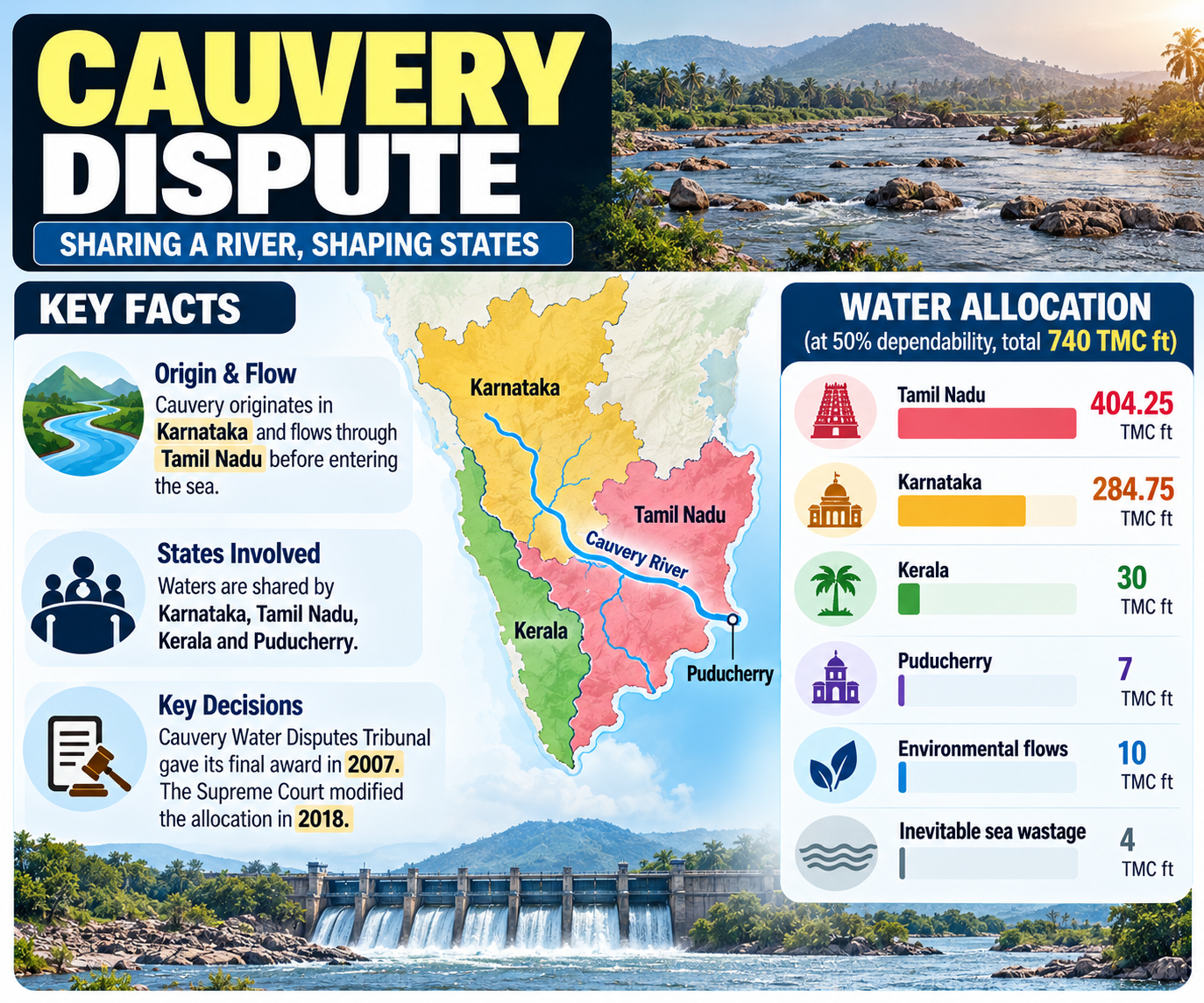
- The Cauvery River originates in Karnataka and flows through Tamil Nadu before entering the sea. Its waters are shared by Karnataka, Tamil Nadu, Kerala and Puducherry.
- The Cauvery Water Disputes Tribunal gave its final award in 2007. The Supreme Court modified the allocation in 2018.
- The total annual Cauvery basin availability was assessed at 740 TMC ft at 50% dependability. The allocation was:
- Tamil Nadu: 404.25 TMC ft
- Karnataka: 284.75 TMC ft
- Kerala: 30 TMC ft
- Puducherry: 7 TMC ft
- Environmental flows: 10 TMC ft
- Inevitable sea wastage: 4 TMC ft
- Tamil Nadu: 404.25 TMC ft
- The Cauvery River originates in Karnataka and flows through Tamil Nadu before entering the sea. Its waters are shared by Karnataka, Tamil Nadu, Kerala and Puducherry.
-
What is Rebus Sic Stantibus?
-
-
- Rebus sic stantibus is a principle of international law meaning “things standing thus.”
- It suggests that an agreement may be reconsidered if there is a fundamental and unforeseen change in circumstances that significantly alters the basis on which the original arrangement was made.
- Karnataka has argued that changing rainfall patterns, climate change, environmental degradation and increasing water stress have altered the hydrological realities of the Cauvery basin.
- Rebus sic stantibus is a principle of international law meaning “things standing thus.”
-
Karnataka’s Major Arguments:
-
-
- Karnataka has questioned the adequacy of the existing pro-rata distress-sharing mechanism during drought years, arguing that there is no sufficiently scientific formula for determining how shortages should be shared.
- It has also highlighted the different rainfall patterns in the basin. The Southwest Monsoon is crucial for Karnataka, while Tamil Nadu receives significant benefits from the Northeast Monsoon.
- Karnataka argues that in distress years, priority should be given first to drinking water, followed by irrigation requirements in drought-prone areas.
- Karnataka has questioned the adequacy of the existing pro-rata distress-sharing mechanism during drought years, arguing that there is no sufficiently scientific formula for determining how shortages should be shared.
-
Link with the Indus Waters Treaty:
Karnataka's reference to the Indus Waters Treaty (IWT) of 1960 adds a wider dimension to the issue.
The State noted that the Union government has also sought changes in the IWT citing changed circumstances. However, the two cases are legally different: the IWT is an international treaty between India and Pakistan, while Cauvery is an inter-State water dispute within India.
Constitutional Framework:
-
-
- Inter-State river disputes are primarily governed by Article 262 of the Constitution and the Inter-State River Water Disputes Act, 1956.
- The Cauvery dispute demonstrates the complexities of balancing constitutional federalism, established legal allocations and changing environmental realities.
- Inter-State river disputes are primarily governed by Article 262 of the Constitution and the Inter-State River Water Disputes Act, 1956.
-
Challenges Ahead:
Reopening the allocation could face opposition from Tamil Nadu and other stakeholders. It would also require strong scientific evidence to establish that existing hydrological conditions have fundamentally changed.
Way Forward:
India needs adaptive river-basin management based on scientific data, periodic review of allocations, efficient irrigation, water conservation, climate modelling and better coordination among basin States.
Conclusion:
The Cauvery issue highlights the need to balance legal certainty with changing ecological realities. A sustainable solution requires cooperative federalism, scientific distress-sharing mechanisms and periodic assessment of river-water availability rather than relying solely on rigid historical allocations.



