
Context:
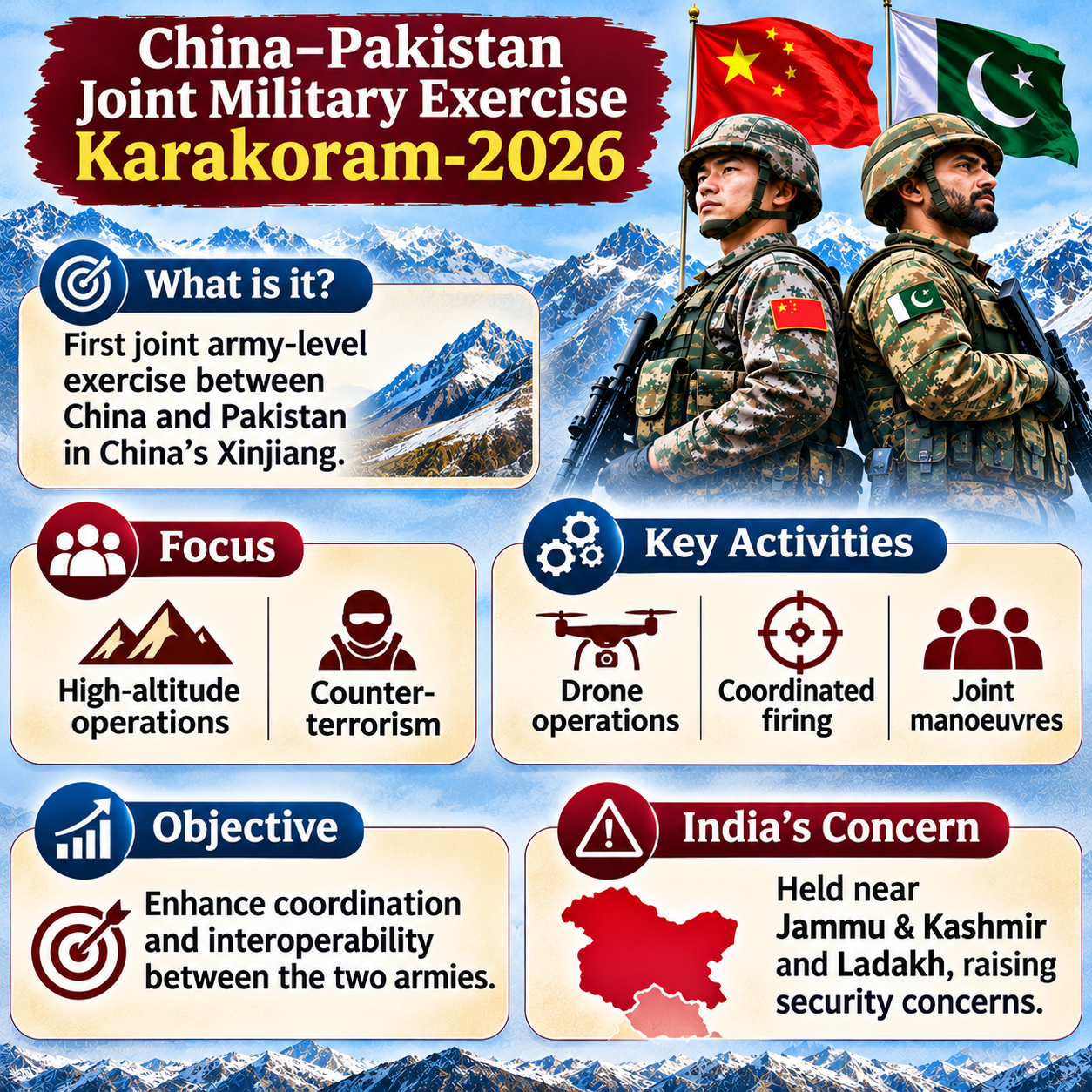
Recently, China and Pakistan conducted Karakoram-2026, their first joint army-level military exercise in China's Xinjiang region. The exercise marks a significant expansion of their defence cooperation, moving beyond arms supplies and naval and air drills towards greater military coordination and interoperability. Its location near India's Union Territories of Jammu and Kashmir and Ladakh has raised security concerns for India.
About Karakoram-2026:
The exercise involved the People's Liberation Army (PLA) and Pakistan Army, focusing on high-altitude operations and counter-terrorism. It included specialised combat tactics, close-quarter combat, drone operations, coordinated firing, joint command and military manoeuvres. The exercise aimed to improve communication, operational coordination and interoperability between the two armies.
About China-Pakistan Strategic Partnership:
-
-
- The partnership has evolved since the 1963 Sino-Pakistan Boundary Agreement, under which Pakistan ceded the Shaksgam Valley to China, a territory claimed by India. China and Pakistan share a long-standing strategic partnership based on military, economic and geopolitical interests.
- China is Pakistan's major defence supplier, providing fighter aircraft, missiles, drones, naval platforms and air-defence systems. Both countries also cooperate in defence production, including the JF-17 fighter aircraft.
- conomically, the China-Pakistan Economic Corridor (CPEC) connects China's Xinjiang region with Gwadar Port through Pakistan-occupied Kashmir (PoK), a region claimed by India. Their cooperation also extends to intelligence sharing, cyber capabilities and joint military exercises.
- The partnership has evolved since the 1963 Sino-Pakistan Boundary Agreement, under which Pakistan ceded the Shaksgam Valley to China, a territory claimed by India. China and Pakistan share a long-standing strategic partnership based on military, economic and geopolitical interests.
-
Strategic Implications for India:
-
-
- The deepening partnership poses several challenges for India's national security. First, it increases the possibility of a two-front security challenge, requiring India to remain prepared along both the Line of Actual Control (LAC) and Line of Control (LoC).
- Second, improved military interoperability could enhance coordination between Chinese and Pakistani forces during a regional crisis.
- Third, cooperation in drones, surveillance, missiles and electronic warfare may strengthen their military capabilities.
- Fourth, CPEC passing through PoK challenges India's sovereignty and territorial claims. The partnership also reflects China's growing strategic influence in South Asia.
- The deepening partnership poses several challenges for India's national security. First, it increases the possibility of a two-front security challenge, requiring India to remain prepared along both the Line of Actual Control (LAC) and Line of Control (LoC).
-
Challenges for India:
India faces the challenge of maintaining military preparedness on two fronts while addressing technological gaps in drones, electronic warfare and precision weapons. Inadequate border infrastructure, regional strategic competition and China's expanding influence among neighbouring countries further complicate India's security environment.
Way Forward:
India should strengthen integrated defence planning, modernise its armed forces and promote indigenous defence manufacturing. Developing border roads, tunnels, airfields and logistics infrastructure is essential for rapid troop mobilisation. Greater intelligence sharing, surveillance and counter-drone capabilities must be prioritised. Diplomatically, India should deepen strategic partnerships with Indo-Pacific countries and strengthen engagement with its South Asian neighbours.
Conclusion:
Karakoram-2026 highlights the transformation of China-Pakistan relations into deeper military cooperation. Although it does not establish a formal military alliance, it underlines the need for India's strategic vigilance. A combination of military preparedness, technological self-reliance, border development and proactive diplomacy is essential to safeguard India's national interests.



