
Context:
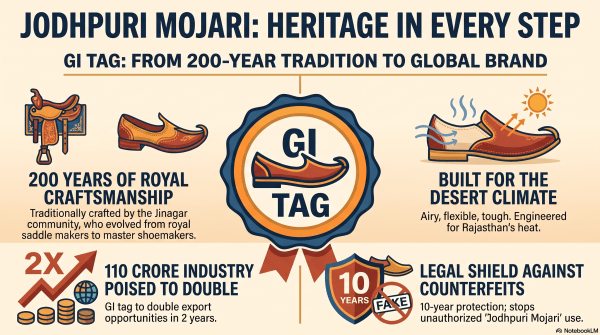
Recently, Mojari craft of Jodhpur, a nearly 200-year-old traditional footwear, has received a GI tag from the Centre. The recognition will help protect artisans, improve branding, and increase export opportunities.
About Jodhpuri Mojari:
Jodhpuri Mojari is a handcrafted leather footwear famous for its embroidery, durability, flexibility, and traditional design. It is suitable for Rajasthan’s hot climate due to its lightweight and airy structure. Worn by both men and women, Mojari is designed as a slip-on shoe that can be easily removed at homes and temples.
Historical Background:
-
-
- The craft is mainly practised by the Jinagar community, who were traditionally associated with saddle making. The term Jinagar is linked with jeen (saddle), meaning makers of saddles. Historically, the community produced horse saddles and leather covers for swords and daggers for royal armies.
- According to local traditions, the community shifted towards shoemaking after impressing a Jodhpur ruler with a creatively designed pair of leather shoes during a royal wedding. Over time, Mojari developed into a unique symbol of Jodhpur’s cultural identity.
- The craft is mainly practised by the Jinagar community, who were traditionally associated with saddle making. The term Jinagar is linked with jeen (saddle), meaning makers of saddles. Historically, the community produced horse saddles and leather covers for swords and daggers for royal armies.
-
About GI Tags:
A Geographical Indication (GI) tag is a sign used on products that have a specific geographical origin and possess qualities, reputation, or characteristics due to that origin. It connects a product’s identity with its region of production.
Legal Framework:
|
Aspect |
Details |
|
Governing Law |
Geographical Indications of Goods (Registration and Protection) Act, 1999 |
|
Effective Date |
September 2003 |
|
Purpose |
Protection of geographical products and prevention of misuse |
|
International Link |
Compliant with WTO’s TRIPS Agreement |
India introduced the GI law to protect traditional products as intellectual property and promote their economic value.
Administrative Body:
-
-
- GI registration is administered by the Geographical Indications Registry, Chennai under the Department for Promotion of Industry and Internal Trade (DPIIT), Ministry of Commerce and Industry.
- The overall administration of intellectual property rights is carried out under the Controller General of Patents, Designs and Trade Marks.
- GI registration is administered by the Geographical Indications Registry, Chennai under the Department for Promotion of Industry and Internal Trade (DPIIT), Ministry of Commerce and Industry.
-
Validity Period:
-
-
- A GI registration remains valid for 10 years.
- It can be renewed periodically.
- A GI registration remains valid for 10 years.
-
First GI Tag in India:
The first Indian product to receive a GI tag was Darjeeling Tea (2004–05). It became the first product protected under India’s GI framework.
Benefits of GI Tag:
-
-
- Provides legal protection against unauthorised use.
- Preserves traditional knowledge and cultural heritage.
- Improves market recognition.
- Promotes exports.
- Supports local artisans and rural employment.
- Provides legal protection against unauthorised use.
-
Recent GI Tags in India:
Recent GI recognitions include:
-
-
- Jolbhora Sandesh and Monohara of West Bengal.
- Khurasani Imli of Madhya Pradesh.
- Bhagaiya Silk, Kuchai Silk, Munda Jewellery, and Bamboo Craft of Jharkhand.
- Ponduru Khadi of Andhra Pradesh.
- Jolbhora Sandesh and Monohara of West Bengal.
-
Conclusion:
The GI tag for Jodhpuri Mojari represents more than recognition of a footwear tradition—it is a step towards preserving Rajasthan’s centuries-old craftsmanship and empowering artisan communities. By linking cultural heritage with economic opportunities, GI protection can help India safeguard traditional products while expanding their presence in global markets.



