
Context:
Recently, The Indian Space Research Organisation (ISRO) clarified that India's space reforms are aimed at expanding the space ecosystem by increasing private-sector participation while allowing ISRO to concentrate on advanced research, strategic missions and frontier technologies.
India’s New Space-Sector Model:
-
-
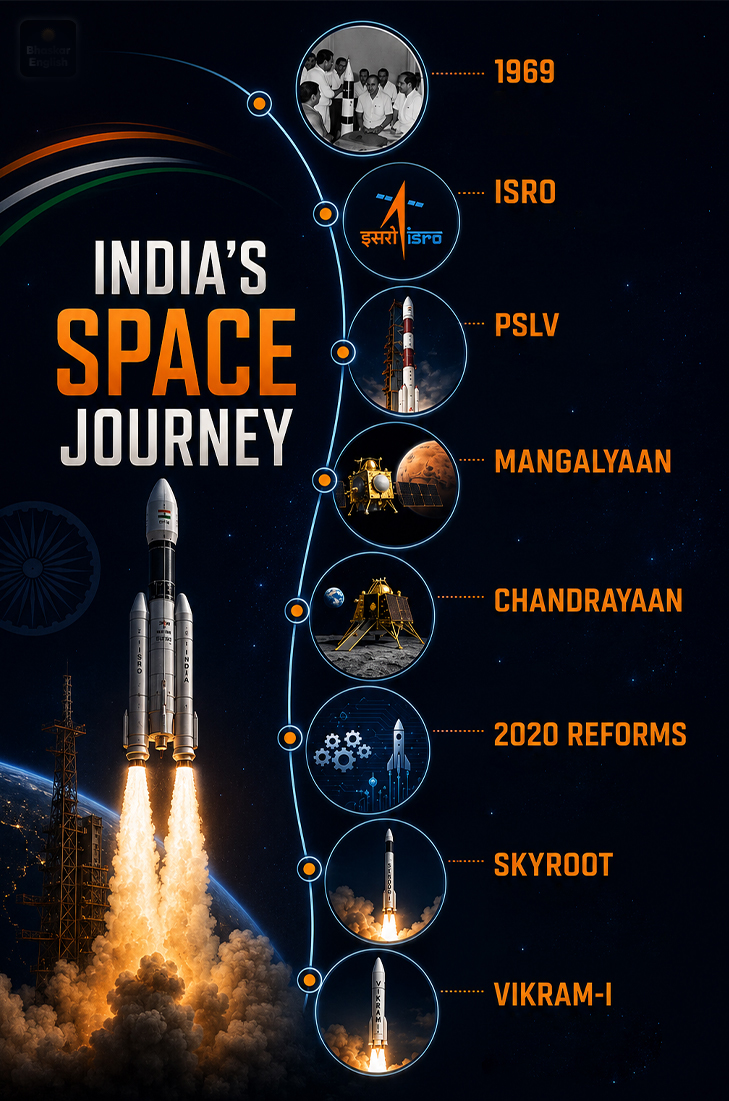
- Space-sector reforms began in 2020 and were institutionalised through the Indian Space Policy 2023. The framework seeks to divide responsibilities among different stakeholders:
- ISRO: Advanced R&D, space science, exploration and strategic missions.
- IN-SPACe: Authorisation, regulation and promotion of non-government space activities.
- NSIL: Commercialisation and industry-led utilisation of mature ISRO technologies.
- Private sector: Manufacturing, launches, satellites, applications and commercial services.
- ISRO: Advanced R&D, space science, exploration and strategic missions.
- Thus, mature and scalable technologies can increasingly move to industry, allowing ISRO's scientific manpower to concentrate on next-generation capabilities.
- Space-sector reforms began in 2020 and were institutionalised through the Indian Space Policy 2023. The framework seeks to divide responsibilities among different stakeholders:
-
ISRO vs Private Sector:
|
Aspect |
ISRO |
Private Sector |
|
Primary role |
Frontier R&D and national missions |
Commercialisation and scaling |
|
Focus |
Advanced and strategic technologies |
Mature and market-oriented technologies |
|
Activities |
Human spaceflight, deep-space missions, next-gen systems |
Manufacturing, satellites, launch and services |
|
Strength |
Scientific and strategic expertise |
Investment, innovation and production scale |
|
Objective |
National technological goals |
Commercial and global market growth |
Growth of India’s Private Space Sector:
India's reforms have resulted in rapid expansion of the private space ecosystem. According to the impact assessment cited in the material, India now has over 400 active space startups, while cumulative private investment has crossed $600 million. Private firms have also demonstrated launch and orbital capabilities and placed numerous satellites and payloads in space.
Government Initiatives for private sectors:
Major measures include:
-
-
- ₹1,000 crore Venture Capital Fund for space startups.
- ₹500 crore Technology Adoption Fund for commercialising indigenous technologies.
- Liberalised FDI policy for the space sector.
- Access to ISRO facilities and technology transfer.
- POEM platform for in-orbit technology validation.
- Technical and skill-development support.
- Promotion of space-manufacturing clusters.
- Earth-observation PPP initiatives.
- ₹1,000 crore Venture Capital Fund for space startups.
-
Significance:
Greater private participation can bring capital, innovation, manufacturing capacity and commercial efficiency, while freeing ISRO's scientific manpower for advanced research. It can also increase India's share in the global space economy and strengthen domestic supply chains.
About ISRO:
-
-
- The Indian Space Research Organisation (ISRO) was established on 15 August 1969, replacing the Indian National Committee for Space Research (INCOSPAR), which had been established in 1962 under the leadership of Dr. Vikram Sarabhai.
- Its primary mandate is to develop space technology and apply it to various national needs. This includes communication, broadcasting, meteorology, remote sensing, navigation, disaster management and resource monitoring. ISRO also undertakes satellite development, launch-vehicle development, space science and exploration.
- The Indian Space Research Organisation (ISRO) was established on 15 August 1969, replacing the Indian National Committee for Space Research (INCOSPAR), which had been established in 1962 under the leadership of Dr. Vikram Sarabhai.
-
Conclusion:
India's space reforms should be viewed as commercialisation and ecosystem expansion rather than privatisation of ISRO. The objective is to create a collaborative model in which ISRO leads frontier science and strategic missions while private industry provides scale, innovation and commercial capacity.



