
Iran War & India’s Energy Security: Ethanol Blending Explained
Context:
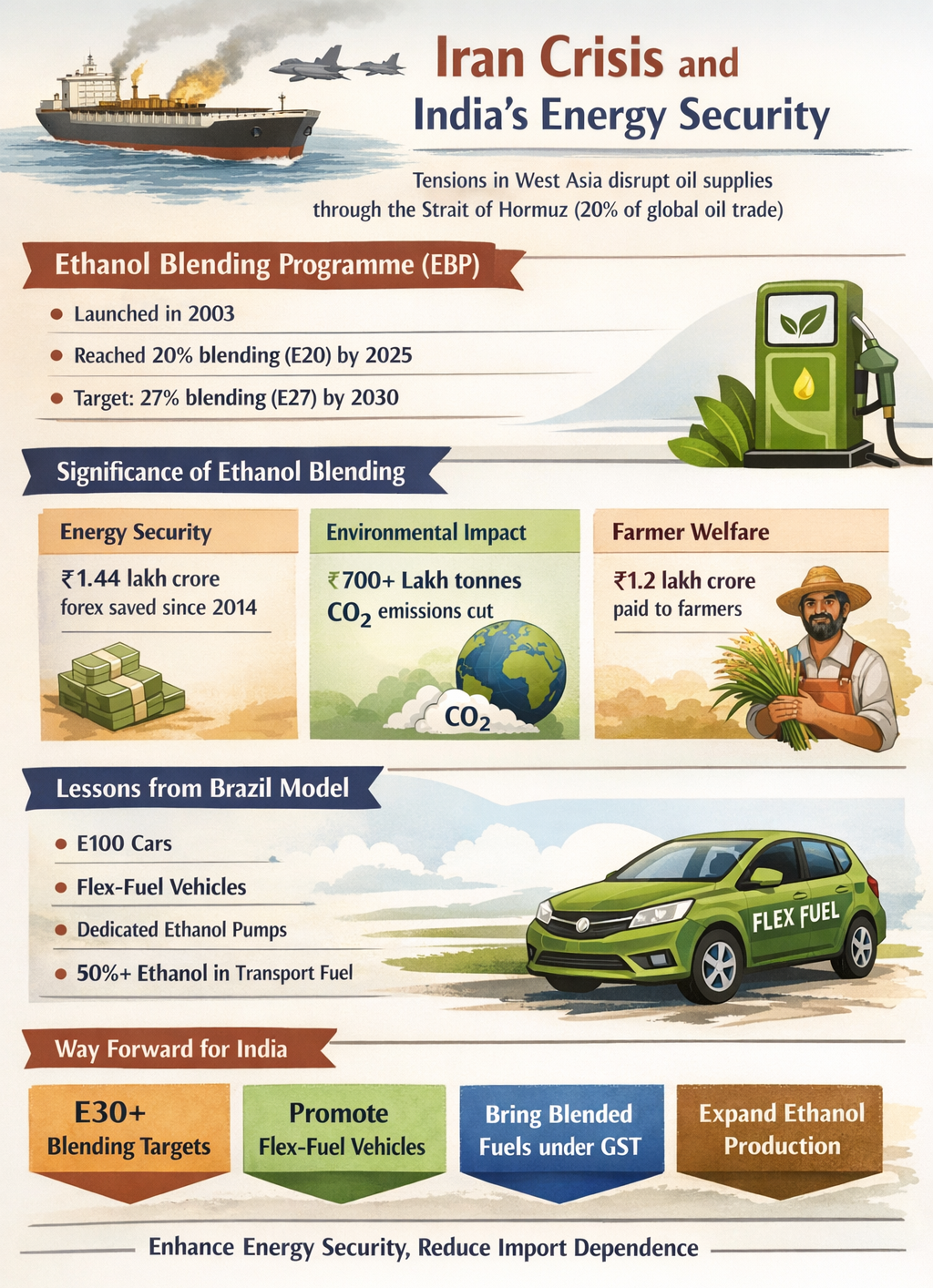
The ongoing Iran–West Asia conflict has triggered a major global energy crisis by disrupting oil supplies, especially through the Strait of Hormuz, which handles nearly 20% of global oil trade. Prime Minister Narendra Modi, speaking in Parliament on the West Asia war, emphasised that India’s ramped-up ethanol blending programme over the last decade has helped reduce vulnerabilities arising from imported energy.
About Ethanol Blending Programme (EBP):
-
-
- The Ethanol Blending Programme (EBP), launched in 2003, is a strategic initiative to mix ethanol (a renewable biofuel) with petrol. It aims to:
- Reduce dependence on crude oil imports
- Lower vehicular emissions
- Provide remunerative markets for farmers
- Reduce dependence on crude oil imports
- India has achieved a major milestone by reaching 20% blending (E20) nationwide by March 2025, ahead of the 2030 target. Blending has increased sharply from ~1.5% in 2014 to 20% in 2025, with a future target of 27% (E27) by 2030 under the National Policy on Biofuels.
- The Ethanol Blending Programme (EBP), launched in 2003, is a strategic initiative to mix ethanol (a renewable biofuel) with petrol. It aims to:
-
Significance of Ethanol Blending:
-
-
- Energy Security: India imports ~87–88% of crude oil; ethanol blending has saved over ₹1.44 lakh crore in forex since 2014.
- Environmental Impact: Reduces carbon monoxide emissions by up to 50% and hydrocarbons by 20%, mitigating over 700 lakh tonnes of CO₂ emissions.
- Farmer Welfare: Over ₹1.2 lakh crore disbursed to farmers; ensures market for sugarcane, maize, and surplus grains.
- Thus, ethanol blending integrates energy, environment, and agriculture policies.
- Energy Security: India imports ~87–88% of crude oil; ethanol blending has saved over ₹1.44 lakh crore in forex since 2014.
-
Policy Support:
-
-
- National Policy on Biofuels (2018/2022): Expanded feedstocks (molasses, maize, rice)
- PM-JI-VAN Yojana: Promotes 2G ethanol from crop residues
- Interest Subvention Scheme: 6% subsidy for distillery expansion
- GST reduction on ethanol (18% to 5%)
- Global Biofuels Alliance (2023) for international cooperation
- National Policy on Biofuels (2018/2022): Expanded feedstocks (molasses, maize, rice)
-
Brazil Model: Key Lessons:
-
-
- Brazil’s experience after the 1970s oil shocks offers a successful template. Under the Proálcool Programme (1975):
- Petrol blending with ethanol was mandated (minimum 11%)
- By 1979, E100 vehicles running on hydrous ethanol were introduced
- By 1985, ethanol production reached ~1,200 crore litres with dedicated fuel pumps
- In 2003, flex-fuel vehicles enabled use of both petrol and ethanol blends
- Petrol blending with ethanol was mandated (minimum 11%)
- By 2024, ethanol constituted over 50% of Brazil’s transport fuel mix, with blending levels reaching 27–30%. This demonstrates the effectiveness of sustained policy, infrastructure, and technological innovation.
- Brazil’s experience after the 1970s oil shocks offers a successful template. Under the Proálcool Programme (1975):
-
India’s Progress and Policy Gaps:
-
-
- India has significantly scaled up ethanol supply—from negligible levels a decade ago to over 1,000 crore litres, with increasing reliance on grain-based feedstock.
- However, key constraints remain:
- Lack of flex-fuel vehicles and conversion infrastructure
- Absence of separate dispensing systems (E30, E100)
- Taxation distortions (ethanol under GST, petrol outside GST)
- Need for coordinated action between government, auto industry, and oil marketing companies
- Addressing these issues is essential for expanding ethanol use beyond current limits.
- Lack of flex-fuel vehicles and conversion infrastructure
- India has significantly scaled up ethanol supply—from negligible levels a decade ago to over 1,000 crore litres, with increasing reliance on grain-based feedstock.
-
Way Forward:
The Iran war provides a strategic opportunity for India to replicate the Brazil model. Key steps include:
-
-
- Increasing blending targets from E20 to E30+
- Promoting flex-fuel vehicles and retrofitting existing ones
- Rationalising taxation by bringing blended fuels under GST
- Expanding ethanol infrastructure and production sustainably
- Increasing blending targets from E20 to E30+
-
Conclusion:
global oil shocks—from the 1970s to the present Iran conflict—highlight the urgency of energy diversification. By accelerating ethanol adoption, India can enhance energy security, reduce import dependence, and build long-term economic resilience.



