
International Big Cat Alliance (IBCA)
Context:
Recent reports notes that China is unlikely to join the International Big Cat Alliance (IBCA). The development comes ahead of the first IBCA global summit scheduled in New Delhi from June 1–3, with participation expected from around 95 countries.
About the IBCA:
-
-
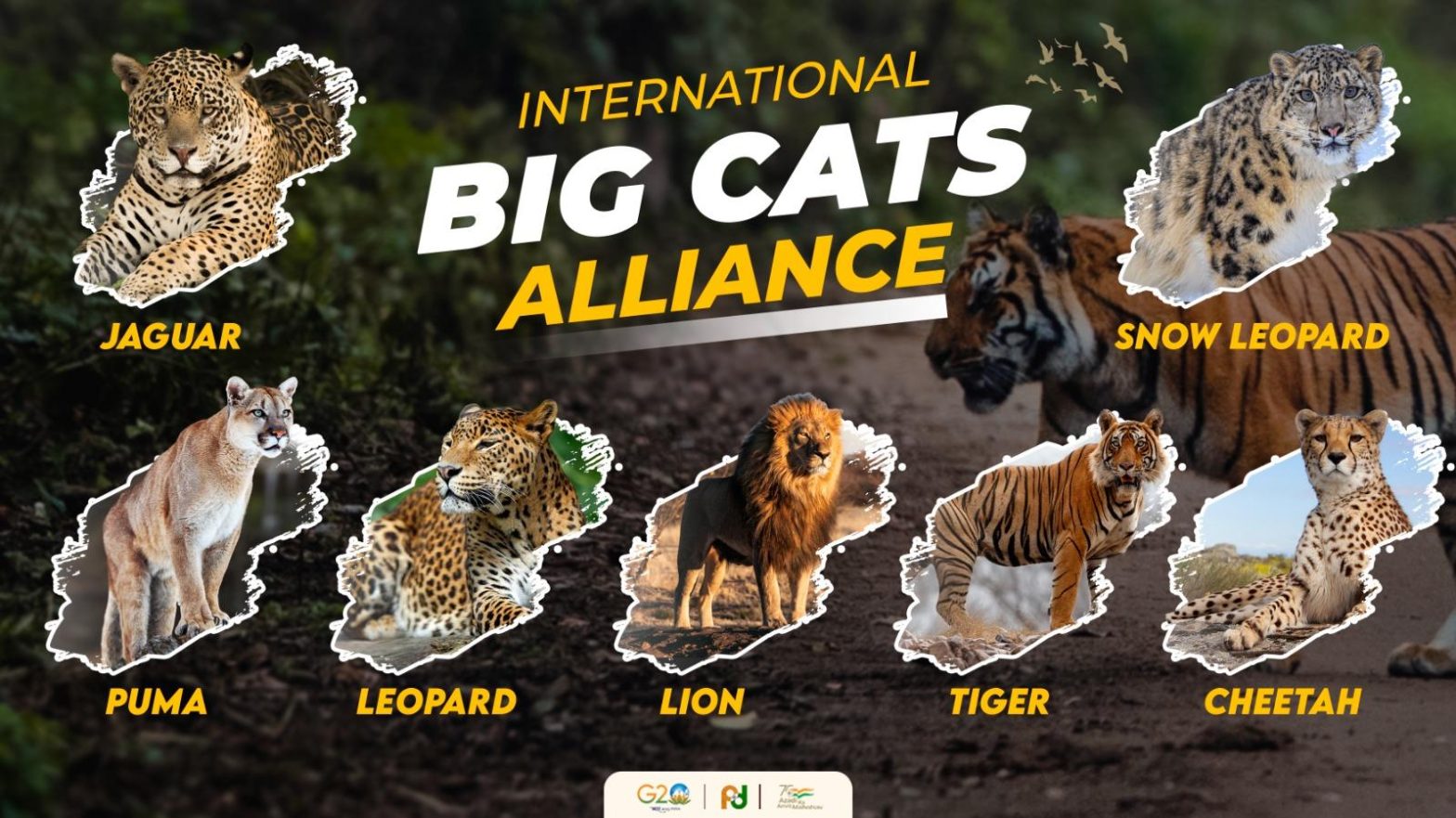
- The International Big Cat Alliance is a treaty-based intergovernmental organisation headquartered in India. It was launched by India on April 9, 2023, marking 50 years of Project Tiger. The alliance aims to create a global platform for cooperation in conserving seven big cat species: tiger, lion, leopard, snow leopard, cheetah, jaguar, and puma.
- The initiative is implemented domestically through the National Tiger Conservation Authority (NTCA) under the Ministry of Environment, Forest and Climate Change (MoEFCC). Its institutional framework is broadly modelled on the International Solar Alliance, with an Assembly of Members, Standing Committee, and Secretariat.
- The International Big Cat Alliance is a treaty-based intergovernmental organisation headquartered in India. It was launched by India on April 9, 2023, marking 50 years of Project Tiger. The alliance aims to create a global platform for cooperation in conserving seven big cat species: tiger, lion, leopard, snow leopard, cheetah, jaguar, and puma.
-
Membership and Participation:
IBCA membership is open to all United Nations member states, including both range and non-range countries. As of now, the alliance has 24 member countries, three observer countries, and several other participating nations. Saudi Arabia has confirmed its membership, while China’s participation remains uncertain.
China’s Position and Conservation Status:
-
-
- Independent scientific assessments indicate that China has a very small wild tiger population, primarily restricted to the northeastern border regions near Russia. These are mainly Amur (Siberian) tigers, with estimated populations of around 50–70 individuals based on camera-trap and landscape studies.
- In contrast, India hosts a significantly larger population of wild tigers. According to the latest estimates, India had around 3,167 tigers in 2022, primarily Bengal tigers distributed across protected reserves from the Himalayas to central and southern India.
- Independent scientific assessments indicate that China has a very small wild tiger population, primarily restricted to the northeastern border regions near Russia. These are mainly Amur (Siberian) tigers, with estimated populations of around 50–70 individuals based on camera-trap and landscape studies.
-
Key Features of IBCA:
-
-
- Global Initiative: Launched in 2023 by India for conservation of big cats
- Species Covered: Tiger, lion, leopard, snow leopard, cheetah, jaguar, and puma
- Legal Status: Became a treaty-based intergovernmental organisation in 2025
- Headquarters: Located in India
- Implementation Body: National Tiger Conservation Authority (NTCA)
- Funding: ₹150 crore approved by Union Cabinet for five years (2023–2028)
- First Summit: Scheduled in New Delhi with the theme “Save Big Cats, Save Humanity, Save Ecosystem”
- Global Initiative: Launched in 2023 by India for conservation of big cats
-
Significance of IBCA:
-
-
- The alliance aims to strengthen global cooperation in habitat conservation, prey base protection, research, innovation, and capacity building. It also promotes coordinated action among member countries to address threats such as poaching, habitat loss, and human-wildlife conflict.
- For India, IBCA reinforces its role as a global leader in wildlife conservation, building on the success of Project Tiger and expanding its conservation diplomacy footprint.
- The alliance aims to strengthen global cooperation in habitat conservation, prey base protection, research, innovation, and capacity building. It also promotes coordinated action among member countries to address threats such as poaching, habitat loss, and human-wildlife conflict.
-
Conclusion:
While IBCA is emerging as an important global platform for apex predator conservation, China’s likely absence highlights the geopolitical and ecological disparities in big cat distribution and conservation priorities. The success of IBCA will depend on wider international participation, scientific collaboration, and sustained commitment to biodiversity protection.



