
Context:
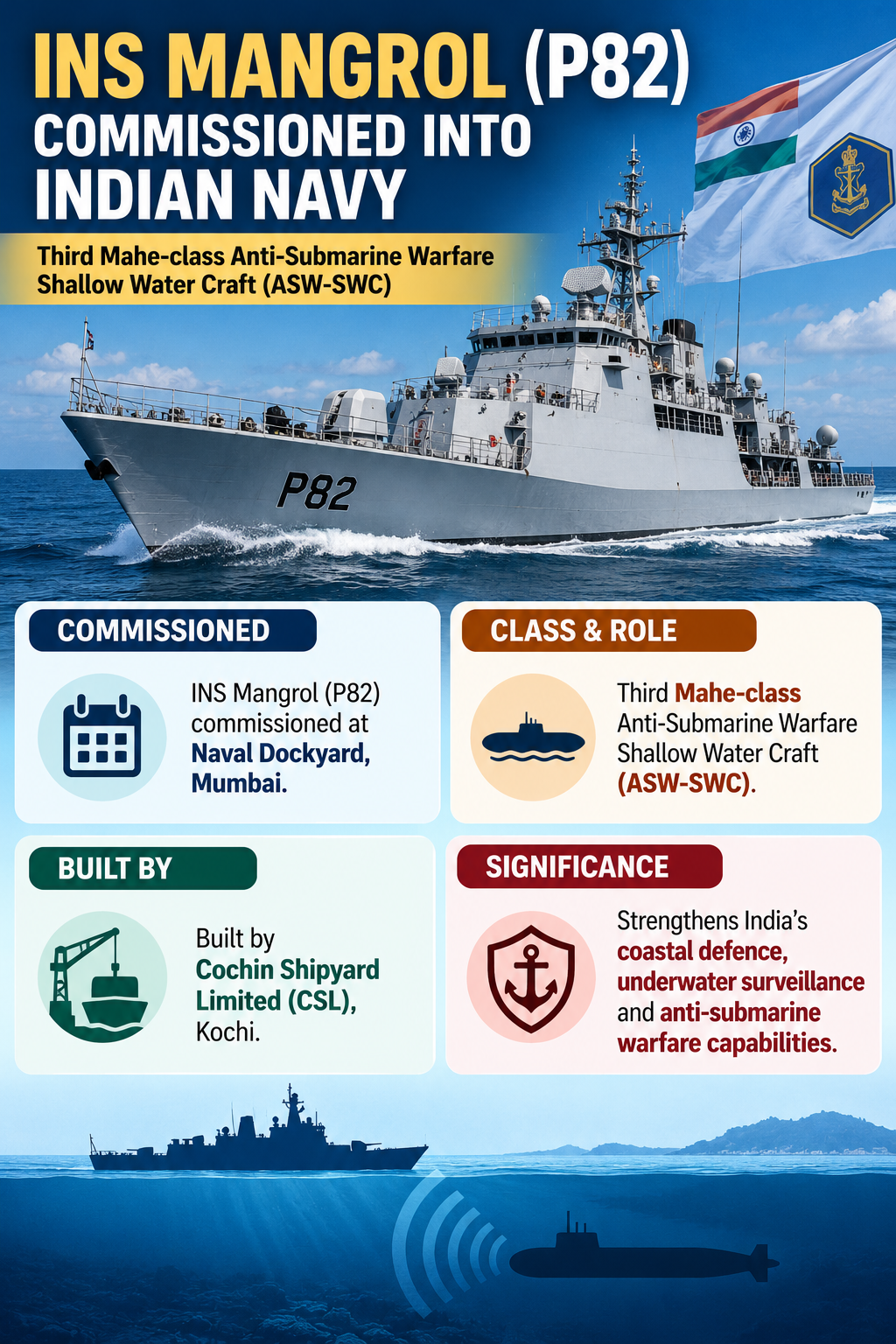
Recently, the Indian Navy commissioned INS Mangrol (P82), the third Mahe-class Anti-Submarine Warfare Shallow Water Craft (ASW-SWC), at the Naval Dockyard in Mumbai. Built by Cochin Shipyard Limited (CSL), Kochi, the vessel strengthens India's coastal defence, underwater surveillance and anti-submarine warfare capabilities.
About Mahe-Class Programme:
-
-
- The Mahe-Class Programme is an Indian Navy project to build eight Anti-Submarine Warfare Shallow Water Craft (ASW-SWC) to replace the older Abhay-class corvettes. The contract was signed with Cochin Shipyard Limited on 30 April 2019, with deliveries scheduled through June 2028.
- The programme supports the modernisation of the Navy's coastal warfare capabilities and promotes indigenous warship construction under the Aatmanirbhar Bharat initiative.
- The Mahe-Class Programme is an Indian Navy project to build eight Anti-Submarine Warfare Shallow Water Craft (ASW-SWC) to replace the older Abhay-class corvettes. The contract was signed with Cochin Shipyard Limited on 30 April 2019, with deliveries scheduled through June 2028.
-
About INS Mangrol:
-
-
- INS Mangrol is the third vessel in the Mahe-class series. It has more than 80% indigenous content, reflecting India's efforts to reduce dependence on imported defence equipment.
- The vessel is named after Mangrol, a coastal town and fishing harbour in Gujarat's Junagadh district. Its primary role is to detect, track and neutralise hostile submarines operating in shallow coastal waters.
- INS Mangrol is the third vessel in the Mahe-class series. It has more than 80% indigenous content, reflecting India's efforts to reduce dependence on imported defence equipment.
-
Specifications and Design:
-
-
- The Mahe-class vessels are approximately 78 metres long, with a displacement of around 900–1,100 tonnes. They can achieve a maximum speed of approximately 25 knots using diesel engines and waterjet propulsion.
- Their design enables effective manoeuvrability in shallow and confined waters. The vessels are equipped with RBU-6000 anti-submarine rocket launchers, triple lightweight torpedo launchers, mine-laying rails, a 30 mm naval gun and indigenous hull-mounted sonar systems.
- The Mahe-class vessels are approximately 78 metres long, with a displacement of around 900–1,100 tonnes. They can achieve a maximum speed of approximately 25 knots using diesel engines and waterjet propulsion.
-
Key Roles and Capabilities:
-
-
- INS Mangrol is designed for littoral anti-submarine warfare, which involves countering submarine threats in coastal waters. Its sonar systems help detect and track underwater targets, while its weapons enable it to engage hostile submarines.
- The vessel can also undertake subsurface surveillance, search and rescue (SAR), mine-laying and low-intensity maritime operations (LIMO). These capabilities strengthen the protection of ports, harbours and coastal approaches.
- INS Mangrol is designed for littoral anti-submarine warfare, which involves countering submarine threats in coastal waters. Its sonar systems help detect and track underwater targets, while its weapons enable it to engage hostile submarines.
-
Significance for India:
-
-
- The programme strengthens India's coastal security and maritime domain awareness by improving its ability to detect and respond to underwater threats. It also supports India's maritime security interests in the Indian Ocean Region.
- The construction of these vessels by an Indian shipyard advances Aatmanirbhar Bharat and Make in India, promotes domestic defence manufacturing and creates opportunities for Indian suppliers and micro, small and medium enterprises (MSMEs).
- The programme strengthens India's coastal security and maritime domain awareness by improving its ability to detect and respond to underwater threats. It also supports India's maritime security interests in the Indian Ocean Region.
-
Conclusion:
The commissioning of INS Mangrol represents an important step in modernising the Indian Navy's coastal warfare capabilities. The Mahe-class programme combines indigenous shipbuilding with specialised anti-submarine technology, contributing to coastal defence, maritime surveillance and India's long-term objective of defence self-reliance.



