
INS Mahendragiri
Context:
Recently, The Indian Navy recently took delivery of INS Mahendragiri (Yard 12654), the sixth ship of the Nilgiri-class (Project 17A) frigates, marking a significant step in strengthening India’s maritime defence capabilities. Built by Mazagon Dock Shipbuilders Limited (MDL), Mumbai, this milestone reflects India’s growing emphasis on indigenous warship design and construction under the Aatmanirbhar Bharat initiative.
About Project 17A:
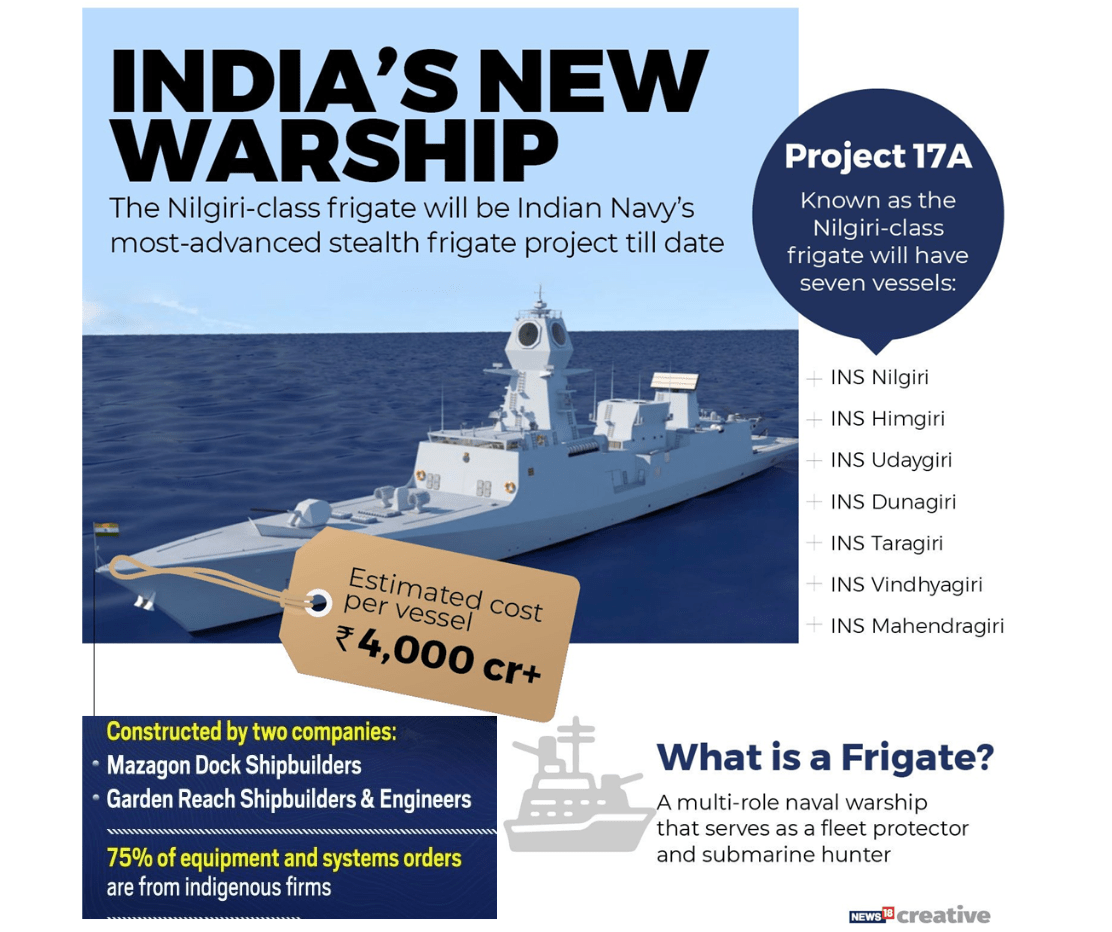
The Nilgiri-class frigates (Project 17A) are the next-generation follow-on to the Shivalik-class (Project 17) frigates, featuring enhanced stealth, automation, and combat capabilities. A total of seven frigates are being constructed, divided between two major public sector shipyards—Mazagon Dock Shipbuilders Limited (MDL), Mumbai, which is building four ships, and Garden Reach Shipbuilders & Engineers (GRSE), Kolkata, which is constructing three. The project has an indigenous content of around 75%, involving over 200 MSMEs, thereby strengthening India’s domestic defence industrial ecosystem and supporting self-reliance in critical technologies.
List of Seven Frigates:
The fleet includes INS Nilgiri, INS Himgiri, INS Udaygiri, INS Taragiri, INS Dunagiri, INS Vindhyagiri, and INS Mahendragiri. These vessels have been commissioned or delivered between 2025 and 2026, with INS Nilgiri being commissioned in January 2025 and INS Mahendragiri delivered in April 2026. The staggered induction of these ships ensures a steady enhancement of naval operational capability and fleet modernisation.
Key Technical Specifications:
The Project 17A frigates incorporate advanced stealth features, including a reduced radar cross-section achieved through radar-absorbent materials and improved hull design. They are constructed using Integrated Modular Construction techniques, allowing pre-outfitted blocks to be assembled for faster production timelines. The ships displace around 6,670 tonnes, measure approximately 149 metres in length, and are capable of achieving speeds between 28–32 knots using CODOG or CODAG propulsion systems.
Weapon and Sensor Suite:
These frigates are heavily armed for multi-dimensional warfare. Their air defence is provided by the 32-cell Barak-8 (LR-SAM) system, while surface strike capability is ensured through 8 BrahMos supersonic cruise missiles. They also feature a 76mm Super Rapid Gun Mount, AK-630 Close-In Weapon Systems (CIWS), and anti-submarine warfare equipment including torpedo tubes, rocket launchers, and HUMSA-NG sonar. Advanced sensors like the MF-STAR AESA radar enable multi-target tracking, while the Shakti electronic warfare suite provides capabilities for electronic surveillance, interception, and jamming.
Significance:
Designed entirely by the Indian Navy’s Warship Design Bureau, Project 17A represents a major achievement in indigenous defence engineering. These frigates are designed for blue-water operations and play a crucial role in carrier battle groups such as those centred around INS Vikrant, enhancing India’s maritime power projection. The naming convention, based on Indian mountain ranges, continues the legacy of earlier Nilgiri-class vessels, symbolising continuity in naval tradition alongside technological advancement.
Conclusion:
The induction of INS Mahendragiri as part of the Nilgiri-class frigate programme underscores India’s accelerating progress in indigenous defence manufacturing and naval modernisation. With advanced stealth, firepower, and automation, Project 17A significantly enhances the Indian Navy’s operational readiness and strengthens its role as a key maritime force in the Indo-Pacific region.



