
Context:
Recently, Pakistan has reacted strongly to India's decision to keep the Indus Waters Treaty (IWT) "in abeyance". India has also issued notices seeking modification and renegotiation of the Treaty, to which Pakistan has not yet responded.
What is the Indus Waters Treaty?
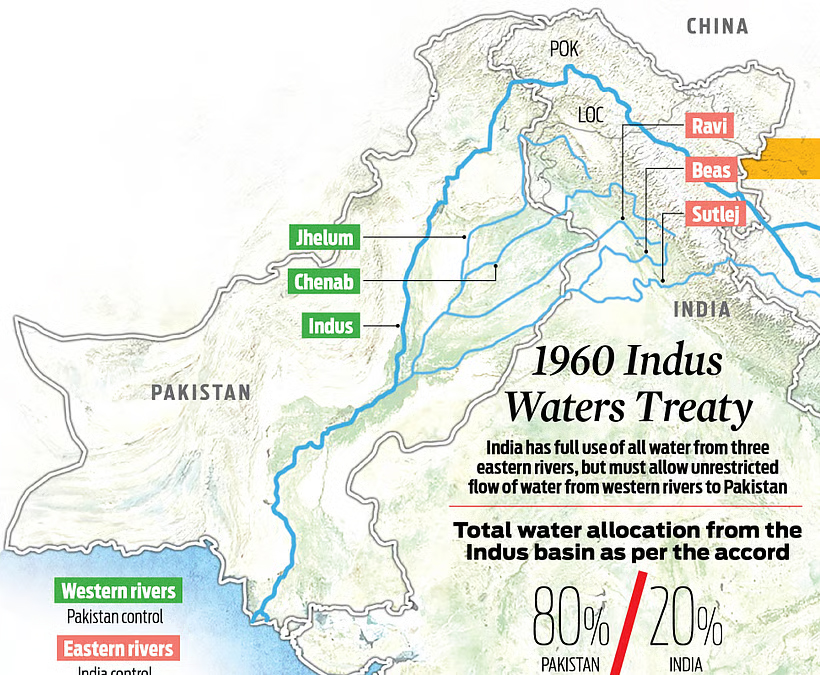
The Indus Waters Treaty (IWT) was signed on 19 September 1960 between India and Pakistan with the mediation of the World Bank. It governs the sharing of the waters of the Indus River System. Under the Treaty, the Eastern Rivers (Ravi, Beas, and Sutlej) were allocated to India, while the Western Rivers (Indus, Jhelum, and Chenab) were allocated primarily to Pakistan, with India retaining limited rights for domestic use, irrigation, and run-of-the-river hydropower projects.
Why has India Kept the Treaty in Abeyance?
India cited:
-
-
- Continued cross-border terrorism.
- The Pahalgam terrorist attack.
- National security concerns.
- Continued cross-border terrorism.
-
Why is there a Need for Renegotiation?
The Treaty was framed over six decades ago and does not adequately address present-day challenges. Climate change, glacier melting, changing rainfall patterns, rising population, growing water demand, and technological advancements have significantly altered water management needs. It also lacks provisions on environmental flows, water quality, disaster management, and integrated river basin management.
Permanent Indus Commission (PIC):
The Permanent Indus Commission (PIC) was established under the Treaty to facilitate data sharing, inspections, technical cooperation, and dispute resolution. However, it mainly functions as an implementing body and lacks the broader river management role seen in modern river commissions.
Significance:
The Indus River System is vital for irrigation, hydropower generation, drinking water, and agriculture in northern India. The Treaty has survived wars and political tensions, making it one of the world's most successful transboundary water-sharing agreements. However, since the Indus originates in Tibet, China's upstream activities also hold strategic importance for India.
Way Forward:
India's request for modification is permitted under Article XII of the Treaty. A modernized agreement should incorporate climate resilience, environmental protection, improved flood management, scientific data sharing, and stronger institutional mechanisms while safeguarding India's water and security interests.
Conclusion:
The Indus Waters Treaty has played a crucial role in maintaining water cooperation between India and Pakistan. However, changing geopolitical realities, climate change, and emerging water challenges make its review and modernization essential for ensuring sustainable and equitable management of the Indus Basin.



