
Context:
A recent study published in Nature has confirmed that several of India’s major river deltas are sinking at alarming rates in many cases, faster than regional sea levels are rising. Land subsidence in these deltas is primarily driven by human activities, placing millions of people at heightened risk of flooding, permanent inundation, and displacement.
About River Deltas:
-
-
- Deltas are fertile, fan-shaped landforms built by river sediment deposited where a river slows down upon entering a larger body of water, such as an ocean or lake. Named after the Greek letter Delta ($\Delta$), they feature rich soil and crucial ecosystems. Deltas are typically densely populated, supporting millions through agriculture, fisheries, and trade; however, they are highly vulnerable to subsidence, flooding, and climate change. Key examples include the Nile, the Mississippi, and the Ganga-Brahmaputra (the world's largest) deltas. Common types include arcuate (fan-shaped), bird's foot, and cuspate.
- Deltas are fertile, fan-shaped landforms built by river sediment deposited where a river slows down upon entering a larger body of water, such as an ocean or lake. Named after the Greek letter Delta ($\Delta$), they feature rich soil and crucial ecosystems. Deltas are typically densely populated, supporting millions through agriculture, fisheries, and trade; however, they are highly vulnerable to subsidence, flooding, and climate change. Key examples include the Nile, the Mississippi, and the Ganga-Brahmaputra (the world's largest) deltas. Common types include arcuate (fan-shaped), bird's foot, and cuspate.
-
Importance of Deltas:
-
-
- River deltas cover just 1% of the world’s land area but support 350–500 million people and 10 of the world’s 34 megacities. They provide crucial services, including agriculture, fisheries, ports, and maritime trade.
- However, deltas are low-lying ecosystems, often situated less than two meters above sea level, making them highly vulnerable to climate-driven threats such as storm surges, rising seas, and shifting rainfall patterns.
- River deltas cover just 1% of the world’s land area but support 350–500 million people and 10 of the world’s 34 megacities. They provide crucial services, including agriculture, fisheries, ports, and maritime trade.
-
Key Findings of the Study:
-
-
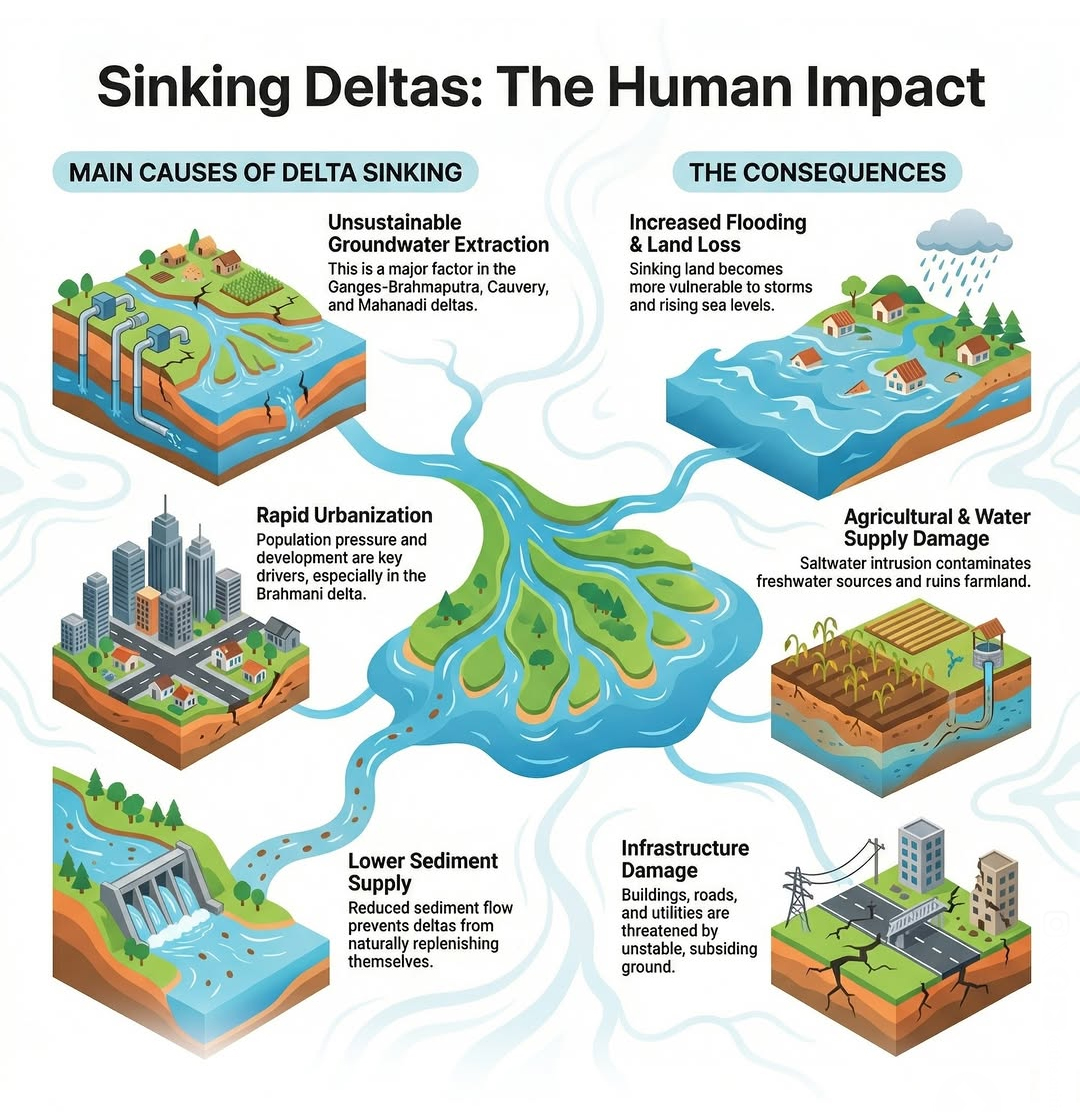
- Land subsidence, the gradual sinking of the Earth’s surface has emerged as a key risk factor. Between 2014 and 2023, over half of the world’s studied deltas experienced subsidence rates exceeding 3 mm per year.
- In 13 deltas, including India’s Brahmani, Mahanadi, and Ganga-Brahmaputra, sinking rates exceeded the global mean sea-level rise ($\approx$ 4 mm/year). The Brahmani and Mahanadi are among the fastest-sinking, with large areas subsiding by over 5 mm per year. This subsidence, combined with sea-level rise, significantly increases flood risks even in the absence of extreme climate events.
- Land subsidence, the gradual sinking of the Earth’s surface has emerged as a key risk factor. Between 2014 and 2023, over half of the world’s studied deltas experienced subsidence rates exceeding 3 mm per year.
-
Human Activity and Groundwater Extraction:
Excessive groundwater extraction is the primary driver of subsidence in Indian deltas. Overuse for agriculture, industry, and domestic needs causes underground sediments to compact, resulting in irreversible surface-level decline. Additionally, upstream dams and levees reduce sediment supply, depriving deltas of their natural replenishment. This mirrors patterns observed in the Nile, Po, and Mississippi deltas.
Implications for India:
Indian deltas are described as "unprepared divers," facing high relative sea-level rise but possessing limited adaptation capacity. Vulnerable communities particularly rural and Indigenous populations in low-lying areas face increased risks of flooding, land loss, and displacement. Urban centers like Kolkata are also sinking, which heightens infrastructure vulnerability.
Way Forward:
-
-
- Urgent measures are required to mitigate these risks:
- Regulating groundwater extraction.
- Restoring natural sediment flows.
- Strengthening flood defenses.
- Implementing integrated delta management policies.
- Prioritizing climate-resilient planning for vulnerable populations to reduce social, economic, and ecological risks.
- Regulating groundwater extraction.
- Urgent measures are required to mitigate these risks:
-
Conclusion:
India’s river deltas are vital for food security, trade, and livelihoods. Accelerated subsidence due to human activity, combined with rising seas, poses a looming crisis. Evidence-based policy interventions can safeguard these fragile landscapes, protect millions of people, and ensure sustainable development.



