
India’s New Labour Codes and Their Implementation
Context:
Recently, The Ministry of Labour and Employment has notified the final rules for all four Labour Codes. The implementation marks a major overhaul of India’s labour regulatory framework aimed at simplifying laws, improving compliance, and expanding worker protections.
About New Labour Codes:
The Government of India has notified four new Labour Codes (Wages, Social Security, Industrial Relations and Occupational Safety) by merging 29 central labour laws. These codes have been in effect since 21 November 2025. Their main objective is to promote ease of doing business, ensure minimum wages for all workers, establish a 48-hour work week, and provide better protection even for contract workers.
Constitutional Basis of Labour Laws:
Labour is a subject under the Concurrent List (List III) of the Seventh Schedule of the Constitution of India. This means both the Centre and States can legislate on labour matters, leading to the need for harmonised national-level codes.
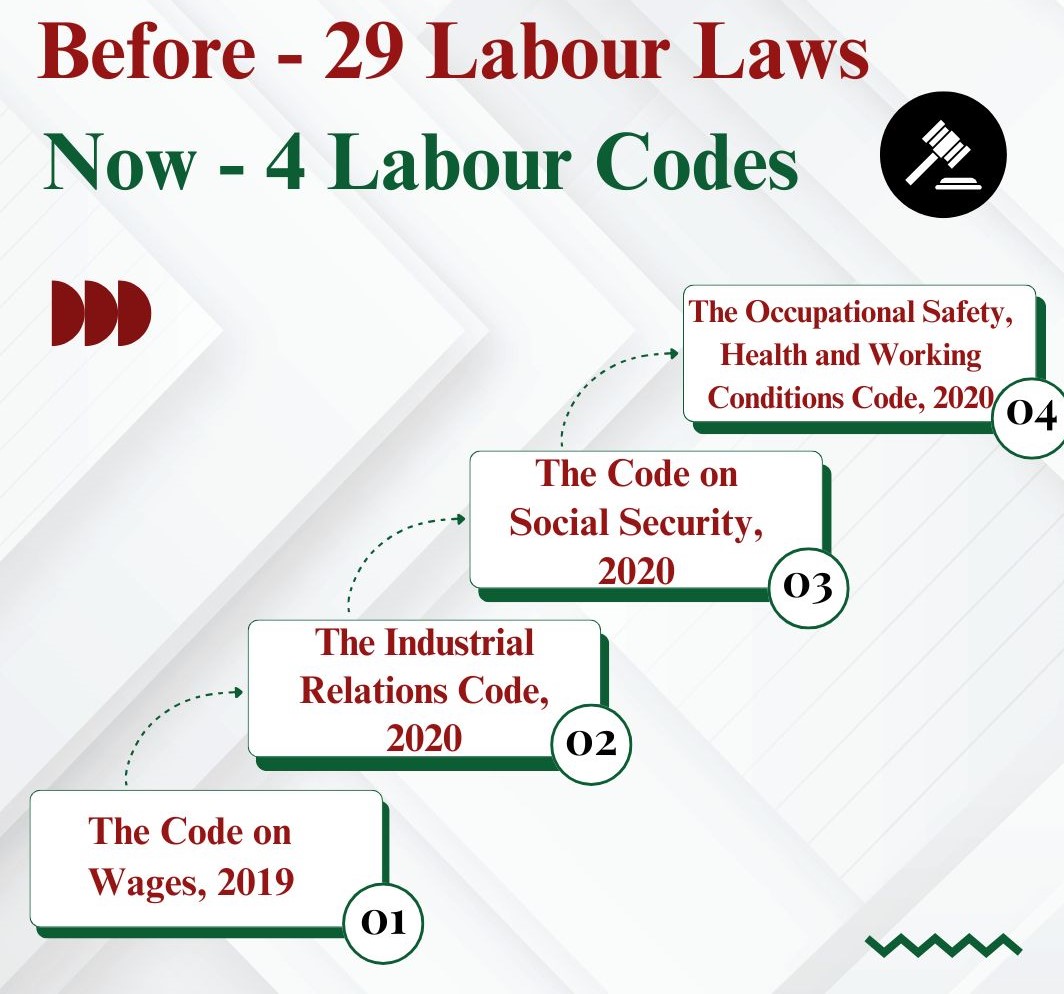
Key Highlights of the Four Labour Codes:
-
-
- The four codes are:
- Code on Wages (2019)
- Industrial Relations Code (2020)
- Social Security Code (2020)
- Occupational Safety, Health and Working Conditions Code (2020)
- Code on Wages (2019)
- The four codes are:
-
Key provisions include:
-
-
- National floor wage fixed by the Centre
- Mandatory 8-hour workday and 48-hour weekly cap
- Universal wage slips and compliance transparency
- Social security coverage for gig and unorganised workers
- Single registration and licensing system for employers
- National floor wage fixed by the Centre
-
Key Policies:
-
-
- A national floor wage will be determined considering minimum living standards such as food, clothing, and housing. It will act as a baseline below which states cannot fix wages.
- However, the removal of a fixed formula for minimum wage calculation in the final rules has raised concerns.
- A national floor wage will be determined considering minimum living standards such as food, clothing, and housing. It will act as a baseline below which states cannot fix wages.
-
Impact on Workers:
-
-
- Formal workers: Better regulation, wage protection, and safety standards
- Informal workers: Inclusion in social security schemes, though implementation remains key
- Gig workers: A dedicated National Social Security Board ensures representation and welfare coverage
- Women workers: Permission for night shifts with consent, safe transport, and workplace safety measures
- Formal workers: Better regulation, wage protection, and safety standards
-
Impact on Ease of Doing Business:
The codes simplify compliance through:
-
-
- Single licence system for multi-state contractors
- Digital registration processes
- Consolidation of multiple laws into unified frameworks
- This reduces regulatory burden and improves labour market flexibility.
- Single licence system for multi-state contractors
-
Concerns and Criticisms:
Key concerns include:
-
-
- Lack of clear formula for minimum wage fixation
- Possible wage disparities across states
- Implementation challenges due to federal coordination
- Fear of diluted bargaining power for workers
- Labour unions argue that flexibility may come at the cost of worker protection.
- Lack of clear formula for minimum wage fixation
-
Conclusion:
The implementation of the four Labour Codes marks a structural transformation in India’s labour governance system. While they aim to improve formalisation, ease of doing business and worker protection, their success will depend on balanced implementation.



