
Context:
A recent study published in Nature Sustainability warns that India’s natural ecosystems are increasingly threatened by invasive alien plants, resulting in ecological, socio-economic, and livelihood impacts.
About Invasive Species:
Invasive species are non-native organisms that spread rapidly, outcompeting native flora and fauna, altering ecosystem structure, and disrupting ecological balance.
Key Findings:
Extent of the Problem
-
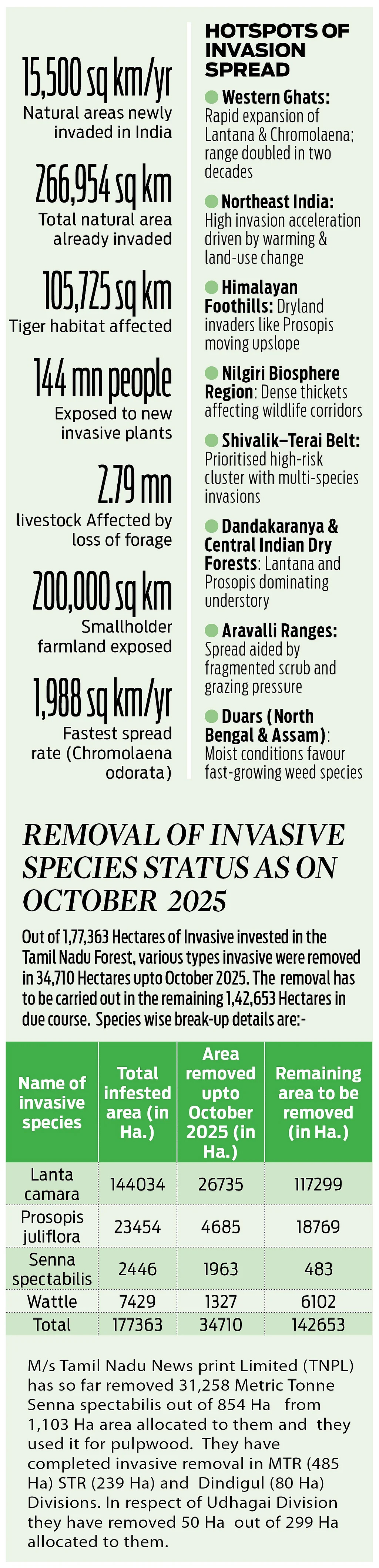
- India loses approximately 15,500 sq km of natural areas every year to invasive alien plants.
- Nearly two-thirds of natural ecosystems in India now host 11 major invasive plant species, including Lantana camara, Chromolaena odorata, and Prosopis juliflora.
- India loses approximately 15,500 sq km of natural areas every year to invasive alien plants.
Drivers of Invasion:
-
- Climate Change: Rising temperatures, altered rainfall patterns, and more frequent fires facilitate invasive species expansion.
- Land-Use Change: Conversion of forests, grasslands, and wetlands for agriculture or development increases ecological vulnerability.
- Biodiversity Loss: Habitat fragmentation and loss of native species reduce ecosystem resistance to invasives.
- Fire Regimes & Grazing Pressure: Changes in fire frequency and livestock grazing influence the spread of wet- and dry-biome invasive species differently.
- Climate Change: Rising temperatures, altered rainfall patterns, and more frequent fires facilitate invasive species expansion.
Major Invasive Species in India:
1. Lantana camara – Dominant across most states, affecting forests and grasslands.
2. Chromolaena odorata – One of the fastest-spreading invasive plants in India, with widespread distribution that significantly alters native ecosystems.
3. Prosopis juliflora – Introduced to prevent desertification; now dominates dry regions, displacing native shrubs essential for wildlife and pastoral communities.
4. Other notable species: Ageratina adenophora, Mikania micrantha, Xanthium strumarium.
Vulnerable Ecosystems:
-
- Western Ghats, Himalayas, and North-East, Ecologically sensitive regions experiencing nearly double the invasion rates.
- Dry grasslands of Peninsular India, wet grasslands along the Ganga–Brahmaputra basin, Shola grasslands of the Western Ghats, and savannas, Particularly vulnerable to invasive expansion.
- Entire ecosystems risk shifting from native dominance to invasive dominance within a generation if left unchecked.
- Western Ghats, Himalayas, and North-East, Ecologically sensitive regions experiencing nearly double the invasion rates.
Socio-Economic Impacts:
-
- Livelihoods at Risk: Reduced fodder and fuelwood availability, declining soil fertility, and restricted access to water and grazing areas.
- Economic Losses: India suffered losses worth ₹8,30,000 crore ($127.3 billion) due to invasive species between 1960 and 2020.
- Health Impacts: Respiratory ailments and nutritional insecurity associated with certain invasive species.
- Displacement & Migration: Rural and pastoral communities increasingly compelled to travel longer distances for essential resources.
- Livelihoods at Risk: Reduced fodder and fuelwood availability, declining soil fertility, and restricted access to water and grazing areas.
Environmental and Ecological Consequences:
-
- Biodiversity Loss: Native plant and animal species are displaced, disrupting ecosystem functions.
- Altered Ecosystem Dynamics: Soil moisture, fire regimes, and grazing patterns change at different rates for wet- and dry-biome invaders.
- Accelerated Spread: Species once confined to arid zones are now expanding into Himalayan forests and wet evergreen ecosystems.
- Biodiversity Loss: Native plant and animal species are displaced, disrupting ecosystem functions.
Conclusion:
Invasive alien plants are accelerating ecosystem transformation in India, posing severe threats to biodiversity, livelihoods, and ecological stability. Immediate, coordinated, and science-driven interventions are essential to prevent a larger socio-ecological crisis. Establishing a National Invasive Species Mission is critical to safeguarding India’s natural heritage and supporting rural livelihoods.



