
Context:
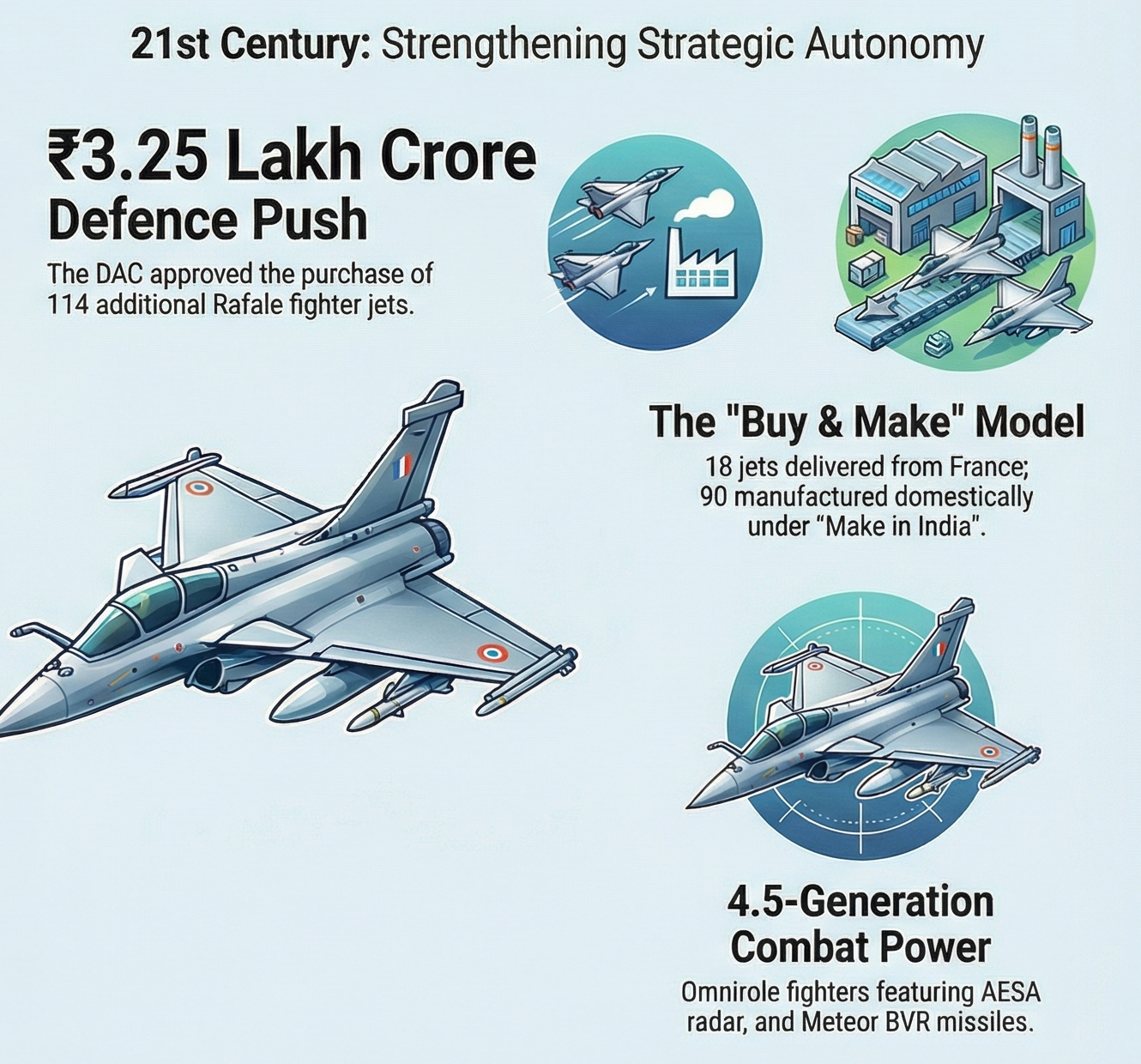
Recently, the Defence Acquisition Council (DAC) approved the purchase of 114 additional Rafale fighter jets for the Indian Air Force (IAF) at a cost of ₹3.25 lakh crore. This marks one of the largest defence acquisitions in recent years and comes amid India’s need to strengthen its aerial combat capabilities, given that the IAF currently operates below its sanctioned strength of 42 squadrons. Eighteen aircraft will be delivered in fly-away condition from France, while the remaining 90 will be manufactured domestically under the “Make in India” initiative.
About the Defence Acquisition Council:
-
-
- The DAC, chaired by the Defence Minister, is the apex decision-making body for defence procurement in India. It grants Acceptance of Necessity (AoN) for acquisition proposals, approves long-term plans, and ensures the timely execution of approved programmes.
- The council’s approval enables the Rafale deal to move into detailed technical and commercial negotiations, reflecting India’s focus on structured and efficient defence planning.
- The DAC, chaired by the Defence Minister, is the apex decision-making body for defence procurement in India. It grants Acceptance of Necessity (AoN) for acquisition proposals, approves long-term plans, and ensures the timely execution of approved programmes.
-
Boost to Indigenous Manufacturing:
A key feature of this acquisition is domestic production. Around 90 aircraft will be assembled in India, supporting technology transfer, employment generation, and skill development in the aerospace sector. This “Buy & Make” model strengthens self-reliance in defence production, reduces dependency on foreign suppliers, and reinforces India’s strategic autonomy in critical military technologies.
About Rafale:
-
-
- The Rafale is a 4.5-generation, twin-engine, omnirole fighter capable of executing air superiority, ground attack, reconnaissance, and nuclear deterrence missions in a single sortie. Its advanced avionics include the RBE2 AESA radar, the SPECTRA electronic warfare suite, and modular data fusion systems.
- Powered by Snecma M88 engines, it can supercruise at speeds of up to Mach 1.8, with a combat radius exceeding 1,000 km. Its weapons suite includes Meteor BVR missiles, SCALP/Storm Shadow cruise missiles, and Exocet anti-ship missiles. IAF-specific modifications enhance survivability, high-altitude performance, and operational flexibility.
- The Rafale is a 4.5-generation, twin-engine, omnirole fighter capable of executing air superiority, ground attack, reconnaissance, and nuclear deterrence missions in a single sortie. Its advanced avionics include the RBE2 AESA radar, the SPECTRA electronic warfare suite, and modular data fusion systems.
-
Strategic and Operational Significance:
-
-
- This acquisition addresses critical capability gaps in India’s fighter fleet, ensuring preparedness amid ongoing security challenges along the western and northern borders.
- By expanding the Rafale fleet to 176 aircraft, including 26 naval Rafale-M jets for carrier operations, India strengthens deterrence and operational readiness across multiple domains.
- This acquisition addresses critical capability gaps in India’s fighter fleet, ensuring preparedness amid ongoing security challenges along the western and northern borders.
-
Conclusion:
Beyond its operational benefits, the deal consolidates India’s defence partnership with France, fostering long-term strategic and technological collaboration. By combining advanced foreign technology with domestic manufacturing, the acquisition advances India’s goal of strategic autonomy while demonstrating its capability to integrate high-end defence systems into its armed forces.



