
Context:
On the occasion of the Foundation Day of the Indian Council of Agricultural Research (ICAR), the Ministry of Agriculture and Farmers' Welfare dedicated India's first indigenous African Swine Fever (ASF) vaccine to the nation. The vaccine has been developed by the ICAR–National Institute of High Security Animal Diseases (ICAR-NIHSAD), Bhopal. It marks a significant milestone in India's efforts to strengthen livestock health, biosecurity, and indigenous vaccine research.
What is African Swine Fever (ASF)?
-
-
- African Swine Fever (ASF) is a highly contagious and fatal viral disease that affects both domestic and wild pigs. It is caused by the African Swine Fever Virus (ASFV), and its mortality rate can reach up to 100 percent.
- The disease does not infect humans and poses no direct threat to food safety. However, it causes severe economic losses to the pig farming industry. Since 2020, several ASF outbreaks have been reported in India, with the northeastern states being the worst affected.
- African Swine Fever (ASF) is a highly contagious and fatal viral disease that affects both domestic and wild pigs. It is caused by the African Swine Fever Virus (ASFV), and its mortality rate can reach up to 100 percent.
-
Key Features of the Indigenous Vaccine:
-
-
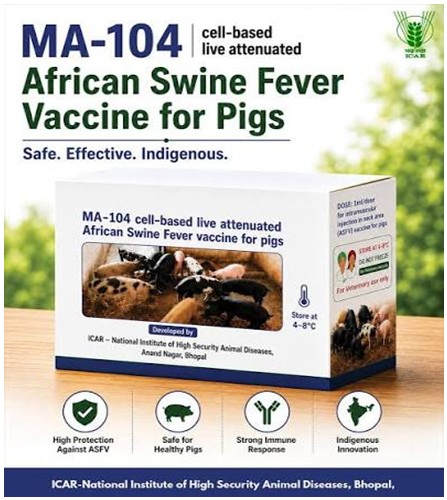
- This is India's first MA-104 cell line-based live-attenuated vaccine, developed against ASFV Genotype II. It employs targeted gene deletion technology, which reduces the virus's disease-causing ability while enabling the animal to develop a strong immune response.
- The vaccine is intended for healthy pigs aged more than eight weeks. It is administered as a 1 ml intramuscular injection, followed by a booster dose after 14 days.
- The vaccine is produced using a non-proprietary MA-104 cell line, which reduces dependence on expensive foreign production platforms and enables large-scale, cost-effective manufacturing.
- This is India's first MA-104 cell line-based live-attenuated vaccine, developed against ASFV Genotype II. It employs targeted gene deletion technology, which reduces the virus's disease-causing ability while enabling the animal to develop a strong immune response.
-
Significance:
-
-
- The primary objective of this vaccine is to reduce large-scale pig mortality caused by African Swine Fever, minimize the need for mass culling of infected animals, and protect the livelihoods of pig farmers. It will be particularly beneficial in Northeast India, where pig farming is an important pillar of the rural economy.
- The development of this vaccine strengthens India's indigenous vaccine research capabilities and reinforces livestock biosecurity. Its potential for affordable large-scale production can accelerate nationwide vaccination programmes. Furthermore, India could emerge as a key supplier of cost-effective ASF vaccines to countries across Asia and Africa in the future.
- The primary objective of this vaccine is to reduce large-scale pig mortality caused by African Swine Fever, minimize the need for mass culling of infected animals, and protect the livelihoods of pig farmers. It will be particularly beneficial in Northeast India, where pig farming is an important pillar of the rural economy.
-
Conclusion:
The development of the indigenous African Swine Fever vaccine represents a major achievement in India's animal health and biotechnology sector. It is expected to play a vital role in controlling ASF, enhancing livestock productivity, safeguarding farmers' incomes, and strengthening the country's overall biosecurity framework.



