
Context:
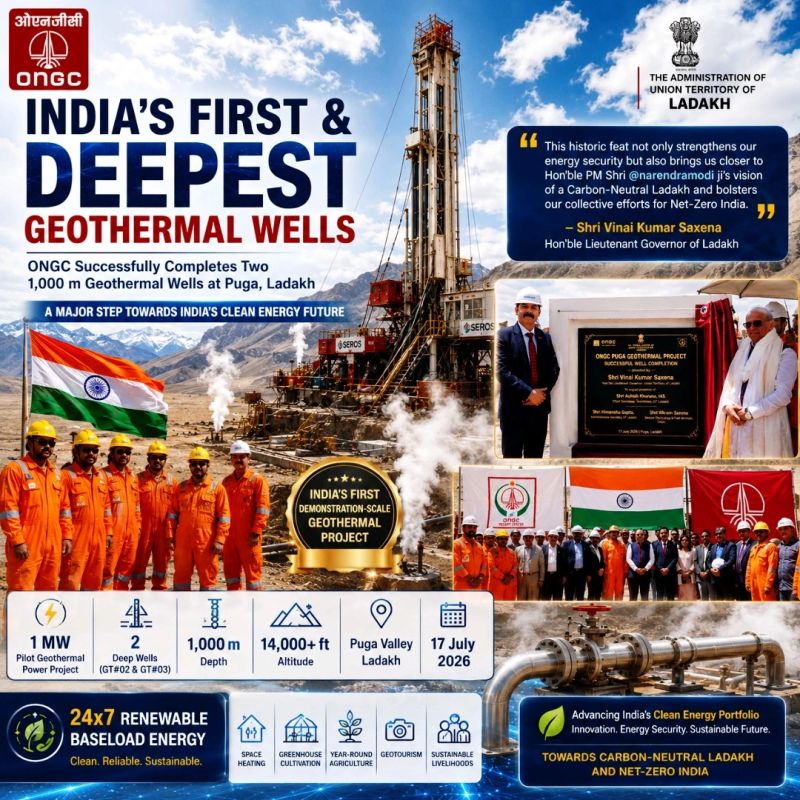
Recently, India's first and deepest geothermal wells were commissioned at Puga Valley, Ladakh, by the ONGC Energy Centre. The two wells, each drilled to a depth of 1,000 metres at an altitude of over 14,000 feet, will support India's first 1 MW pilot geothermal power project. This marks a significant step towards achieving India's clean energy and Net Zero by 2070 goals.
What is Geothermal Energy?
Geothermal energy is the heat stored beneath the Earth's crust, generated by the planet's formation and the continuous radioactive decay of minerals. This heat is extracted through deep wells to produce electricity, provide direct heating, or operate geothermal heat pumps for heating and cooling buildings. Unlike solar and wind energy, geothermal energy provides continuous (base-load) power irrespective of weather conditions.
Significance of the Puga Project:
-
-
- The Puga Valley project is India's first demonstration-scale geothermal power project. Engineers recorded temperatures of around 135°C at a depth of 400 metres, indicating promising geothermal potential. The project is expected to facilitate reservoir evaluation, commercial geothermal exploration, and the development of indigenous expertise in high-altitude drilling.
- The initiative also strengthens Ladakh's energy security, reducing dependence on diesel-based power generation and supporting the vision of making Ladakh a carbon-neutral region.
- The Puga Valley project is India's first demonstration-scale geothermal power project. Engineers recorded temperatures of around 135°C at a depth of 400 metres, indicating promising geothermal potential. The project is expected to facilitate reservoir evaluation, commercial geothermal exploration, and the development of indigenous expertise in high-altitude drilling.
-
Advantages of Geothermal Energy:
-
-
- Renewable and sustainable source of energy.
- Low greenhouse gas emissions compared to fossil fuels.
- Provides uninterrupted 24×7 electricity.
- Requires relatively less land than many other renewable energy sources.
- Suitable for remote and mountainous regions like Ladakh.
- Renewable and sustainable source of energy.
-
Challenges:
Despite its advantages, geothermal energy faces several constraints:
-
-
- High exploration and drilling costs.
- Limited availability of economically viable geothermal reservoirs.
- Technical challenges due to difficult terrain and extreme climatic conditions.
- Need for advanced drilling technology and skilled manpower.
- High exploration and drilling costs.
-
Way Forward:
India should accelerate geothermal resource mapping, promote public-private partnerships, develop dedicated geothermal policies, and encourage research in drilling technologies. Integrating geothermal energy with solar and wind can improve energy reliability and diversify the renewable energy mix.
Conclusion:
The commissioning of India's first deep geothermal wells at Puga Valley represents a historic milestone in the country's clean energy journey. Beyond electricity generation, the project demonstrates India's technological capability, enhances energy security, and contributes to sustainable development. If successfully scaled up, geothermal energy can emerge as an important component of India's renewable energy portfolio and support the nation's long-term climate and energy objectives.



