
Context:
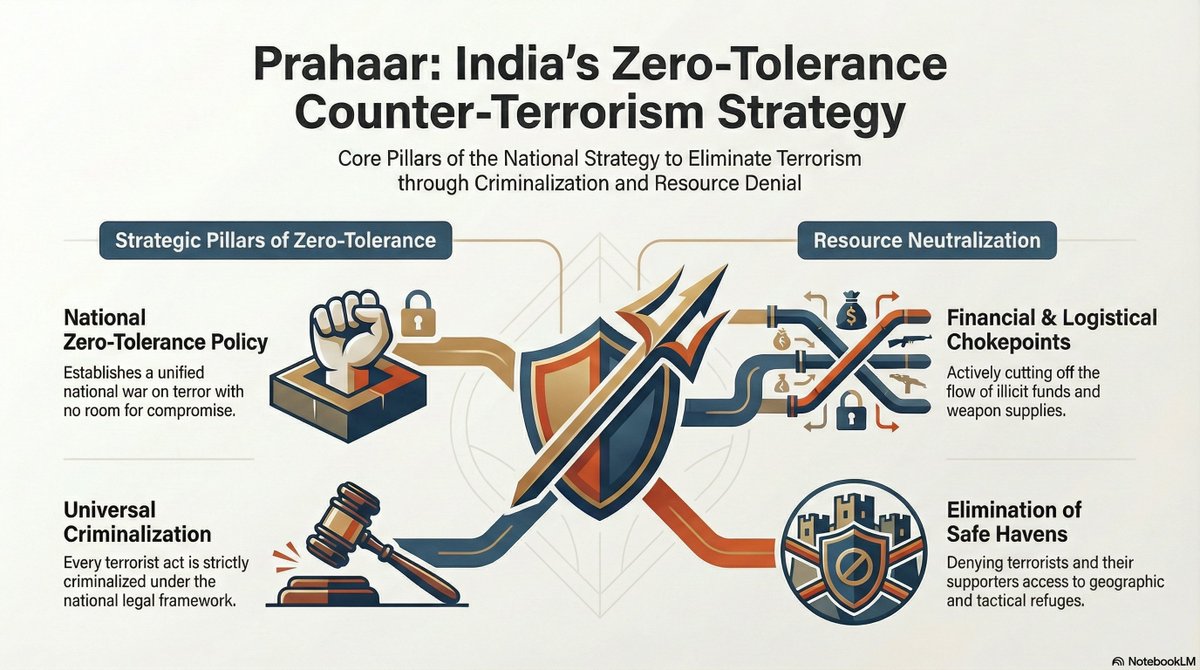
On 23 February 2026, the Government of India officially unveiled PRAHAAR, the country’s first comprehensive national counter‑terrorism policy and strategy. This landmark doctrine seeks to transform India’s approach to terrorism from disparate responses into a unified, proactive, and intelligence‑driven national strategy.
About Terrorism:
Terrorism in India is defined as the unlawful use of violence, including bombings, firearms, and hazardous materials, designed to threaten the nation's unity, integrity, or security, or to intimidate the public.
Definition:
-
-
- Legal Definition: Under Section 113 of the Bharatiya Nyaya Sanhita, 2023, a terrorist act is committed when someone threatens the nation’s unity, integrity, or security, or causes fear through the use of explosives, firearms, or other lethal means.
- Key Legislation: The Unlawful Activities (Prevention) Act (UAPA) is the primary law used to combat such activities.
- Legal Definition: Under Section 113 of the Bharatiya Nyaya Sanhita, 2023, a terrorist act is committed when someone threatens the nation’s unity, integrity, or security, or causes fear through the use of explosives, firearms, or other lethal means.
-
Why PRAHAAR Was Needed:
-
-
- Despite decades of counter‑terror efforts, India has continued to face cross-border terrorism, evolving internal extremist threats, and the use of technology-enabled tactics. Terror groups and hostile entities have increasingly exploited drones, encrypted communication, cyber platforms, crypto funding, and the dark web to recruit, plan, and execute attacks. Global organisations such as Al‑Qaeda and ISIS also attempt to influence and radicalise vulnerable people within India.
- With this changing threat landscape, previous reactive practices were deemed insufficient. PRAHAAR aims to provide a national playbook — bridging intelligence, operational responses, legal action, societal engagement, and international cooperation under one coherent doctrine.
- Despite decades of counter‑terror efforts, India has continued to face cross-border terrorism, evolving internal extremist threats, and the use of technology-enabled tactics. Terror groups and hostile entities have increasingly exploited drones, encrypted communication, cyber platforms, crypto funding, and the dark web to recruit, plan, and execute attacks. Global organisations such as Al‑Qaeda and ISIS also attempt to influence and radicalise vulnerable people within India.
-
Core Features of the PRAHAAR Doctrine:
-
-
- Prevention: Intelligence‑led proactive measures via MAC and JTFI to thwart terror plots.
- Response: Graded, proportionate actions, scaling from local police to NSG for major incidents.
- Coordination: Whole-of-government and society approach for better inter-agency cooperation.
- Rule of Law: Counter-terror actions respect constitutional rights and judicial oversight.
- Addressing Root Causes: Tackles radicalisation through community engagement, education, and rehabilitation.
- International Cooperation: Intelligence sharing, extradition, legal assistance, and multilateral coordination.
- Recovery & Resilience: Rapid post-incident recovery including healthcare, economic, and social support.
- Prevention: Intelligence‑led proactive measures via MAC and JTFI to thwart terror plots.
-
Significance and Implications:
-
-
- PRAHAAR represents a paradigm shift in India’s security architecture:
- It formalises national doctrine, rather than ad‑hoc or reactive counter‑terror measures.
- Encourages interagency integration, reducing operational silos across states and the Centre.
- Bridges technology and human intelligence, recognising the digital dimension of modern terrorism.
- Balances security imperatives with rights protection, crucial for maintaining democratic norms.
- It formalises national doctrine, rather than ad‑hoc or reactive counter‑terror measures.
- PRAHAAR represents a paradigm shift in India’s security architecture:
-
Conclusion:
PRAHAAR marks India’s first cohesive anti‑terror policy, articulating a structured, intelligence-driven doctrine rooted in zero-tolerance. Its holistic framework spans prevention, response, coordination, legal safeguards, societal resilience, and global partnerships. As terrorism evolves in complexity, PRAHAAR positions India to respond systematically and proactively to both traditional and emerging threats.



