
India’s Energy Transition: Why LNG and PNG Are Replacing LPG
Context:
Recently, due to the energy crisis in West Asia and global supply uncertainties, the Government of India has started prioritising liquefied natural gas (LNG), especially piped natural gas (PNG), over liquefied petroleum gas (LPG) for domestic and industrial fuel. In this context, the government notified the Natural Gas and Petroleum Products Distribution (Through Laying, Building, Operation and Expansion of Pipelines and Other Facilities) Order, 2026, which provides a transparent and standardised regulatory framework for the expansion of PNG networks and reduction of LPG dependency.
Types of Gaseous Fuels:
India uses multiple types of gaseous fuels for domestic and industrial purposes:
-
-
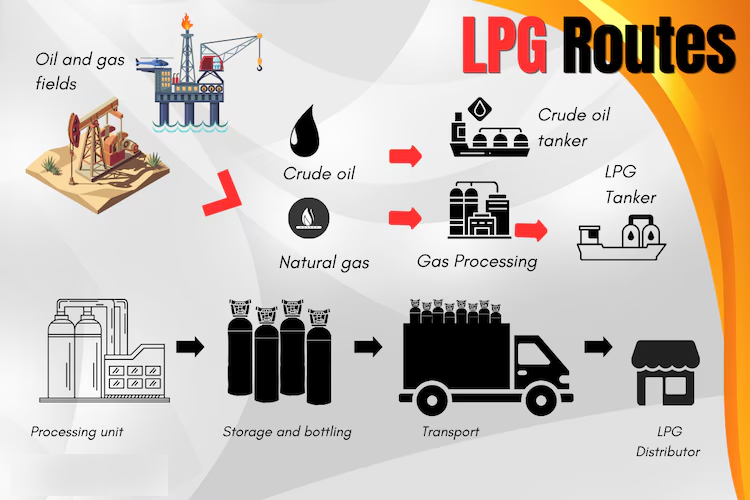
- Liquefied Petroleum Gas (LPG): A mixture of propane and butane obtained during oil refining and natural gas processing. It is mainly used in homes for cooking via cylinders.
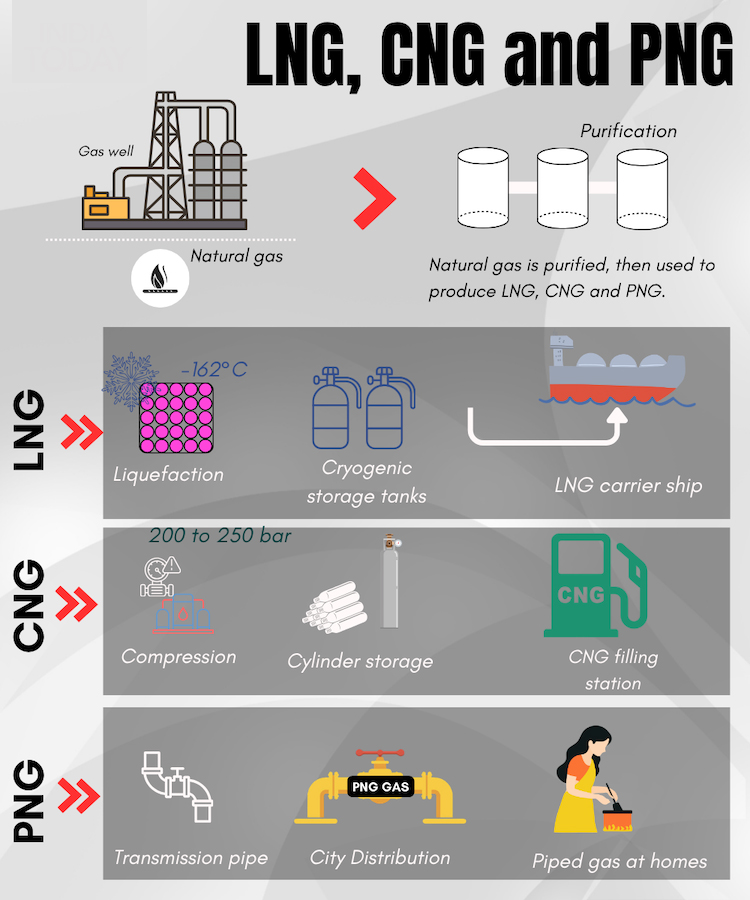
- Liquefied Natural Gas (LNG): Natural gas cooled to extremely low temperatures to liquefy it for easy transport via sea or land. It is primarily used in industries and power plants.
- Piped Natural Gas (PNG): Supplied directly to homes, businesses, and institutions through pipelines. PNG ensures continuous supply and is more convenient for usage.
- Compressed Natural Gas (CNG): Natural gas compressed at high pressure for use as vehicular fuel.
- Liquefied Petroleum Gas (LPG): A mixture of propane and butane obtained during oil refining and natural gas processing. It is mainly used in homes for cooking via cylinders.
-
Key Reasons for Transition from LPG to LNG/PNG:
-
-
- Energy Security and Geopolitical Risks: India heavily depends on imports for its energy needs. About 90% of LPG imports pass through the Strait of Hormuz, a highly unstable region. Any conflict or tension could disrupt supply. In contrast, LNG sources are spread across countries like the U.S., Australia, and Russia, providing flexibility in supply.
- Economic Factors and Fiscal Management: The government’s subsidy burden on LPG has been increasing, especially after the expansion of the Pradhan Mantri Ujjwala Yojana. By promoting PNG/LNG, subsidies in urban areas can be reduced, allowing resources to be redirected to rural regions. Additionally, LPG prices are linked to crude oil and are volatile, while PNG prices are relatively stable.
- Logistics and Infrastructure: LPG is cylinder-based, requiring refilling, storage, and truck transport, which is expensive and carbon-intensive. PNG, being pipeline-based, provides continuous supply with a “pay-as-you-use” system, reducing transportation costs.
- Environmental Commitment: Natural gas (CH4) emits less CO2, NOx, and sulfur compared to other fossil fuels. India aims to increase gas’s share in its energy mix from 6% to 15% by 2030, which requires robust PNG infrastructure.
- Safety and Consumer Convenience: PNG is considered safer because natural gas is lighter than air and disperses quickly in case of leaks. LPG, being heavier, can accumulate and cause explosions.
- Energy Security and Geopolitical Risks: India heavily depends on imports for its energy needs. About 90% of LPG imports pass through the Strait of Hormuz, a highly unstable region. Any conflict or tension could disrupt supply. In contrast, LNG sources are spread across countries like the U.S., Australia, and Russia, providing flexibility in supply.
-
Conclusion:
The shift from LPG to LNG/PNG is a well-planned energy strategy for India. It protects the country from global supply shocks, establishes a cleaner and efficient energy system, and enhances economic stability. However, extending pipelines to rural areas remains a challenge and requires continuous investment.



