
Context:
The current global security environment is undergoing a phase of rapid transformation, where the traditional concept of warfare has now evolved into multi-domain conflict. Artificial Intelligence (AI)-based warfare systems, drone swarm technology, cyber-attacks, electronic warfare and space-based surveillance mechanisms have today become key determinants of any country’s military capability. This transformation becomes even more significant for India as it is situated in a complex geopolitical environment where, on the one hand, there are military tensions with China along the northern borders, and on the other hand, persistent strategic challenges from Pakistan along the western frontier. Additionally, new dimensions such as maritime security in the Indo-Pacific region and protection of supply chains have also become central to national security policy. Therefore, in the face of changing geopolitical and security challenges, modernisation of the defence sector has become essential to ensure preparedness.
-
-
- In the context of these emerging challenges, an unprecedented allocation has been made for the defence sector in the Union Budget-2026. This budget does not merely indicate financial growth but also points towards a structural shift in India’s defence policy where the focus is moving away from traditional ‘force maintenance’ to ‘capability creation’. This development is extremely important not only from the perspective of internal security but also in terms of technological self-reliance, industrial development and strategic autonomy.
- In the context of these emerging challenges, an unprecedented allocation has been made for the defence sector in the Union Budget-2026. This budget does not merely indicate financial growth but also points towards a structural shift in India’s defence policy where the focus is moving away from traditional ‘force maintenance’ to ‘capability creation’. This development is extremely important not only from the perspective of internal security but also in terms of technological self-reliance, industrial development and strategic autonomy.
-
Key Provisions of Defence Budget-2026:
-
-
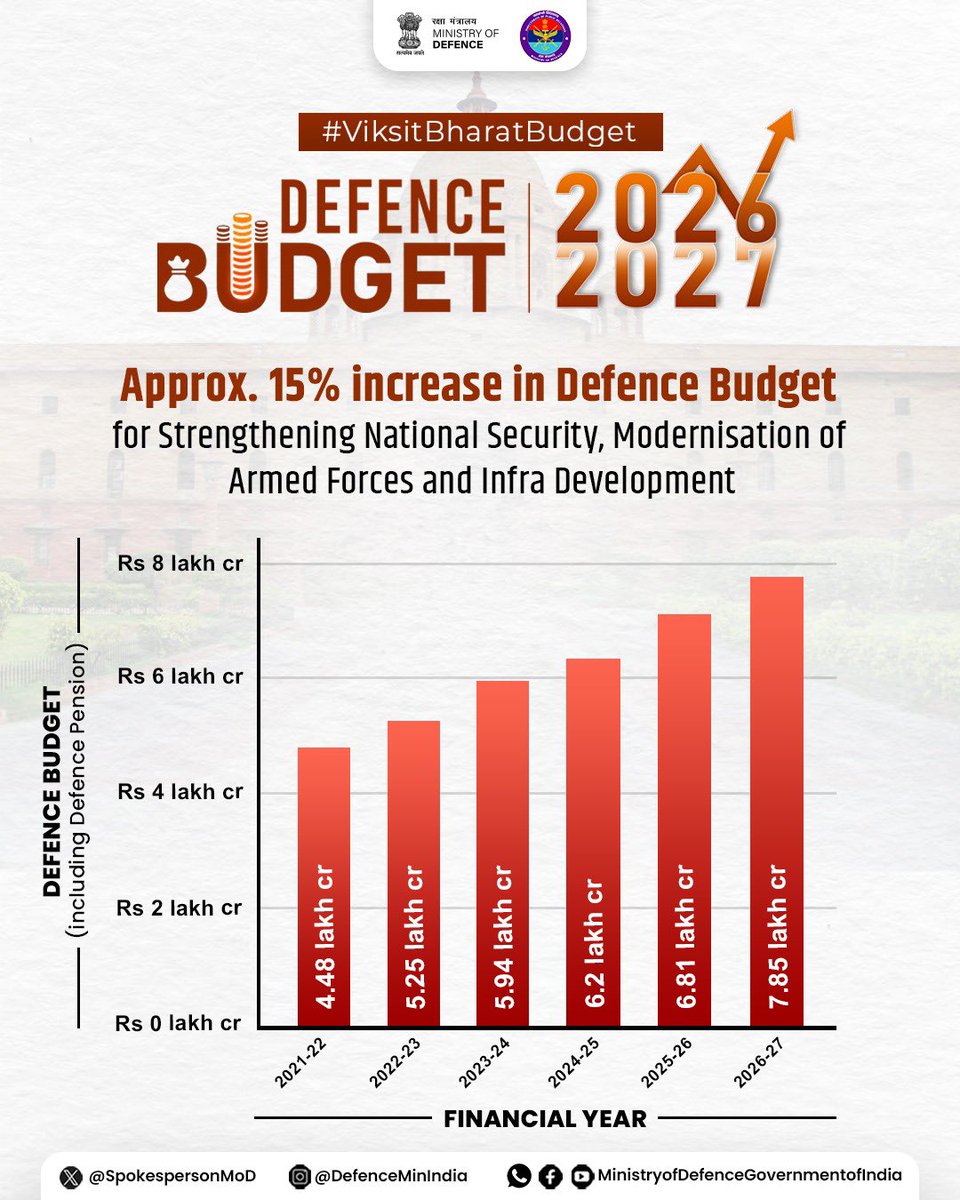
- In the Union Budget 2026, an allocation of approximately ₹7.85 lakh crore has been made for the defence sector, reflecting an increase of about 15 percent compared to the previous financial year. This amount constitutes approximately 14–15 percent of the total Central Government expenditure, clearly indicating that national security remains among the top priorities of the government.
- The most significant aspect of this budget is the increase in capital expenditure, under which approximately ₹2.19 lakh crore has been allocated. About ₹1.85 lakh crore has been earmarked for capital acquisition, which will be used for the procurement of new military equipment, aircraft, naval platforms and advanced surveillance systems. In addition, approximately ₹1.39 lakh crore has been reserved for procurement from domestic defence industries, with the objective of promoting indigenous defence manufacturing.
- The allocation for the Defence Research and Development Organisation (DRDO) has also been increased, which will encourage indigenous technological development, innovation and the creation of advanced defence systems. This allocation is an attempt to reduce import dependency in India’s defence sector and move towards self-reliance.
- In the Union Budget 2026, an allocation of approximately ₹7.85 lakh crore has been made for the defence sector, reflecting an increase of about 15 percent compared to the previous financial year. This amount constitutes approximately 14–15 percent of the total Central Government expenditure, clearly indicating that national security remains among the top priorities of the government.
-
|
Major Highlights of the Defence Budget: An allocation of ₹7.85 lakh crore has been made to the Ministry of Defence in the Union Budget 2026–27, which is the highest among all ministries.
|
Strategic Significance:
-
-
- The real importance of the increase in defence expenditure in Budget-2026 lies in its strategic implications. Traditionally, India’s military structure has been manpower-intensive, where deployment of a large number of troops formed a primary component of defence strategy. However, modern warfare has become technology-driven, where network-centric warfare systems, precision-guided weapons, real-time surveillance and data-based decision-making play a crucial role.
- This budget attempts to move India towards a technology-intensive military framework. Investment in advanced Air Force platforms, naval assets, drone systems and electronic warfare capabilities will strengthen India’s multi-domain warfare capability. Such investment is particularly important for enhancing surveillance capacity along the northern borders and strengthening naval dominance in maritime regions.
- Additionally, increasing emphasis on information warfare and cyber security will prepare India for future hybrid wars. Thus, Budget-2026 is not limited to the procurement of military equipment but represents a step towards building a comprehensive defence strategy.
- The real importance of the increase in defence expenditure in Budget-2026 lies in its strategic implications. Traditionally, India’s military structure has been manpower-intensive, where deployment of a large number of troops formed a primary component of defence strategy. However, modern warfare has become technology-driven, where network-centric warfare systems, precision-guided weapons, real-time surveillance and data-based decision-making play a crucial role.
-
Self-Reliance and Defence Industrial Base:
-
-
- Self-reliance in the defence sector (Atmanirbhar Bharat) has emerged as a major pillar of India’s long-term strategic policy. The allocation reserved for procurement from domestic defence industries in Budget-2026 is a significant initiative in this direction. Its objective is not only to reduce import dependency but also to develop domestic manufacturing capacity and promote defence exports.
- Through private sector participation, defence start-ups and the Public-Private Partnership (PPP) model, India can develop a robust defence industrial base. Moreover, coordination between civilian and military technologies (civil-military fusion) can facilitate the development of dual-use technologies, which will prove beneficial for both economic development and national security.
- If these initiatives are implemented effectively, India will not only be able to meet its defence requirements domestically but will also be able to establish its presence in the global defence export market.
- Self-reliance in the defence sector (Atmanirbhar Bharat) has emerged as a major pillar of India’s long-term strategic policy. The allocation reserved for procurement from domestic defence industries in Budget-2026 is a significant initiative in this direction. Its objective is not only to reduce import dependency but also to develop domestic manufacturing capacity and promote defence exports.
-

Challenges:
-
-
- High Burden of Salary and Pension Expenditure: Although sufficient resources have been allocated to the defence sector in Budget-2026, a significant portion of defence expenditure is still spent on salaries and pensions. This limits the resources available for military modernisation and procurement of new equipment.
- Complexity in Defence Procurement Process: The complexity and long timelines involved in the defence procurement process often hinder the timely availability of modern military equipment, thereby affecting the process of capability creation.
- Limited Technological Capacity of Domestic Industry: The technological capacity of domestic defence industries, particularly in advanced aerospace and electronics sectors, is still not at par with global standards, which affects the goal of self-reliance.
- Limited Investment in Research and Development (R&D): Inadequate investment in defence research and development hampers indigenous technological advancement.
- Technological Dependence: Dependence on foreign countries for advanced military technologies remains a major challenge in achieving self-reliant defence production.
- Need for Institutional and Policy Reforms: These challenges cannot be addressed merely through financial allocation but require institutional reforms and efficient policy-making to accelerate defence modernisation.
- High Burden of Salary and Pension Expenditure: Although sufficient resources have been allocated to the defence sector in Budget-2026, a significant portion of defence expenditure is still spent on salaries and pensions. This limits the resources available for military modernisation and procurement of new equipment.
-
Way Forward:
-
-
- India needs to adopt a long-term strategy for defence modernisation. Policy reforms are essential to ensure a faster and more transparent procurement process, active participation of the private sector and promotion of research and innovation.
- Defence production can be enhanced through Public-Private Partnerships. In addition, structural military reforms such as theatre commands can ensure better utilisation of resources.
- Greater emphasis must also be placed on quality standards and global collaboration to promote defence exports. This will not only provide economic benefits but also strengthen India’s strategic autonomy.
- India needs to adopt a long-term strategy for defence modernisation. Policy reforms are essential to ensure a faster and more transparent procurement process, active participation of the private sector and promotion of research and innovation.
-
Conclusion:
The Union Budget-2026 represents a significant turning point in India’s defence policy, where the focus is not merely on increasing military expenditure but on long-term capability creation. If institutional reforms and technological innovation are given equal importance along with financial resources, India will be able to effectively address future security challenges. Thus, defence expenditure in this budget is not only a means to strengthen national security but also an important step towards enhancing India’s strategic self-reliance and global power status.
| UPSC/PCS Mains Practice Question: Increased expenditure on defence modernisation in Union Budget-2026 is a significant step towards strengthening India’s military capability. Analyse its strategic significance and discuss the structural challenges faced in defence modernisation. |



