
Context:
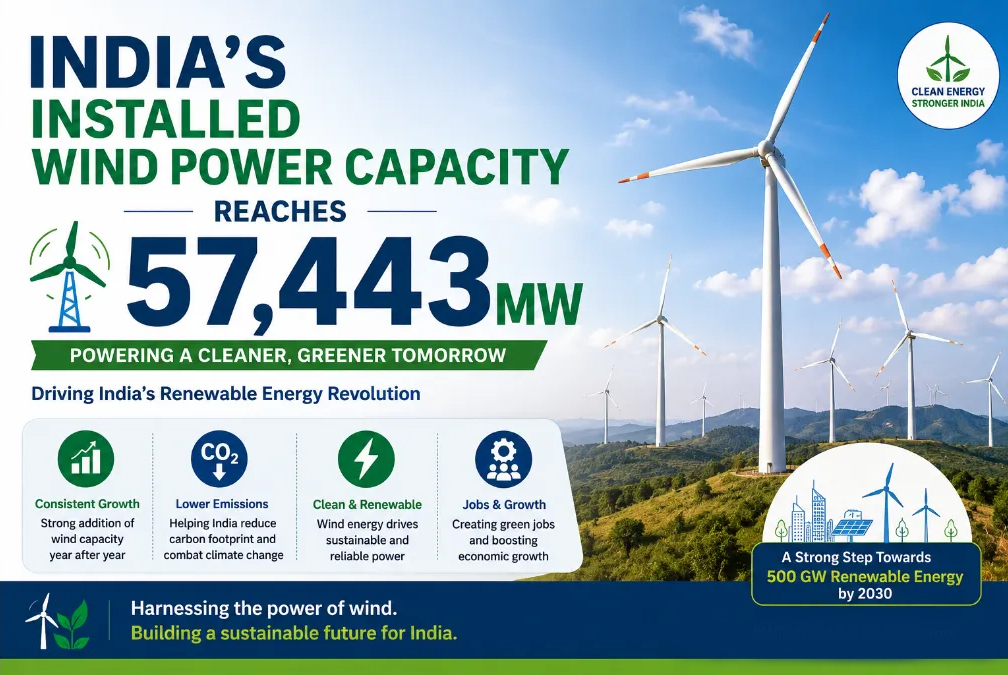
Recently, the Ministry of New and Renewable Energy (MNRE) informed the Lok Sabha that India’s installed wind power capacity reached 57,443 MW as of 30 June 2026.
India’s Wind Power Status:
-
-
- As of 30 June 2026, India's installed wind power capacity stands at 57,443 MW, making it one of the leading renewable energy sources in the country.
- Wind power generation has shown consistent growth over the last three financial years, increasing from 83 billion units in FY 2023–24 and FY 2024–25 to 106 billion units in FY 2025–26.
- The annual capacity addition also increased significantly from 3,253 MW in FY 2023–24 to 4,151 MW in FY 2024–25, and further to a record 6,057 MW in FY 2025–26.
- According to the Global Wind Energy Council (GWEC) Report 2026, India ranked 4th globally in cumulative wind energy installations as of 31 December 2025.
- As of 30 June 2026, India's installed wind power capacity stands at 57,443 MW, making it one of the leading renewable energy sources in the country.
-
State-wise Distribution of Wind Power:
India's wind energy development is concentrated in states with favourable wind resources and long coastlines.
|
State |
Installed Capacity (MW) |
|
Gujarat |
16,086 |
|
Tamil Nadu |
12,273 |
|
Karnataka |
8,896 |
|
Maharashtra |
6,318 |
|
Rajasthan |
5,516 |
|
Andhra Pradesh |
4,461 |
|
Madhya Pradesh |
3,686 |
|
Telangana |
128 |
|
Kerala |
71 |
|
Others |
4 |
|
Total |
57,443 |
Wind Energy Potential in India:
According to the National Institute of Wind Energy (NIWE), India possesses an estimated wind energy potential of:
-
-
- 695.5 GW at a 120-metre hub height.
- Over 1,164 GW at a 150-metre hub height.
- Wind energy is expected to contribute at least 140 GW towards India's target of achieving 500 GW of non-fossil fuel-based installed electricity capacity by 2030.
- 695.5 GW at a 120-metre hub height.
-
Government Initiatives to Promote Wind Energy:
The Government has undertaken several initiatives to accelerate wind energy development, including:
-
-
- Development of transmission infrastructure under the Green Energy Corridor Scheme.
- Waiver of Inter-State Transmission System (ISTS) charges for eligible wind and solar projects.
- Preparation of a transmission expansion plan up to 2030.
- Allowing 100% Foreign Direct Investment (FDI) under the automatic route.
- Notification of Renewable Purchase Obligation (RPO) and Renewable Consumption Obligation (RCO) trajectories up to 2029-30.
- Issuance of revised competitive bidding guidelines for wind, solar, hybrid, and Firm & Dispatch able Renewable Energy (FDRE) projects.
- Launch of the Viability Gap Funding (VGF) Scheme for offshore wind energy projects.
- Notification of the National Repowering and Life Extension Policy for Wind Power Projects, 2023.
- Notification of the Offshore Wind Energy Lease Rules, 2023.
- Issuance of revised guidelines for installation of prototype wind turbine models.
- Introduction of the Approved List of Models and Manufacturers (ALMM) for wind turbines and components.
- Notification of the Green Energy Open Access Rules, 2022.
- Launch of the Green Term Ahead Market (GTAM) to facilitate renewable energy trading.
- Measures to ensure timely payment to renewable energy generators through Letter of Credit (LC) or advance payment mechanisms.
- Development of transmission infrastructure under the Green Energy Corridor Scheme.
-
Challenges:
Despite rapid progress, India's wind energy sector faces several challenges:
-
-
- Land acquisition and project clearances.
- Transmission infrastructure bottlenecks.
- High bird mortality in major wind energy regions, particularly in Rajasthan.
- Repowering of ageing and less efficient wind turbines.
- Variability of wind resources requiring grid balancing and storage solutions.
- Land acquisition and project clearances.
-
Conclusion:
India's wind power sector has witnessed significant growth, with installed capacity reaching 57.44 GW and record annual capacity additions in FY 2025–26. Continued policy support, expansion of transmission infrastructure, offshore wind development, and modernization of existing wind farms will be essential for achieving the country's renewable energy targets and strengthening energy security.



