
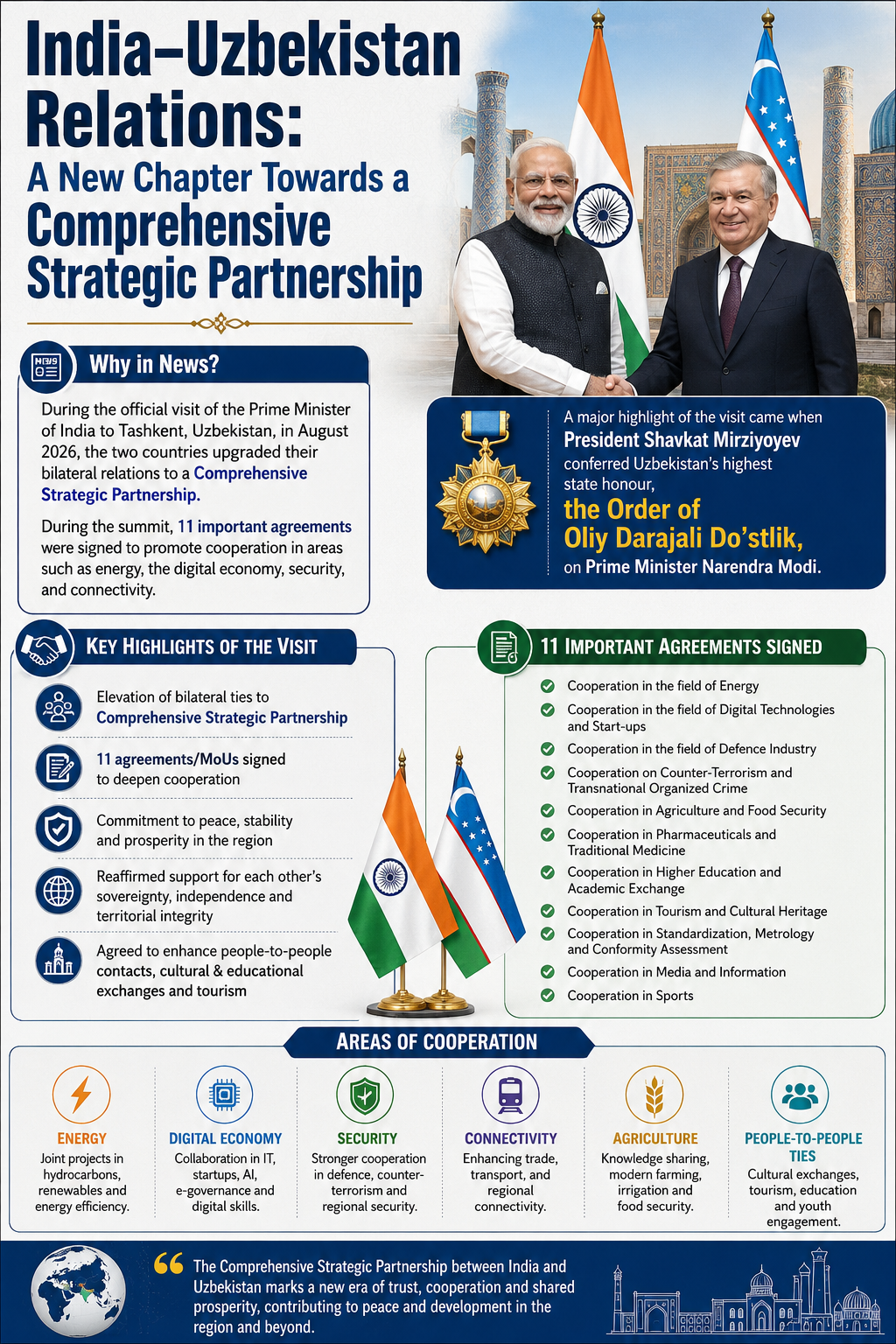
Why in News?
During the official visit of the Prime Minister of India to Tashkent, Uzbekistan, in August 2026, the two countries upgraded their bilateral relations to a Comprehensive Strategic Partnership. During the summit, 11 important agreements were signed to promote cooperation in areas such as energy, the digital economy, security, and connectivity.
Key Highlights of the 2026 Bilateral Summit:
-
-
- Energy Security (Long-Term Uranium Agreement): To strengthen India's civilian nuclear energy sector, the two countries signed a historic agreement for the long-term supply of uranium. This agreement will ensure continuity in uranium supplies from Uzbekistan to India.
- Connectivity and Financial Inclusion (UPI–UZQR Integration): As part of India's major achievements in the field of Digital Public Infrastructure (DPI), an agreement was signed between the National Payments Corporation of India (NPCI) and Uzbekistan's HUMO network. Under this arrangement, India's UPI will be integrated with Uzbekistan's national UZQR code system, promoting digital trade and tourism between the two countries.
- Trade and Investment: In 2025, bilateral trade increased by 33% to $1.3 billion. Both countries have set a target of achieving $5 billion in bilateral trade by 2030. To achieve this objective, negotiations on a Preferential Trade Agreement (PTA) are being accelerated.
- Tourism and Culture: Uzbekistan has announced visa-free travel for Indian citizens for up to 30 days. India has also announced $1 million in assistance for ecological restoration in the Aral Sea Basin, along with technical assistance for the preservation of Buddhist archaeological sites—Fayaz Tepa and Kara Tepa—in Termez.
- Energy Security (Long-Term Uranium Agreement): To strengthen India's civilian nuclear energy sector, the two countries signed a historic agreement for the long-term supply of uranium. This agreement will ensure continuity in uranium supplies from Uzbekistan to India.
-
Historical and Cultural Relations:
The relationship between India and Uzbekistan is rooted in centuries-old Silk Road civilisation and cultural exchanges.
-
-
- Buddhist Heritage: Ancient Buddhist sites such as Fayaz Tepa and Kara Tepa, located in Termez, Uzbekistan, reflect the deep historical and cultural connections between the two countries.
- Cultural Exchanges: During the recent summit, India announced technical assistance for the preservation of these ancient Buddhist sites. In addition, Sufism and Mughal history have contributed to strengthening people-to-people ties between the two countries.
- Buddhist Heritage: Ancient Buddhist sites such as Fayaz Tepa and Kara Tepa, located in Termez, Uzbekistan, reflect the deep historical and cultural connections between the two countries.
-
Strategic Importance of Uzbekistan for India:
-
-
- Gateway to Central Asia: Uzbekistan is geographically located at the heart of Central Asia. It is the only Central Asian country that shares borders with all four other Central Asian countries as well as Afghanistan. Therefore, Uzbekistan is one of the most important links for the success of India's Connect Central Asia Policy.
- Security and Counter-Terrorism Cooperation: Both countries share intelligence to promote stability in Afghanistan and counter religious extremism. The two militaries regularly conduct the Exercise Dustlik, with its 7th edition concluding in April 2026.
- Eurasian Integration: Uzbekistan is an important partner for India in multilateral forums such as the Shanghai Cooperation Organisation (SCO) and the India–Central Asia Summit.
- Gateway to Central Asia: Uzbekistan is geographically located at the heart of Central Asia. It is the only Central Asian country that shares borders with all four other Central Asian countries as well as Afghanistan. Therefore, Uzbekistan is one of the most important links for the success of India's Connect Central Asia Policy.
-
Major Challenges:
-
-
- Geographical Constraints: India does not have direct access to Central Asia because Pakistan does not permit transit routes for Indian connectivity towards the region.
- Slow Progress on Chabahar Port and INSTC: India is working to develop connectivity with Central Asia through Iran's Chabahar Port and the International North–South Transport Corridor (INSTC). However, geopolitical tensions have slowed progress on these connectivity initiatives.
- Growing Chinese Influence: China's economic and infrastructural dominance in Central Asia through the Belt and Road Initiative (BRI) represents a major diplomatic challenge for India.
- Geographical Constraints: India does not have direct access to Central Asia because Pakistan does not permit transit routes for Indian connectivity towards the region.
-
Way Forward:
India needs to further deepen its relations with Uzbekistan by expediting transport connectivity through Chabahar Port. In addition, cooperation should be expanded in emerging areas such as space technology, defence production, and the digital economy (FinTech). These initiatives can help India strengthen its economic and strategic presence in Central Asia and provide a counterbalance to China's growing influence. The 2026 summit is therefore significant not only for advancing the economic interests of India and Uzbekistan but also for strengthening India's strategic presence in the wider Eurasian region.



