
Context:
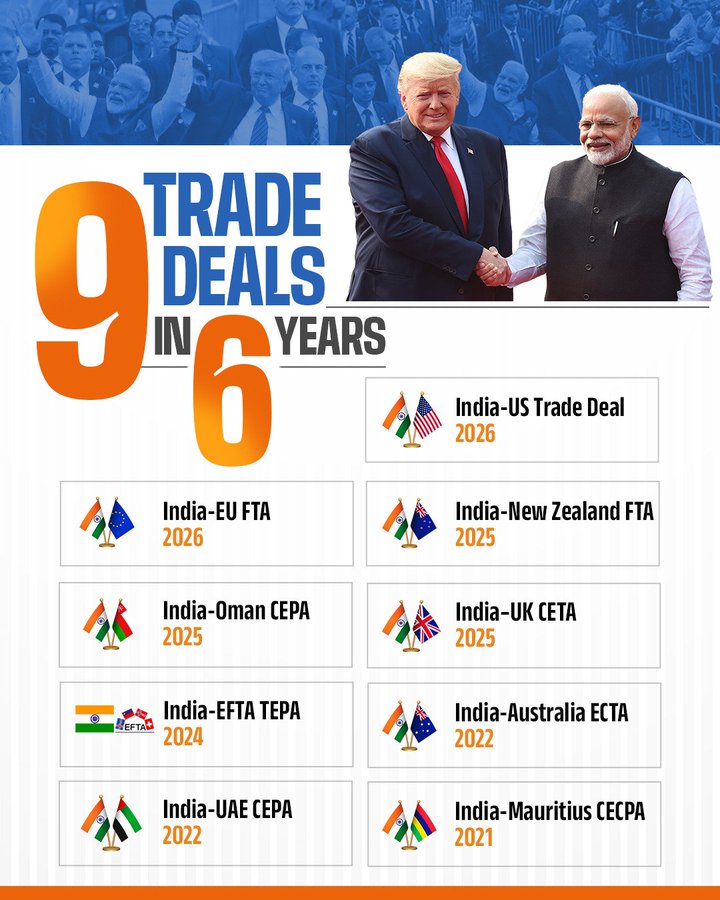
Recently, India and the United States announced a major trade agreement under which U.S. tariffs on Indian goods have been reduced from around 50% to 18%. As part of the arrangement, India agreed to halt purchases of Russian oil and lower trade barriers on U.S. imports, signalling a reset in bilateral economic relations.
Background:
-
-
- In August 2025, the United States imposed punitive duties by raising tariffs on Indian goods to as high as 50%. This included a 25% reciprocal tariff and an additional 25% penalty tariff linked to India’s continued purchase of Russian crude oil.
- The elevated tariffs created uncertainty for Indian exporters across key sectors such as textiles, engineering goods, chemicals, and agricultural products.Under the new understanding, the penalty tariff has been withdrawn, and only the revised reciprocal tariff remains, set at 18%.
- In August 2025, the United States imposed punitive duties by raising tariffs on Indian goods to as high as 50%. This included a 25% reciprocal tariff and an additional 25% penalty tariff linked to India’s continued purchase of Russian crude oil.
-
India–U.S. Trade Overview:
-
-
- Largest Trading Partner: The United States has been India’s largest trading partner, with bilateral trade amounting to approximately USD 131.84 billion in FY 2024–25.
- Trade in Goods and Services: India recorded a healthy trade surplus, with exports to the U.S. valued at USD 86.51 billion and imports at USD 45.33 billion in FY 2024–25.
- Sectoral Composition: Major Indian exports include pharmaceuticals, telecom instruments, precious stones, petroleum products, and ready-made garments.
- Largest Trading Partner: The United States has been India’s largest trading partner, with bilateral trade amounting to approximately USD 131.84 billion in FY 2024–25.
-
Major Export Sectors Set to Benefit:
The reduction in tariffs is expected to significantly enhance the competitiveness of several Indian sectors in the U.S. market:
-
-
- Textiles and Apparel: Previously burdened by high duties, the sector is now poised for renewed demand.
- Gems and Jewellery: Lower tariffs could result in improved valuations and export growth.
- Solar Manufacturing: “Made in India” solar cells and modules gain a cost advantage.
- Engineering Goods: Products such as pumps, compressors, and auto components become more price competitive.
- Textiles and Apparel: Previously burdened by high duties, the sector is now poised for renewed demand.
-
Economic and Strategic Impact of the Deal:
-
-
- Market Reaction: Indian equity markets and the rupee rallied following the announcement, reflecting improved investor confidence.
- Export Competitiveness: Reduced tariffs give Indian exporters a competitive edge over regional rivals such as China, Vietnam, and Bangladesh.
- Broader Engagement: India also committed to increasing imports from the U.S., including energy, defence equipment, and aircraft, as part of a broader commercial engagement framework.
- Market Reaction: Indian equity markets and the rupee rallied following the announcement, reflecting improved investor confidence.
-
Challenges:
Despite the positive announcement, concerns remain regarding the absence of detailed legal texts and sector-wise tariff schedules. Clarity is also required on India’s commitments related to tariff reductions and agricultural market access for U.S. products. Additionally, certain duties, particularly on steel and aluminium may continue to exceed the average 18% rate for specific items.
Conclusion:
The India–U.S. trade deal, reducing tariffs to 18%, marks a significant milestone in bilateral economic relations. It helps ease recent trade tensions and strengthens India’s export prospects. While detailed implementation timelines and sector-specific schedules are awaited, the agreement reflects deepening strategic cooperation across trade, technology and investment, reinforcing the United States’ role as a key economic partner for India.



