
Context:
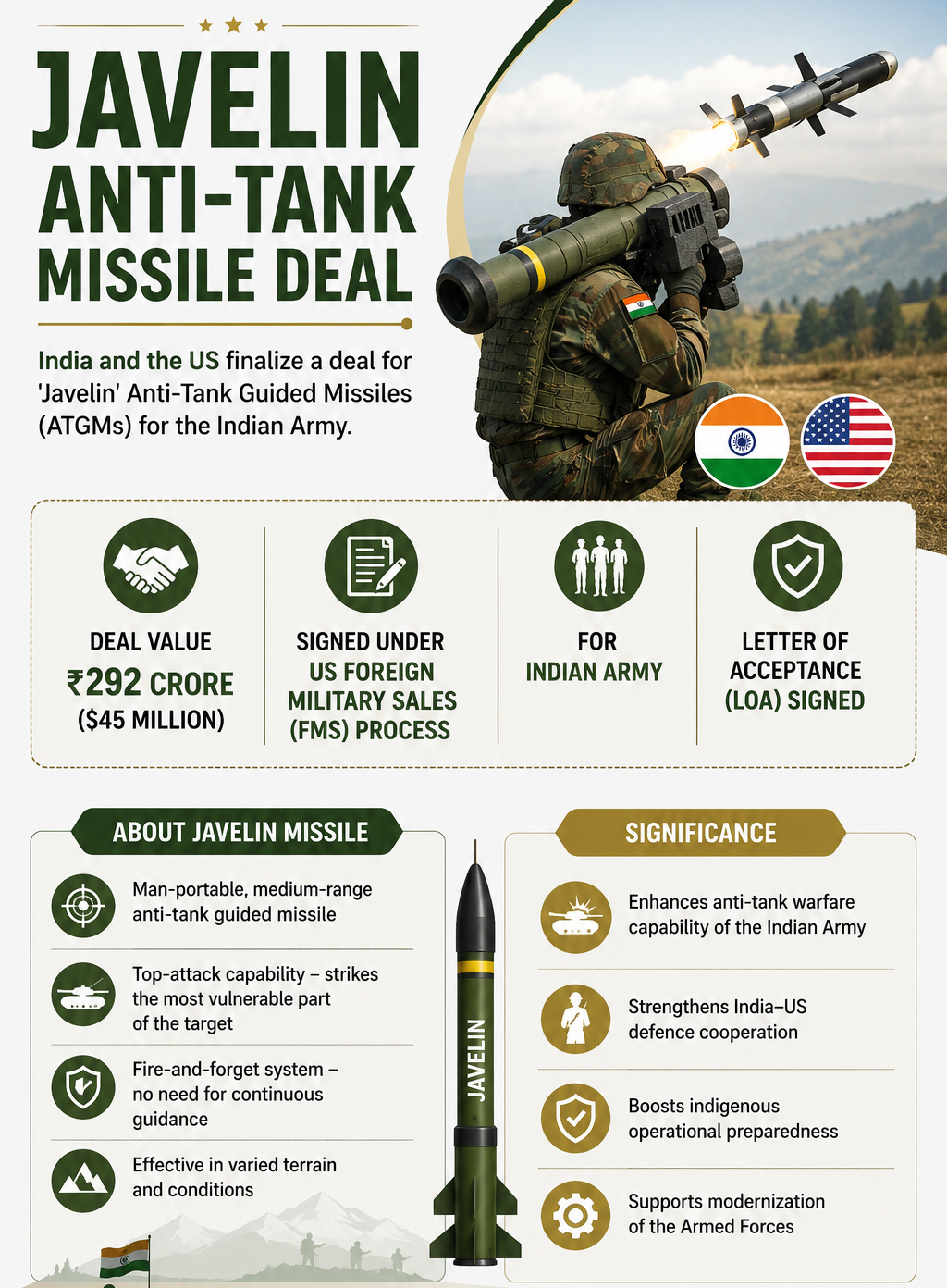
India and the US have recently finalized a deal worth ₹292 crore ($45 million) for 'Javelin' anti-tank guided missiles (ATGMs) for the Indian Army. The Indian Army signed the Letter of Acceptance (LOA) under the US Foreign Military Sales (FMS) process. The US has described this agreement as a significant step towards deepening defense cooperation between the two nations and has linked it to future opportunities for co-production and defense industrial collaboration.
What is the Javelin missile?
-
-
- The FGM-148 Javelin is a man-portable, shoulder-launched, fire-and-forget anti-tank missile system developed by the US. It is primarily designed to destroy tanks, armored vehicles, and other hardened targets. Its key feature is that, once launched, the operator does not need to continuously guide the missile toward the target.
- The Javelin utilizes an infrared seeker and can strike targets in both top-attack and direct-attack modes. In top-attack mode, the missile targets the relatively vulnerable upper section of an armored vehicle, thereby enhancing its effectiveness against modern tanks.
- The FGM-148 Javelin is a man-portable, shoulder-launched, fire-and-forget anti-tank missile system developed by the US. It is primarily designed to destroy tanks, armored vehicles, and other hardened targets. Its key feature is that, once launched, the operator does not need to continuously guide the missile toward the target.
-
Why is it significant for India?
-
-
- The procurement of the Javelin holds special significance in the context of India's security requirements. In mountainous and rugged border regions, a lightweight and portable anti-tank system can boost the combat capabilities of infantry troops. Modern anti-armor capability is crucial for the Indian Army, particularly amidst evolving military dynamics along the borders with China and Pakistan.
- This emergency deal has been finalized in light of the strategic situation that emerged following 'Operation Sindoor' last year and the escalating security challenges along the northern borders. In the initial phase of the agreement, the Indian Army will receive approximately 60 Javelin missile rounds and 16 to 25 lightweight launch units. The first consignment of these weapons is expected to arrive in India by the end of the 2026-27 fiscal year, thereby enhancing the firepower of infantry units deployed at the front lines.
- The procurement of the Javelin holds special significance in the context of India's security requirements. In mountainous and rugged border regions, a lightweight and portable anti-tank system can boost the combat capabilities of infantry troops. Modern anti-armor capability is crucial for the Indian Army, particularly amidst evolving military dynamics along the borders with China and Pakistan.
-
A New Phase in India-US Defense Relations:
-
-
- The Javelin agreement is not limited merely to the procurement of weapons; it opens up opportunities for future collaboration and co-production between the defense industries of both nations. This holds significant potential, aligning with India's 'Make in India' initiative and its priorities regarding self-reliant defense production.
- However, technology transfer—particularly concerning the missile's state-of-the-art seeker technology—remains a significant challenge for actual co-production. While the possibility of co-producing the Javelin in India has been discussed in the past, progress has been hindered by issues related to technology transfer.
-
Strategic Significance:
-
-
- The induction of US Javelin missile technology into the Indian Army will not only fortify India's defense preparedness but also prove instrumental in ensuring regional stability. This strategic defense deal comes at a time when maintaining the balance of power in the Indo-Pacific region has become a shared priority for both nations.
- The Javelin deal also reflects India's multi-source defense procurement policy. While India emphasizes the development of indigenous systems, it simultaneously procures advanced foreign systems to meet immediate operational requirements. This presents the challenge of striking a balance between immediate capability enhancement and long-term self-reliance.
- The induction of US Javelin missile technology into the Indian Army will not only fortify India's defense preparedness but also prove instrumental in ensuring regional stability. This strategic defense deal comes at a time when maintaining the balance of power in the Indo-Pacific region has become a shared priority for both nations.
-
Conclusion:
India has now joined the select club of nations that utilize the Javelin, a move that underscores the country's growing military and diplomatic stature on the global stage. The procurement of the Javelin offers an opportunity to strengthen the Indian Army's anti-armor capabilities while also elevating the India-US defense partnership beyond a mere ‘buyer-seller relationship’ towards technology, industrial collaboration, and co-production.



