
Context:
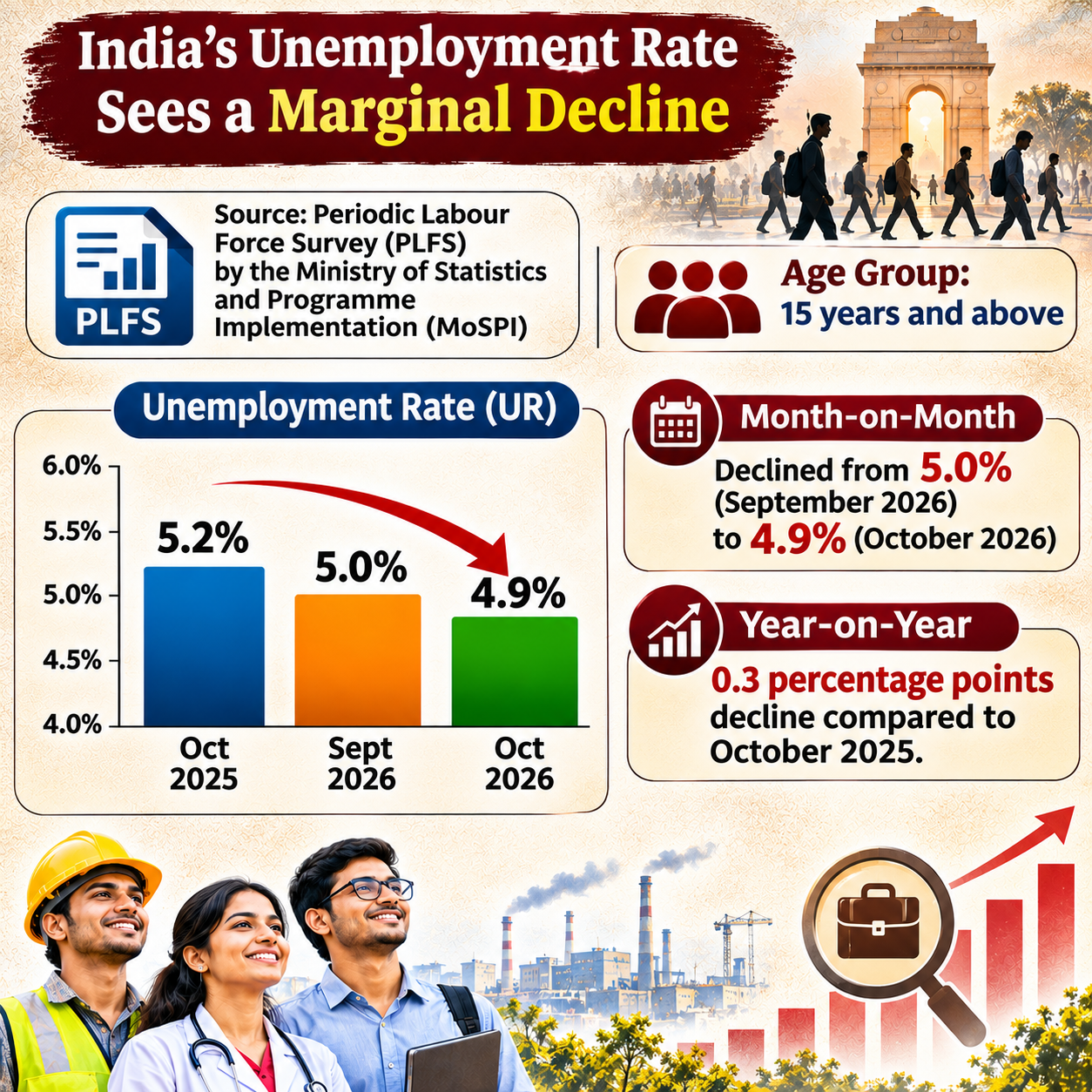
Recently, India’s overall unemployment rate (UR) for persons aged 15 years and above declined marginally to 4.9% in October 2026, compared with 5% in September 2026, according to the latest Periodic Labour Force Survey (PLFS) released by the Ministry of Statistics and Programme Implementation (MoSPI). On a year-on-year basis, the unemployment rate declined by 0.3 percentage points compared with October 2025.
Key Findings of the PLFS:
-
-
- The decline was visible in both rural and urban areas. Rural unemployment fell to 4.2% in October from 4.4% in October 2025, while urban unemployment declined to 6.7% from 7%. Rural male and female unemployment rates stood at 4.3% and 3.8%, respectively.
- However, a significant gender gap persists in urban employment. Urban female unemployment was 8.7%, compared with 6% among urban males. On a year-on-year basis, female unemployment declined from 9.7% to 8.7% in urban areas. Overall female unemployment fell from 5.4% to 5%, while male unemployment declined from 5.1% to 4.9%.
- The Labour Force Participation Rate (LFPR) improved to 55.7% in October from 55.5% in September. Female LFPR increased from 34.6% to 35%. Rural female LFPR rose by 0.6 percentage points to 39.5%, while urban female LFPR remained stable at 25.9%.
- The decline was visible in both rural and urban areas. Rural unemployment fell to 4.2% in October from 4.4% in October 2025, while urban unemployment declined to 6.7% from 7%. Rural male and female unemployment rates stood at 4.3% and 3.8%, respectively.
-
Important Concepts:
-
-
- Unemployment Rate (UR): The percentage of unemployed persons in the total labour force.
- Labour Force Participation Rate (LFPR): The percentage of the population that is either employed or unemployed but actively seeking or available for work.
- Worker Population Ratio (WPR): The percentage of employed persons in the total population.
- Unemployment Rate (UR): The percentage of unemployed persons in the total labour force.
-
Significance of the Findings:
-
-
- The decline in unemployment, alongside an increase in LFPR, indicates a modest improvement in labour-market conditions. The rise in female LFPR, particularly in rural areas, suggests greater participation of women in economic activities.
- However, the higher unemployment rate among urban women highlights persistent barriers such as limited job opportunities, skill mismatches, care responsibilities and gender-based discrimination.
- The decline in unemployment, alongside an increase in LFPR, indicates a modest improvement in labour-market conditions. The rise in female LFPR, particularly in rural areas, suggests greater participation of women in economic activities.
-
Key Challenges:
India continues to face structural unemployment, underemployment, skill mismatch and a high dependence on informal employment. The availability of secure, productive and adequately remunerated jobs remains a concern. Regional disparities and the gender gap in access to employment also require attention.
Way Forward:
India needs to promote labour-intensive manufacturing, strengthen MSMEs and expand employment opportunities in sectors such as textiles, tourism, food processing and construction. Skill development programmes should be aligned with industry requirements. Greater investment in childcare facilities, safe transport, flexible work arrangements and women's entrepreneurship can improve female workforce participation. Formalisation of employment and stronger social-security coverage are equally important.
Conclusion:
The marginal decline in unemployment is a positive development, but the quality, security and inclusiveness of employment remain critical concerns. India's employment strategy must focus not merely on reducing unemployment but also on generating decent, productive and gender-inclusive jobs.



