
Context:
The India–United Kingdom Comprehensive Economic and Trade Agreement (CETA), signed on July 25, 2025, came into force on July 15, 2026. It is one of India’s most important trade agreements in recent years and aims to strengthen economic cooperation between the two countries.
Key Features of CETA:
-
-
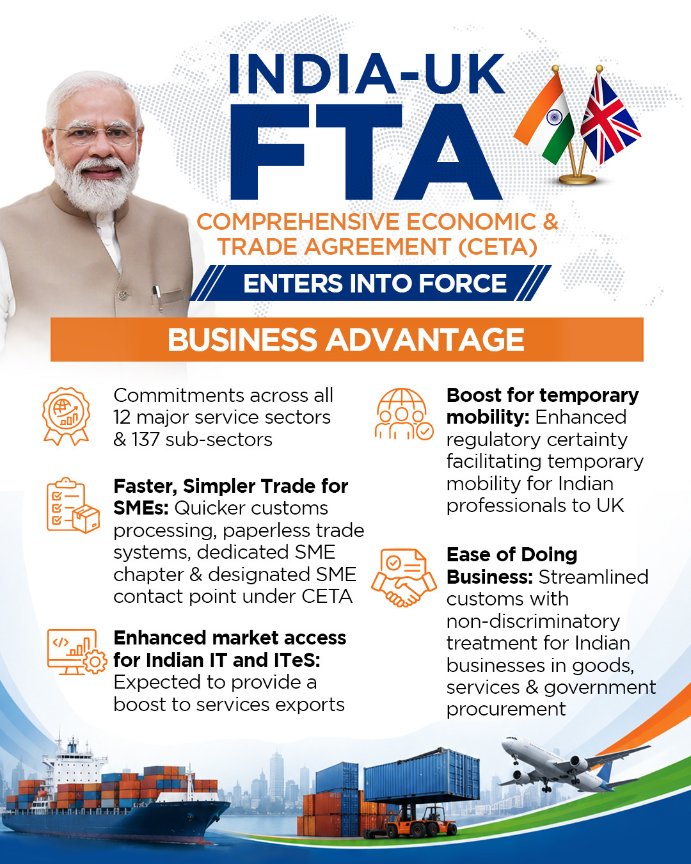
- CETA covers trade in goods and services, digital trade, investment, labour mobility, innovation, government procurement, SMEs, gender inclusion, and environmental cooperation. The agreement removes tariffs on nearly 99% of India’s exports to the U.K., benefiting sectors such as agriculture, textiles, pharmaceuticals, electronics, marine products, engineering goods, chemicals, and leather.
- The U.K. will immediately eliminate tariffs on 96.8% of tariff lines, covering 97.7% of trade value, while India will gradually reduce tariffs across a large share of its imports. The agreement also addresses non-tariff barriers through cooperation on Sanitary and Phytosanitary (SPS) measures and Technical Barriers to Trade (TBT).
- CETA covers trade in goods and services, digital trade, investment, labour mobility, innovation, government procurement, SMEs, gender inclusion, and environmental cooperation. The agreement removes tariffs on nearly 99% of India’s exports to the U.K., benefiting sectors such as agriculture, textiles, pharmaceuticals, electronics, marine products, engineering goods, chemicals, and leather.
-
Sectoral Benefits:
-
-
- Agriculture and Marine Sector: Indian farmers and fisherfolk are expected to benefit from duty-free access for products such as fruits, vegetables, spices, processed foods, shrimp, tuna, and other marine products. Improved SPS cooperation will reduce rejection risks and improve export opportunities.
- Textiles, Engineering and Manufacturing: Tariff elimination on textiles, garments, engineering goods, auto components, and handicrafts will enhance India’s competitiveness in the U.K. market. Labour-intensive MSME clusters in sectors like leather and footwear are expected to gain.
- Pharmaceuticals, Electronics and IT: The agreement improves access for generic medicines, medical devices, smartphones, and digital services. Indian IT and professional service providers will gain from better market access and easier movement of skilled workers.
- Agriculture and Marine Sector: Indian farmers and fisherfolk are expected to benefit from duty-free access for products such as fruits, vegetables, spices, processed foods, shrimp, tuna, and other marine products. Improved SPS cooperation will reduce rejection risks and improve export opportunities.
-
About Double Contribution Convention (DCC):
The DCC addresses the issue of Indian professionals paying social security contributions in both countries. Under the agreement, Indian workers contributing to India’s social security system will be exempt from U.K. social security payments for a specified period. It is expected to benefit over 75,000 Indian workers and 900 employers, particularly in sectors such as IT, healthcare, and professional services.
Government Procurement and Gender Inclusion:
-
-
- CETA opens limited access to India’s government procurement market for eligible U.K. companies, which may improve competition, efficiency, and technology standards. However, sensitive sectors require protection to support the Make in India initiative.
- The agreement also includes India’s first dedicated gender chapter, focusing on supporting women entrepreneurs and increasing their participation in global value chains.
- CETA opens limited access to India’s government procurement market for eligible U.K. companies, which may improve competition, efficiency, and technology standards. However, sensitive sectors require protection to support the Make in India initiative.
-
Challenges:
Despite its benefits, challenges include low FTA utilisation, compliance with international standards, domestic competition, and possible impacts of carbon-related trade measures like the Carbon Border Adjustment Mechanism (CBAM).
Conclusion:
India–U.K. CETA and DCC represent a shift towards inclusive and future-oriented trade agreements. By promoting exports, investment, skilled mobility, and integration into global value chains, the agreements can strengthen India’s economic growth while requiring careful implementation to protect domestic interests.



