
Context:
Recently, India and Switzerland agreed to broaden bilateral cooperation into defence production, military exchanges and civil nuclear energy during Swiss President Guy Parmelin’s state visit to New Delhi. The visit also marked the first anniversary of the India–EFTA Trade and Economic Partnership Agreement (TEPA).
Outcomes of Recent Meeting:
-
-
- Greater cooperation in defence production and military exchanges.
- Expansion of civil nuclear cooperation.
- Migration and Mobility Partnership to facilitate legal migration and professional mobility.
- Young Professionals Scheme for skilled youth exchanges.
- Cooperation in tunnelling, ropeways and electric mobility.
- Joint research in health, clean energy and space.
- Support for deep-tech startups and academia-industry collaboration.
- Greater coordination on ethical AI governance.
- Greater cooperation in defence production and military exchanges.
-
About India–Switzerland Relations:
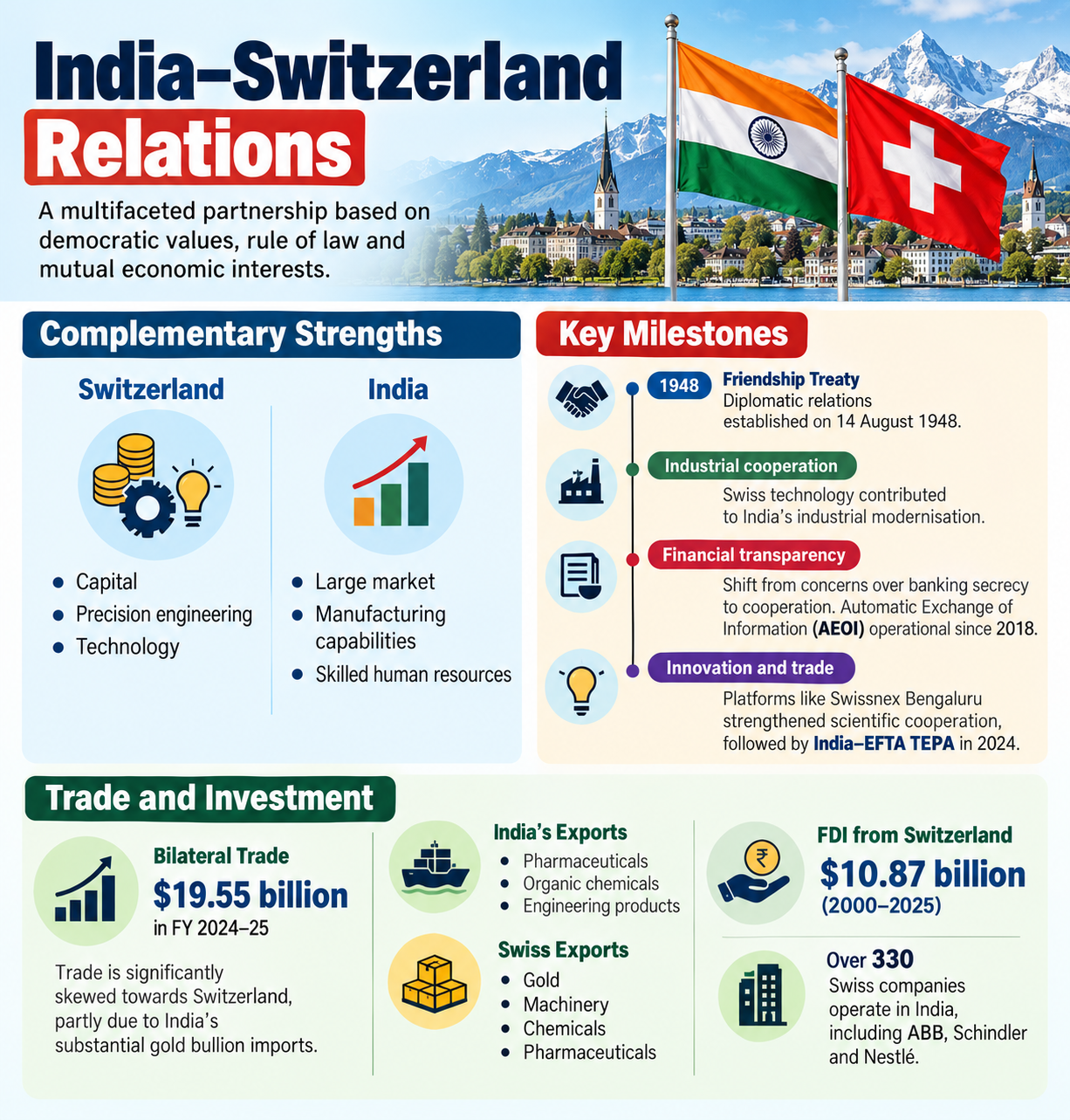
India–Switzerland relations are a multifaceted partnership based on democratic values, rule of law and mutual economic interests. Switzerland contributes capital, precision engineering and technology, while India offers a large market, manufacturing capabilities and skilled human resources.
Historical Evolution:
-
-
- 1948 Friendship Treaty: Diplomatic relations were established on 14 August 1948.
- Industrial cooperation: Swiss technology contributed to India’s industrial modernisation, including early railway and engineering projects.
- Financial transparency: Concerns over banking secrecy gradually shifted towards cooperation against tax evasion. The Automatic Exchange of Information (AEOI) became operational in 2018.
- Innovation and trade: Platforms such as Swissnex Bengaluru strengthened scientific cooperation, followed by the signing of India–EFTA TEPA in 2024.
- 1948 Friendship Treaty: Diplomatic relations were established on 14 August 1948.
-
Current Trade and Investment:
-
-
- Switzerland is an important economic partner, with bilateral trade of around $19.55 billion in FY 2024–25. However, trade is significantly skewed towards Switzerland, partly because of India's substantial gold bullion imports.
- India exports pharmaceuticals, organic chemicals and engineering products, while Swiss exports include gold, machinery, chemicals and pharmaceuticals.
- Switzerland is also a major FDI source, with about $10.87 billion invested during 2000–2025 and over 330 Swiss companies operating in India, including ABB, Schindler and Nestlé.
- Switzerland is an important economic partner, with bilateral trade of around $19.55 billion in FY 2024–25. However, trade is significantly skewed towards Switzerland, partly because of India's substantial gold bullion imports.
-
Key Challenges:
-
-
- Bilateral Investment Treaty (BIT) Impasse: Differences persist over Investor-State Dispute Settlement (ISDS). Switzerland favours international arbitration, whereas India's Model BIT gives greater importance to exhausting domestic remedies.
- Pharmaceutical IPR: Swiss pharmaceutical interests seek stronger intellectual-property protection, while India seeks to safeguard affordable generic medicines and public-health concerns.
- Defence Export Neutrality: Switzerland’s neutrality and war-material regulations can restrict defence exports, technology transfers and re-exports.
- Talent Mobility: Existing mobility pathways need to better reflect India's large pool of skilled professionals.
- Bilateral Investment Treaty (BIT) Impasse: Differences persist over Investor-State Dispute Settlement (ISDS). Switzerland favours international arbitration, whereas India's Model BIT gives greater importance to exhausting domestic remedies.
-
Conclusion:
India–Switzerland relations are transitioning from traditional banking and trade cooperation towards technology, talent, innovation and strategic partnership. Strengthening this relationship can support India’s goals of technological advancement, resilient supply chains, sustainable infrastructure and high-quality employment.



