
Context:
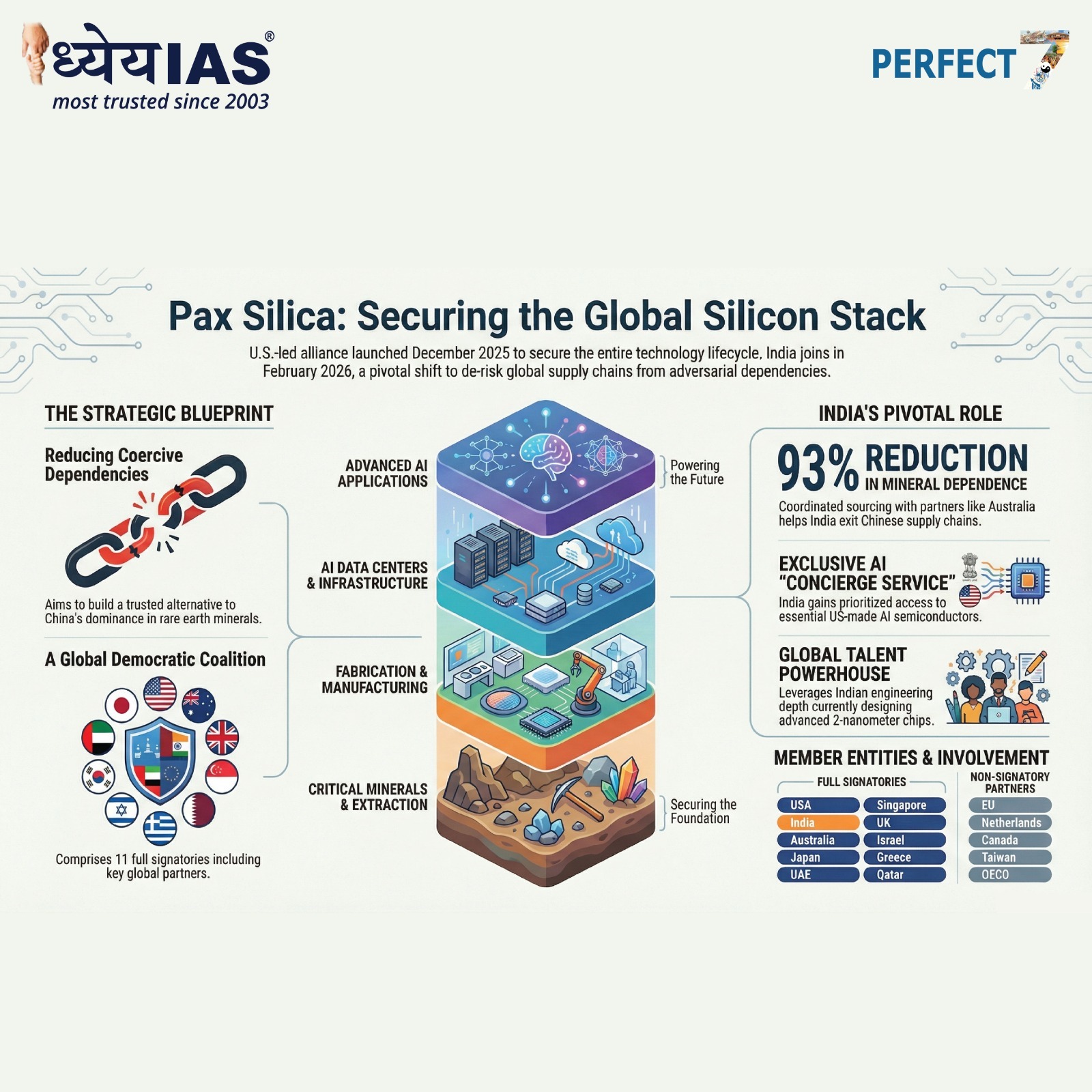
Recently, India formally signed the Pax Silica Declaration on the sidelines of the AI Impact Summit held in New Delhi. This marks India’s entry into a United States–led strategic initiative aimed at building secure and resilient supply chains for artificial intelligence (AI), semiconductors, and critical minerals.
About Pax Silica:
-
-
- Pax Silica was launched in late 2025 as a consortium of nations committed to strengthening technological cooperation and supply chain resilience among “trusted partners,” while addressing geopolitical vulnerabilities in critical technology sectors.
- The name Pax Silica combines “Pax” (Latin for peace) and “Silica” (a fundamental material used in semiconductor manufacturing), symbolising an alliance centered on technology sovereignty and supply chain security.
- It is conceived as a coalition of capabilities focused on ensuring resilient supply chains for AI infrastructure, semiconductor fabrication, critical minerals, and other advanced technologies.
- Initially comprising countries such as Australia, Japan, Israel, South Korea, the United Kingdom, the UAE, Singapore, Qatar, and Greece, India’s inclusion significantly expands the coalition’s geopolitical and economic footprint.
- Pax Silica was launched in late 2025 as a consortium of nations committed to strengthening technological cooperation and supply chain resilience among “trusted partners,” while addressing geopolitical vulnerabilities in critical technology sectors.
-
Strategic Significance:
-
-
- Technological Competition with China: Pax Silica is widely perceived as a strategic initiative to counter China’s dominance in global technology supply chains—particularly in critical minerals processing, semiconductor fabrication, and AI technologies.
- Economic and Security Framework: The pact emphasizes collaborative research, coordinated investments, and supply chain resilience by integrating raw materials, manufacturing ecosystems, and AI development platforms across partner nations.
- Trusted Technology Ecosystem: The initiative seeks to reduce dependence on potentially adversarial sources of critical technologies, thereby safeguarding the “commanding heights” of the global digital economy among like-minded democracies.
- Technological Competition with China: Pax Silica is widely perceived as a strategic initiative to counter China’s dominance in global technology supply chains—particularly in critical minerals processing, semiconductor fabrication, and AI technologies.
-
India’s Domestic and Geopolitical Interests:
-
-
- Technological Self-Reliance: India’s participation aligns with national initiatives such as Atmanirbhar Bharat, the National Critical Mineral Mission, and the India Semiconductor Mission, all of which aim to strengthen domestic technological capabilities and manufacturing ecosystems.
- Talent and Innovation Base: India’s vast engineering talent pool and growing semiconductor design ecosystem are recognized as strategic assets that complement the coalition’s objectives.
- Supply Chain Diversification: Membership provides India with an opportunity to diversify its technology supply chains and reduce reliance on any single external partner, particularly in a global environment where access to infrastructure and raw materials is central to future industries.
- Technological Self-Reliance: India’s participation aligns with national initiatives such as Atmanirbhar Bharat, the National Critical Mineral Mission, and the India Semiconductor Mission, all of which aim to strengthen domestic technological capabilities and manufacturing ecosystems.
-
Geopolitical Implications:
-
-
- Strengthening India–US Strategic Ties: India’s engagement with Pax Silica deepens its strategic partnership with the United States, potentially creating avenues for expanded cooperation in trade, technology transfer, and joint research and development.
- Alignment with Democratic Technology Norms: The alliance promotes governance frameworks grounded in transparency, ethical AI practices, and secure semiconductor standards, aligning India with countries advocating democratic norms in global technology governance.
- Strengthening India–US Strategic Ties: India’s engagement with Pax Silica deepens its strategic partnership with the United States, potentially creating avenues for expanded cooperation in trade, technology transfer, and joint research and development.
-
Conclusion:
India’s signing of the Pax Silica Declaration during the AI Impact Summit in New Delhi marks a significant milestone in contemporary technology diplomacy. It reflects not only deeper collaboration with the United States and other trusted partners but also India’s aspiration to play a central role in shaping secure, democratic, and resilient technology and supply chain architectures in the 21st century.



