
India Seeks Full Membership of IEA: Implications & Challenges
Context:
At the recent International Energy Agency (IEA) Ministerial Meeting in Paris, the agency acknowledged progress on India’s formal request for full membership of the organisation — a significant development in global energy governance. India has been an associate member since 2017 and has now pushed for full member status to deepen its engagement and take part in decision-making.
About the International Energy Agency (IEA):
-
-
- Founded: 1974, in response to the global oil crisis following the 1973 Arab oil embargo
- Purpose: Initially to co-ordinate oil supply security among major consumer nations; today it also focuses on energy transitions, climate change mitigation, renewables, and critical minerals.
- Membership Framework: Originally limited to members of the Organisation for Economic Co-operation and Development (OECD).
- Associate Membership: Since 2015, non-OECD countries — including India — can join as associate members but without full voting rights.
- Founded: 1974, in response to the global oil crisis following the 1973 Arab oil embargo
-
Challenges:
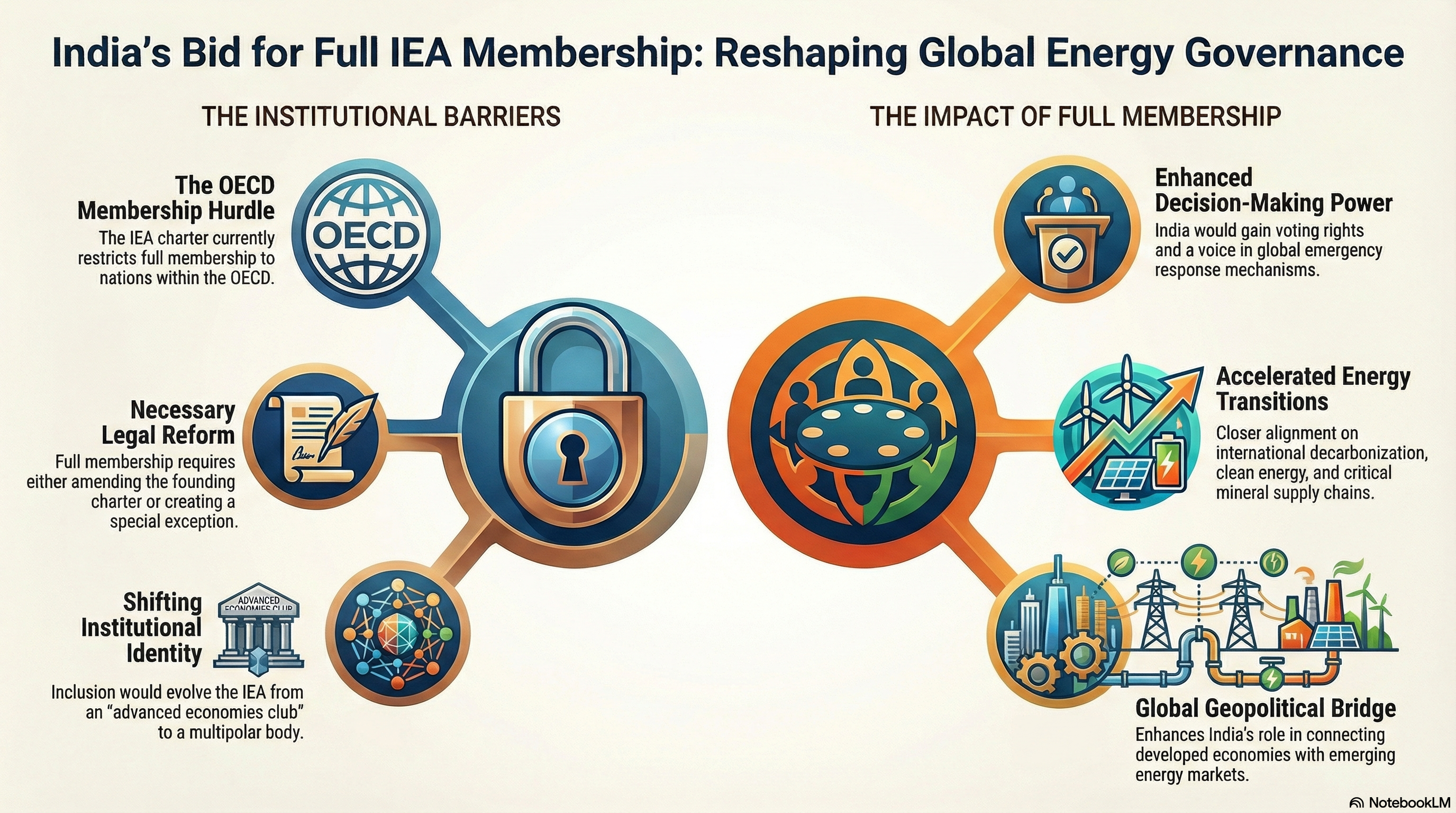
India’s request for full membership faces institutional and legal hurdles. The two main challenges are:
-
-
- The OECD Membership Requirement:
- Implication: The IEA must either
- Amend its charter to expand eligibility beyond the OECD framework, or
- Create a special exception allowing India (and possibly others like Brazil) to become full members.
- Amend its charter to expand eligibility beyond the OECD framework, or
- Both options require consensus among existing IEA members, making the process legally and politically complex rather than procedural.
- The OECD Membership Requirement:
-
Institutional and Geopolitical Considerations:
-
-
- Institutional Identity: IEA has historically been perceived as a consumers’ club of advanced economies; broadening full membership alters this character and influences decision-making balances.
- Geopolitical Dynamics: Inclusion of major Global South energy powers like India and Brazil signals a shift toward a multipolar energy architecture. Some current members may view this as diluting Western/advanced economy dominance, necessitating careful diplomacy.
- Institutional Identity: IEA has historically been perceived as a consumers’ club of advanced economies; broadening full membership alters this character and influences decision-making balances.
-
Significance of India’s Potential Full Membership:
-
-
- If India successfully transitions from associate to full member, it would have wide-ranging implications:
- Energy Governance: Strengthens India’s voice in shaping global energy policies and emergency response mechanisms.
- Global Energy Transitions: Aligns India more closely with international efforts on decarbonisation, clean energy, and critical mineral supply chains.
- Geopolitical Influence: Enhances India’s role as a bridge between developed economies and emerging markets in global energy dialogue.
- Energy Governance: Strengthens India’s voice in shaping global energy policies and emergency response mechanisms.
- This evolution reflects the changing global energy landscape, where non-OECD countries now account for a large share of global energy demand and influence.
- If India successfully transitions from associate to full member, it would have wide-ranging implications:
-
Conclusion:
India’s bid for full IEA membership is more than an application — it represents a push to reform legacy global institutions to reflect contemporary energy realities. While the request has gained significant traction and support, the legal constraint of OECD-only membership and the necessity for broad consensus remain key obstacles. The outcome will not only shape India’s energy diplomacy but also influence how global energy governance adapts to a multipolar world.



