
Context:
In the Union Budget 2026, the Government of India sanctioned the establishment of two new advanced telescopes in Ladakh, the National Large Solar Telescope (NLST) and the National Large Optical–Near Infrared Telescope (NLOT) along with the upgradation of the existing Himalayan Chandra Telescope (HCT). The move is being seen as a transformative step for India’s observational astronomy capabilities.
About the National Large Solar Telescope (NLST):
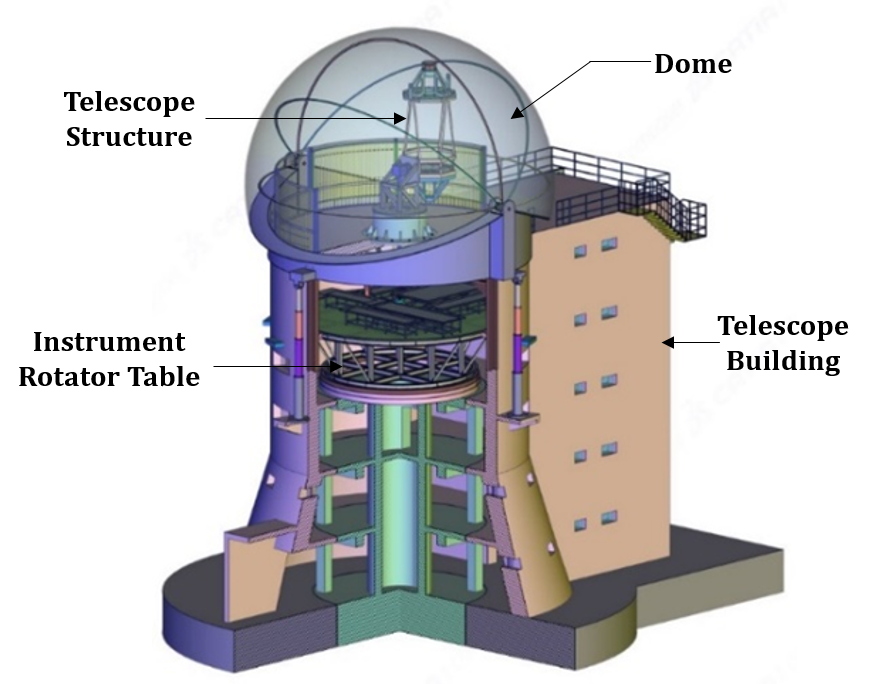
The NLST will be a 2-metre aperture solar telescope to be built in the Merak region near Pangong Tso. It will operate in the visible and near-infrared wavelengths.
Significance:
-
-
- Study of solar magnetism and dynamics
- Monitoring solar flares and energetic events
- Mapping space weather, crucial for satellite protection and space missions
- Complementing India’s space-based solar mission Aditya-L1
- The NLST will become India’s third ground-based solar observatory after Kodaikanal and Udaipur. Its high-altitude location ensures clearer solar imaging with minimal atmospheric distortion.
- Study of solar magnetism and dynamics
-
About the National Large Optical–Near Infrared Telescope (NLOT):
The NLOT will be a 13.7-metre segmented mirror telescope, making it one of the largest optical–infrared telescopes in the world.
-
-
- Key Features:
- 90 hexagonal mirror segments forming a unified primary mirror
- Located in Hanle’s high-altitude, cold, and dry environment
- Minimal atmospheric diffraction, enabling sharper images
- 90 hexagonal mirror segments forming a unified primary mirror
- Research Potential:
- Study of exoplanets
- Stellar and galactic evolution
- Supernovae and transient phenomena
- Clues about the origin of the universe
- Study of exoplanets
- India’s experience in the Thirty Meter Telescope (TMT) project strengthens its technical capacity to build such advanced systems.
- Key Features:
-
Why Ladakh is Ideal for Astronomy:
-
-
-
- High altitude (~4,500 metres)
- Thin, dry atmosphere
- Minimal light pollution
- Dark Sky Reserve status
- High altitude (~4,500 metres)
- These conditions reduce atmospheric distortion and enhance observational precision. Ladakh, particularly Hanle, already hosts the Indian Astronomical Observatory and has been designated India’s first Dark Sky Reserve, making it an ideal site for high-precision astronomical observations.
-
-
Strategic and Scientific Significance:
-
-
- Positions India as a leader in heliophysics and deep-space astronomy
- Enhances India’s contribution to Global South scientific research
- Ensures preferential observation time for Indian scientists
- Strengthens indigenous technological capabilities in advanced optics and precision engineering
- Boosts space security through improved space-weather forecasting
- Positions India as a leader in heliophysics and deep-space astronomy
-
Conclusion:
The establishment of the NLST and NLOT, along with the upgradation of the HCT, marks a paradigm shift in India’s astronomical infrastructure. These facilities will not only deepen our understanding of the Sun and the universe but also enhance India’s scientific autonomy, global standing, and strategic preparedness in space sciences. Ladakh is poised to emerge as one of the world’s premier hubs for ground-based astronomy.



