
Context:
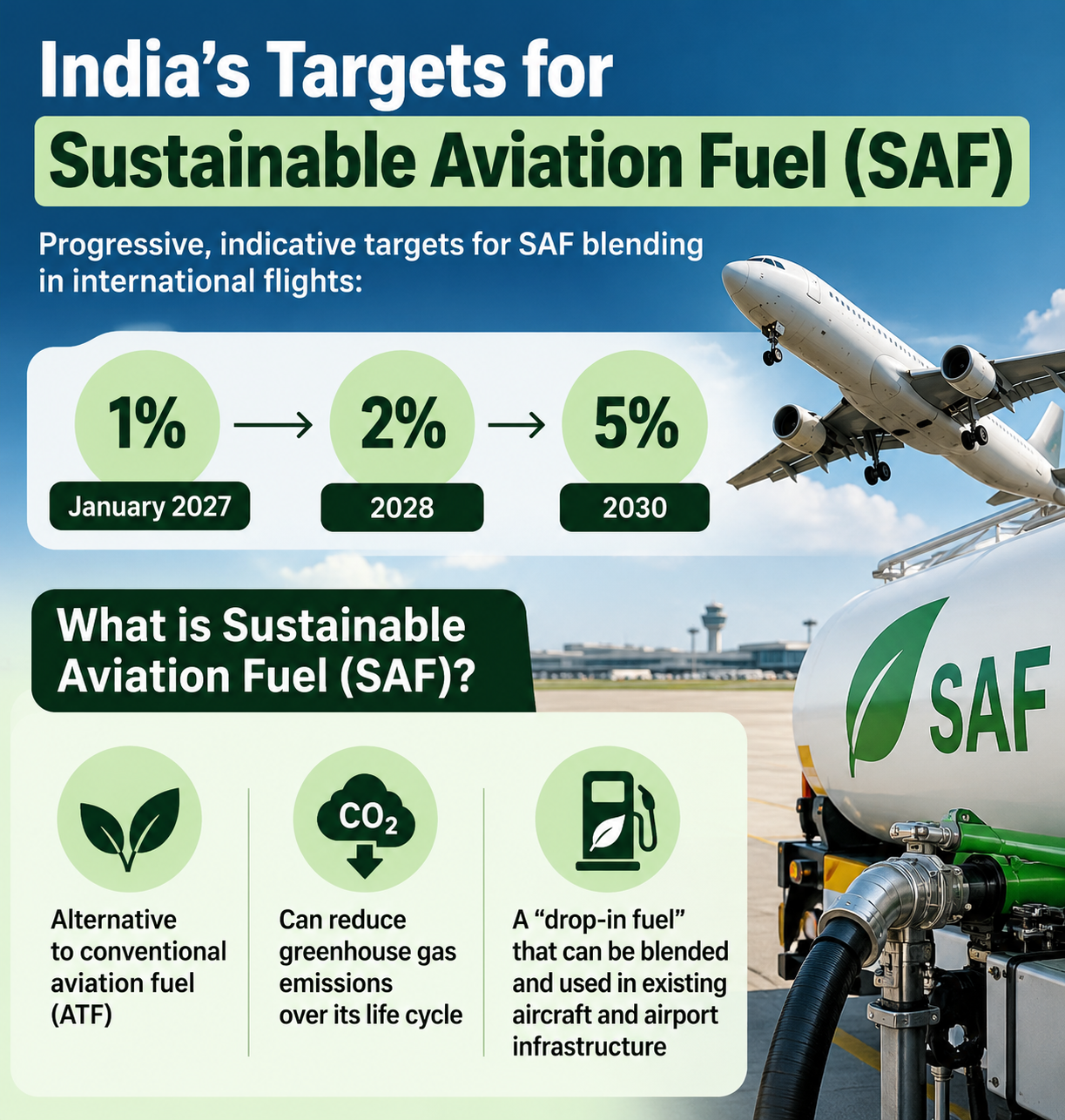
Recently, The Government of India has outlined progressive, indicative targets for Sustainable Aviation Fuel (SAF) blending in international flights: 1% from January 2027, 2% from 2028 and 5% by 2030. The initiative aims to reduce aviation-related emissions and promote cleaner fuels.
What is Sustainable Aviation Fuel (SAF)?
-
-
- SAF is an alternative to conventional fossil-based Aviation Turbine Fuel (ATF). It is produced from sustainable feedstocks and can reduce greenhouse gas emissions over its life cycle.
- SAF is a “drop-in fuel”, meaning it can be blended with conventional jet fuel and used in compatible aircraft engines and existing airport fuel infrastructure without major modifications, subject to applicable fuel specifications.
- SAF is an alternative to conventional fossil-based Aviation Turbine Fuel (ATF). It is produced from sustainable feedstocks and can reduce greenhouse gas emissions over its life cycle.
-
Key Features of India's SAF Initiative:
-
- Progressive targets: 1% blending in 2027, 2% in 2028 and 5% by 2030.
- Initial scope: The rollout focuses on international flights rather than immediately applying uniformly to domestic flights.
- Regulatory framework: In April 2026, the government issued a notification recognising SAF under the relevant ATF regulatory framework to facilitate blending.
- Domestic production: Indian Oil Corporation (IOC) and Bharat Petroleum Corporation Limited (BPCL) are among the public-sector companies pursuing SAF production pathways, including those using used cooking oil.
- Progressive targets: 1% blending in 2027, 2% in 2028 and 5% by 2030.
Feedstocks and Production:
-
-
- SAF can be produced from used cooking oil (UCO), waste fats, agricultural residues, municipal and industrial waste, and alcohol-to-jet (ATJ) pathways. Sustainable production depends on feedstock availability, conversion technology and life-cycle emissions.
- Using waste materials can support circular-economy objectives while reducing dependence on fossil fuels. However, feedstock sustainability and traceability are essential to prevent environmental damage.
- SAF can be produced from used cooking oil (UCO), waste fats, agricultural residues, municipal and industrial waste, and alcohol-to-jet (ATJ) pathways. Sustainable production depends on feedstock availability, conversion technology and life-cycle emissions.
-
Significance of SAF Blending:
-
-
- Environmental benefits: SAF can reduce life-cycle greenhouse gas emissions by up to 80% in certain pathways, depending on feedstock and production methods. This can help decarbonise aviation, a sector that is difficult to electrify.
- International commitments: The Carbon Offsetting and Reduction Scheme for International Aviation (CORSIA), developed by the International Civil Aviation Organization (ICAO), is a global market-based mechanism addressing CO₂ emissions from international aviation. Eligible SAF can contribute to airlines’ emissions-reduction efforts under its rules.
- Energy security: Domestic SAF production could diversify India's aviation fuel sources and reduce exposure to fossil-fuel price volatility.
- Economic opportunities: SAF can create opportunities in waste management, bio-refining, agricultural residue utilisation, research and green-energy investment.
- Environmental benefits: SAF can reduce life-cycle greenhouse gas emissions by up to 80% in certain pathways, depending on feedstock and production methods. This can help decarbonise aviation, a sector that is difficult to electrify.
-
Challenges:
Major challenges include the higher cost of SAF compared with conventional ATF, limited commercial-scale production, inadequate collection of waste feedstocks, certification requirements and the need for investment in supply chains. Poorly managed feedstock production could also create competition for land, water and food crops.
Way Forward:
India should promote research and development, incentivise sustainable domestic production, establish reliable certification and monitoring systems, and strengthen cooperation among fuel producers, airlines and regulators. A phased approach can balance emission reduction with affordability and airline competitiveness.
Conclusion:
India's SAF initiative represents a step towards cleaner aviation, improved energy security and climate-action goals. Its success will depend on affordable production, sustainable feedstocks, effective regulation and credible emissions accounting.