
India–Russia RELOS Pact
Context:
Recently, India and Russia operationalised the Reciprocal Exchange of Logistics Agreement (RELOS) after its signing in February 2025 and subsequent ratification by Russia. The agreement marks a significant evolution in bilateral defence engagement, moving beyond traditional arms transfers to deeper operational cooperation.
Key Provisions of RELOS:
-
-
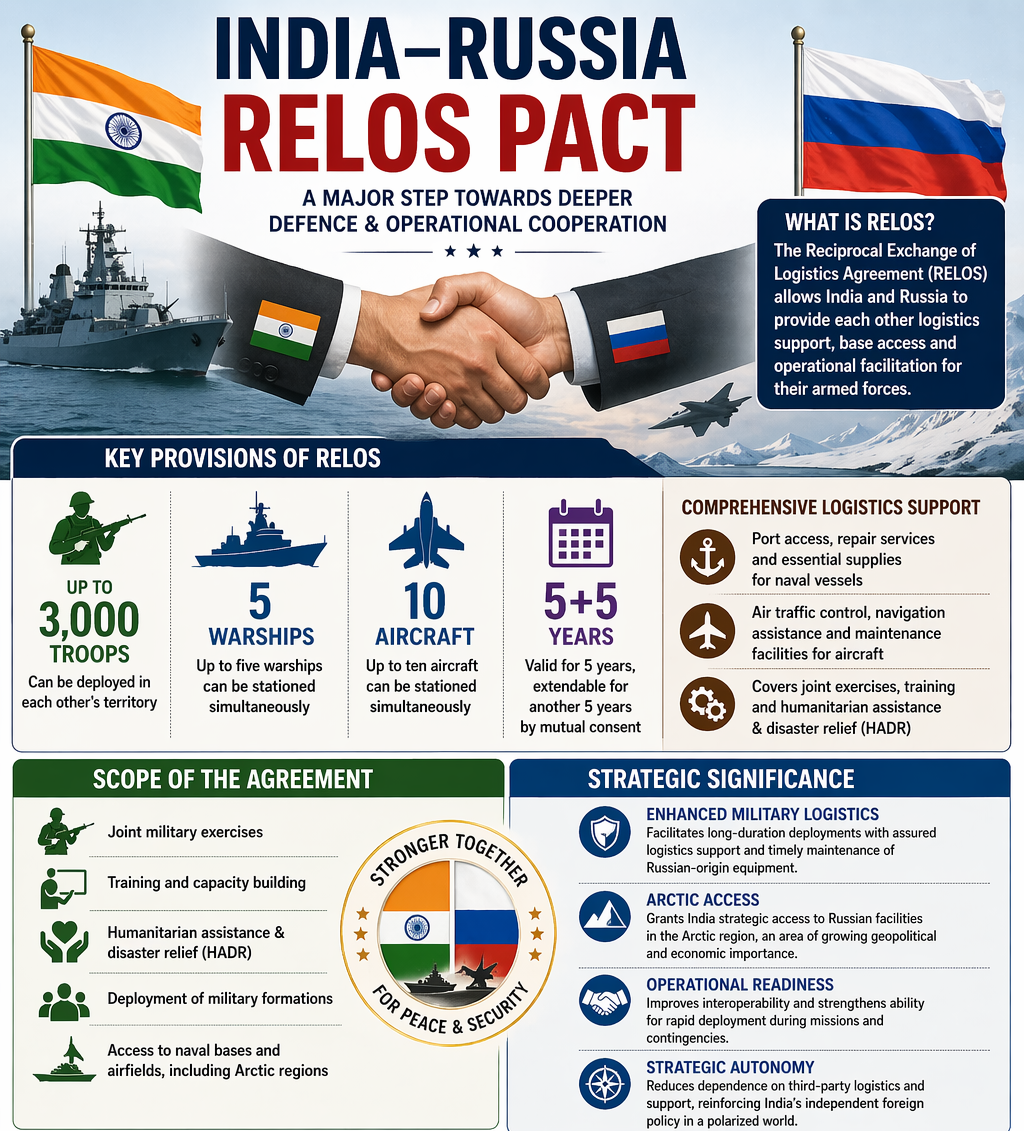
- The Reciprocal Exchange of Logistics Agreement (RELOS) between India and Russia allows for the deployment of up to 3,000 troops in each other’s territory, along with the simultaneous stationing of up to five warships and ten aircraft.
- The agreement is valid for an initial period of five years and may be extended for another five years with mutual consent. It provides comprehensive logistics support, including port access, repair services, and essential supplies for naval vessels, as well as air traffic control, navigation assistance, and maintenance facilities for aircraft.
- Additionally, the pact encompasses provisions for joint military exercises, training initiatives, and humanitarian assistance and disaster relief operations, thereby enhancing operational cooperation between the two countries.
- The Reciprocal Exchange of Logistics Agreement (RELOS) between India and Russia allows for the deployment of up to 3,000 troops in each other’s territory, along with the simultaneous stationing of up to five warships and ten aircraft.
-
Scope of the Agreement:
-
-
- Joint military exercises
- Training and capacity building
- Humanitarian assistance & disaster relief (HADR)
- Deployment of military formations
- Access to naval bases and airfields, including Arctic regions
- Joint military exercises
-
Strategic Significance:
-
-
- Enhanced Military Logistics: The agreement between India and Russia facilitates long-duration military deployments by providing assured access to logistics support, while also ensuring timely maintenance and servicing of Russian-origin equipment used by India.
- Arctic Access: It enables India to gain strategic access to Russian facilities in the Arctic region, enhancing its presence in an area of growing geopolitical and economic importance.
- Operational Readiness: The pact improves interoperability between the armed forces of both countries and strengthens their ability for rapid deployment during missions and contingencies.
- Strategic Autonomy: By reducing dependence on third-party logistics and support, the agreement reinforces India’s ability to pursue an independent foreign policy amid increasing global polarization.
- Enhanced Military Logistics: The agreement between India and Russia facilitates long-duration military deployments by providing assured access to logistics support, while also ensuring timely maintenance and servicing of Russian-origin equipment used by India.
-
India–Russia Defence Relations:
-
-
- India and Russia share a “Special and Privileged Strategic Partnership”, with defence cooperation as a key pillar.
- Military-Technical Cooperation is significant, as nearly 60–70% of India’s military equipment is of Russian/Soviet origin, including systems like the S-400 Triumf, T-90 Tank, and Su-30MKI.
- The partnership has evolved into joint development and production, highlighted by projects such as the BrahMos and AK-203.
- Defence ties are guided by the institutional framework of the India-Russia Intergovernmental Commission on Military and Military Technical Cooperation.
- Regular joint exercises like the INDRA Exercise strengthen interoperability and operational coordination between the two countries.
- India and Russia share a “Special and Privileged Strategic Partnership”, with defence cooperation as a key pillar.
-
Conclusion:
The RELOS pact marks a shift in India–Russia defence ties from a buyer–seller model to deeper operational and logistics cooperation. Despite geopolitical challenges and India’s diversification efforts, it strengthens mutual trust and interoperability. For India, it enhances military preparedness, strategic reach, and reinforces its goal of strategic autonomy in a multipolar world.



