
India Becomes 3rd in Renewable Energy Capacity: IRENA Report 2026
Context:
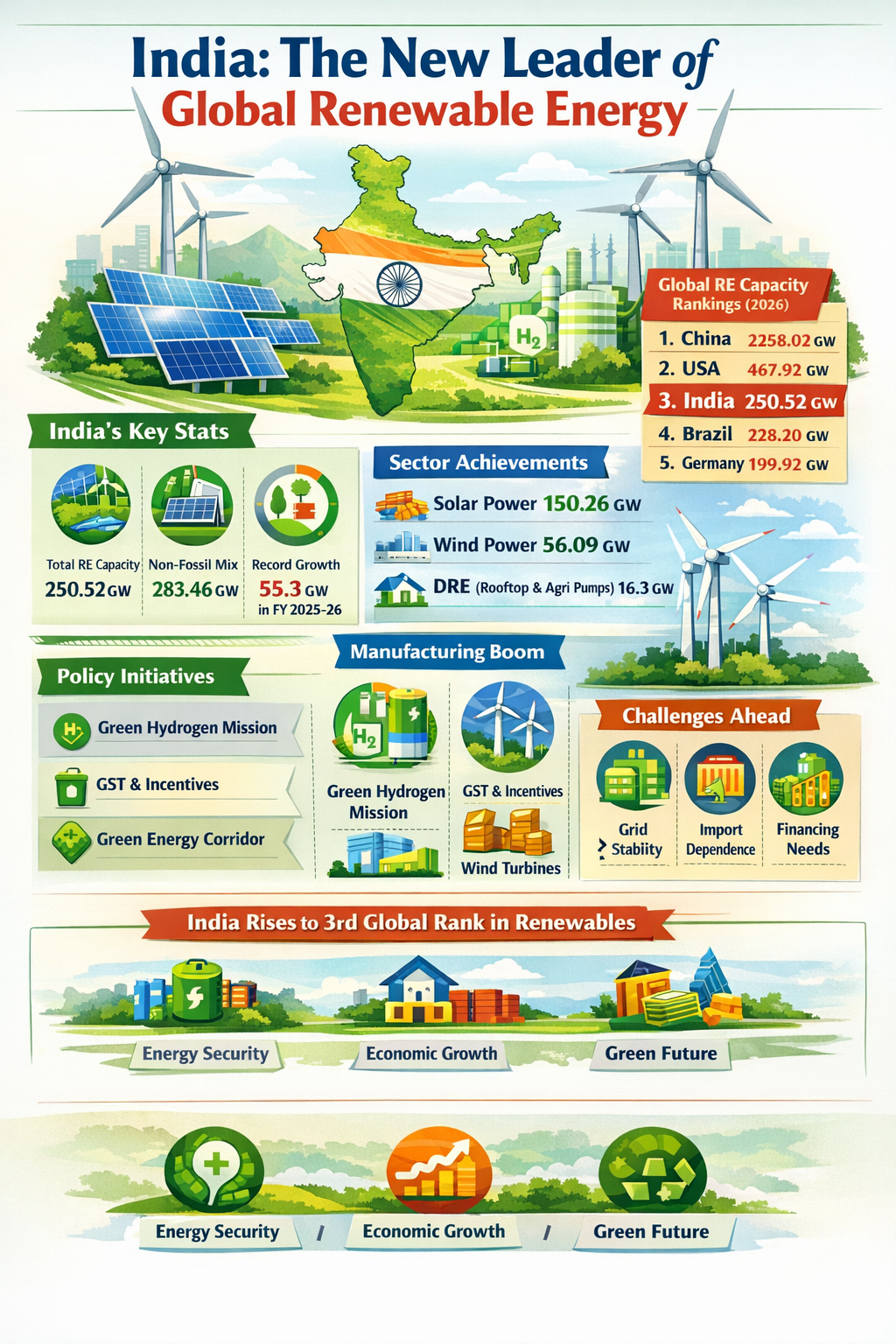
According to the latest 2026 report of the International Renewable Energy Agency (IRENA), India has now reached the third position in the world in installed renewable energy capacity. India has overtaken a major energy producer like Brazil in this race, which reflects India's commitment to “Green Transition.”
Global Scenario and India’s Position:
|
Rank |
Country |
Capacity (GW) |
Special Remark |
|
1 |
China |
2258.02 |
Global manufacturing hub |
|
2 |
USA |
467.92 |
Advanced technological leadership |
|
3 |
India |
250.52 |
Fastest growth rate |
|
4 |
Brazil |
228.20 |
High dependence on hydropower |
|
5 |
Germany |
199.92 |
Backbone of European energy |
India’s Key Energy Statistics:
A revolutionary change has occurred in India’s energy profile:
-
-
- Total installed capacity: India’s total renewable capacity has reached 250.52 GW.
- Non-fossil mix: If nuclear and large hydropower are added, total non-fossil fuel capacity is 283.46 GW.
- Historic growth: In financial year 2025–26, India added a record capacity of 55.3 GW, which is the largest increase made by any developing country in one year at the global level.
- Share in generation: Out of total electricity generation (1845.92 BU), the contribution of non-fossil sources is now 29.2%.
- Total installed capacity: India’s total renewable capacity has reached 250.52 GW.
-
Sector-wise Achievements:
-
-
- Solar Power: India’s solar capacity has crossed 150.26 GW. Compared to 2014 (2.6 GW), this is a 53-fold increase. The “PM-Surya Ghar: Free Electricity Scheme” has popularized solar energy at the household level.
- Wind Energy: With a record increase of 6.05 GW in FY 2025–26, total wind capacity has become 56.09 GW. Offshore wind projects have given new momentum to this.
- Distributed Renewable Energy (DRE): 36% of total capacity (16.3 GW) is coming from rooftops and agricultural pumps (PM-KUSUM), indicating decentralization of energy.
- Solar Power: India’s solar capacity has crossed 150.26 GW. Compared to 2014 (2.6 GW), this is a 53-fold increase. The “PM-Surya Ghar: Free Electricity Scheme” has popularized solar energy at the household level.
-
Manufacturing and ‘Atmanirbhar Bharat’:
India is not only becoming a consumer of energy but also a producer:
-
-
- Solar modules: Production capacity, which was only 2.3 GW in 2014, has now increased to 172 GW. India is now in a position to export modules to the USA and Europe.
- Wind turbines: Turbine manufacturing capacity has increased from 10 GW to 24 GW.
- Solar modules: Production capacity, which was only 2.3 GW in 2014, has now increased to 172 GW. India is now in a position to export modules to the USA and Europe.
-
Policy Support and Government Initiatives:
A strong policy framework is behind India’s success:
-
-
- GST and incentives: GST on solar equipment was rationalized (5%) and customs duty exemption was given for battery storage.
- National Green Hydrogen Mission: With an investment of ₹19,744 crore, India is on the path to becoming a “Green Hydrogen Hub” by 2030.
- Green Energy Corridor: Special zones (RE Zones) of 345 GW capacity have been identified and ₹787 crore has been released for grid connectivity.
- Geothermal Energy Policy 2025: New guidelines for exploitation of geothermal energy in regions like Ladakh and Himachal.
- GST and incentives: GST on solar equipment was rationalized (5%) and customs duty exemption was given for battery storage.
-
Challenges:
Although India has achieved the third position in capacity, some challenges still remain:
-
-
- Grid stability: Due to the intermittency of renewable energy, large-scale Battery Energy Storage Systems (BESS) are required.
- Import dependence: There is still partial dependence on imports for raw materials (such as polysilicon and lithium).
- Financing: For the 500 GW target by 2030, heavy investment and low-interest loans are needed.
- Grid stability: Due to the intermittency of renewable energy, large-scale Battery Energy Storage Systems (BESS) are required.
-
Conclusion:
India's rise to the third position in renewable energy reflects its robust policies and commitment to green initiatives. Despite the challenges, this achievement boosts energy security, economic growth, and job creation, thereby establishing India as a global leader in the green sector.



