
Context:
Recently, India objected to the first meeting of the Pakistan–China Boundary Joint Commission held in Islamabad. India’s Ministry of External Affairs clarified that no mechanism between Pakistan and China can be authorised, without India’s consent, to determine arrangements concerning territories claimed by India. New Delhi reiterated that Jammu & Kashmir and Ladakh are integral parts of India.
Historical Background:
-
-
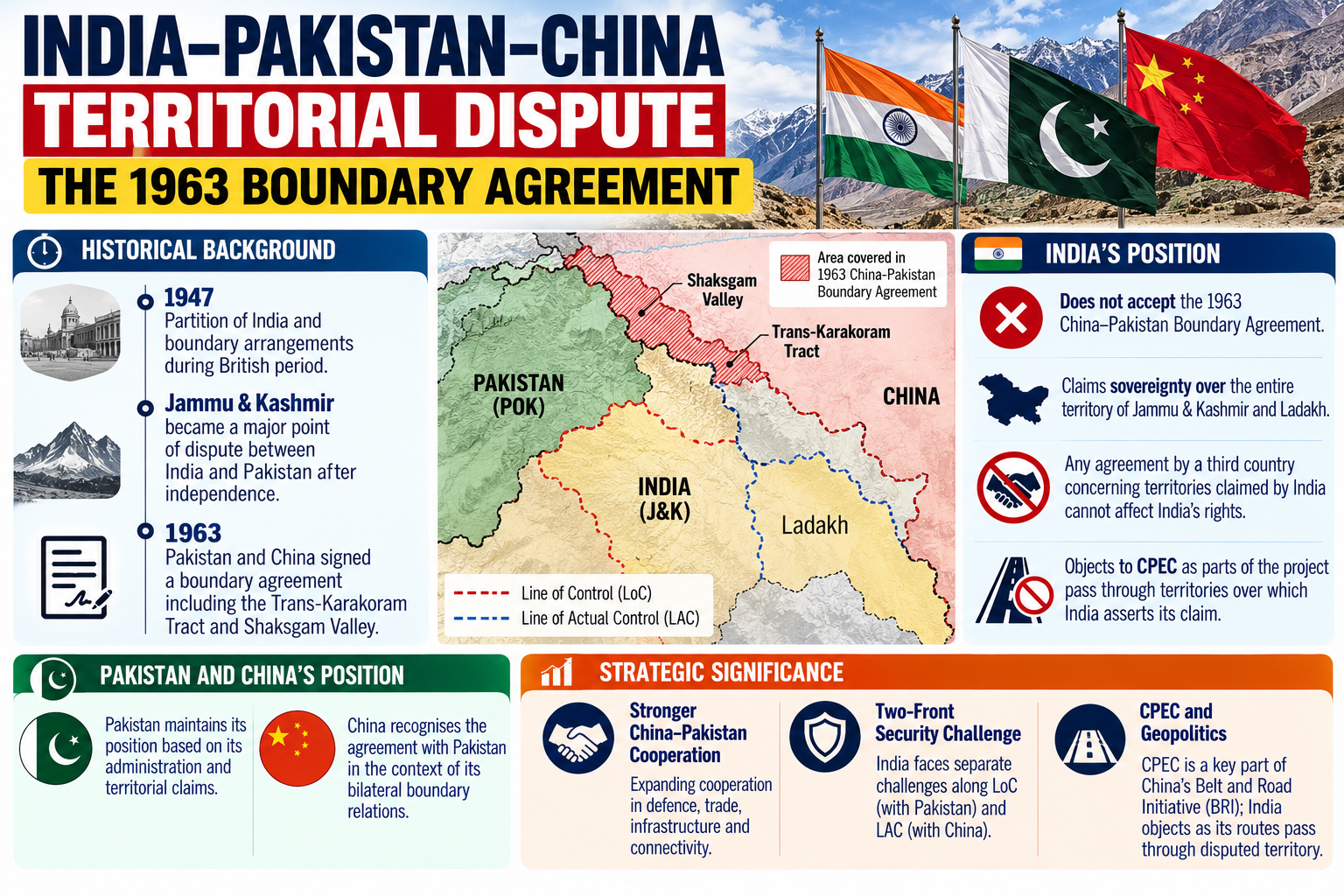
- The territorial disputes among India, Pakistan and China have their roots in the Partition of 1947, boundary arrangements during the British period, and territorial claims that developed after independence. After independence, Jammu & Kashmir became a major point of dispute between India and Pakistan.
- In 1963, Pakistan and China signed a boundary agreement that included provisions concerning the Trans-Karakoram Tract and the Shaksgam Valley. India did not accept this agreement and has maintained that Pakistan cannot enter into an agreement concerning territory over which India asserts sovereign claims.
- On the other hand, Pakistan maintains a different position based on its administration and territorial claims, while China has recognised the agreement with Pakistan in the context of its bilateral boundary relations. Therefore, the issue is not merely a question of boundary demarcation between two countries, but is connected with the territorial claims and security interests of all three countries.
- The territorial disputes among India, Pakistan and China have their roots in the Partition of 1947, boundary arrangements during the British period, and territorial claims that developed after independence. After independence, Jammu & Kashmir became a major point of dispute between India and Pakistan.
-
India’s Position:
According to India’s official position:
-
-
- India does not accept the 1963 China–Pakistan Boundary Agreement.
- India claims sovereignty over the entire territory of Jammu & Kashmir and Ladakh.
- India maintains that any agreement by a third country concerning territories claimed by India cannot affect India’s rights or territorial claims.
- India also objects to the China–Pakistan Economic Corridor (CPEC) because parts of the project pass through territories over which India asserts its claim.
- India does not accept the 1963 China–Pakistan Boundary Agreement.
-
Strategic Significance:
-
-
- China–Pakistan Cooperation: China and Pakistan have extensive cooperation in the areas of defence, trade, infrastructure and connectivity. The institutional expansion of border-related cooperation could further strengthen their strategic partnership. This is significant for India because it has separate border disputes with both China and Pakistan.
- Two-Front Security Challenge: India faces separate security challenges along the Line of Control (LoC) with Pakistan and the Line of Actual Control (LAC) with China. A situation of simultaneous tensions on both fronts could make the management of India’s military and diplomatic resources more complex.
- CPEC and Geopolitics: The China–Pakistan Economic Corridor (CPEC) is an important component of China’s Belt and Road Initiative (BRI). India objects to some of its projects because their routes pass through territories over which India asserts its claim.
- China–Pakistan Cooperation: China and Pakistan have extensive cooperation in the areas of defence, trade, infrastructure and connectivity. The institutional expansion of border-related cooperation could further strengthen their strategic partnership. This is significant for India because it has separate border disputes with both China and Pakistan.
-
Major Challenges for India:
-
-
- Long-standing and unresolved territorial disputes
- Development of military and infrastructure facilities in border areas
- Growing strategic cooperation between China and Pakistan
- Possibility of tensions and miscalculation along the borders
- Difficult Himalayan terrain and associated border-management challenges
- Balancing security interests with economic and regional connectivity objectives
- Long-standing and unresolved territorial disputes
-
Way Forward:
-
-
- For India, a balanced strategy should give importance to both diplomatic engagement and security preparedness. Border infrastructure, surveillance and logistical capabilities need to be strengthened to ensure effective border management.
- India should also advance its alternative connectivity initiatives. Such projects can be based on the principles of sovereignty, transparency, economic viability and consultation with concerned countries.
- For India, a balanced strategy should give importance to both diplomatic engagement and security preparedness. Border infrastructure, surveillance and logistical capabilities need to be strengthened to ensure effective border management.
-
Conclusion:
The Pakistan–China Boundary Joint Commission highlights the complex territorial and strategic relations among India, Pakistan and China. India’s objection is primarily based on the principle that any arrangement concerning territories claimed by India cannot affect its rights without its consent. The challenge for India is to protect its sovereignty and security interests while maintaining sufficient space for regional stability and diplomatic engagement. Such an approach can provide a more sustainable basis for managing boundary disputes and promoting broader regional peace.



