
Context:
Recently, India has invited Pakistan’s Minister for National Heritage and Culture, Aurangzeb Khan Khichi, to the inaugural Shanghai Cooperation Organisation (SCO) Civilisational Dialogue Forum, scheduled to be held in New Delhi from 20–22 November 2026. The invitation marks a significant diplomatic development amid strained India–Pakistan relations following the military confrontation in May 2025 after the Pahalgam terror attack.
About the Civilisational Dialogue Forum:
The initiative was proposed by Prime Minister Narendra Modi at the SCO summit in Tianjin, China, in September 2025 and subsequently adopted by the grouping. The forum aims to promote cultural understanding, shared heritage, civilisational connections and people-to-people exchanges among member countries. Representatives from SCO member states and partner countries are expected to participate.
What is the Shanghai Cooperation Organisation (SCO)?
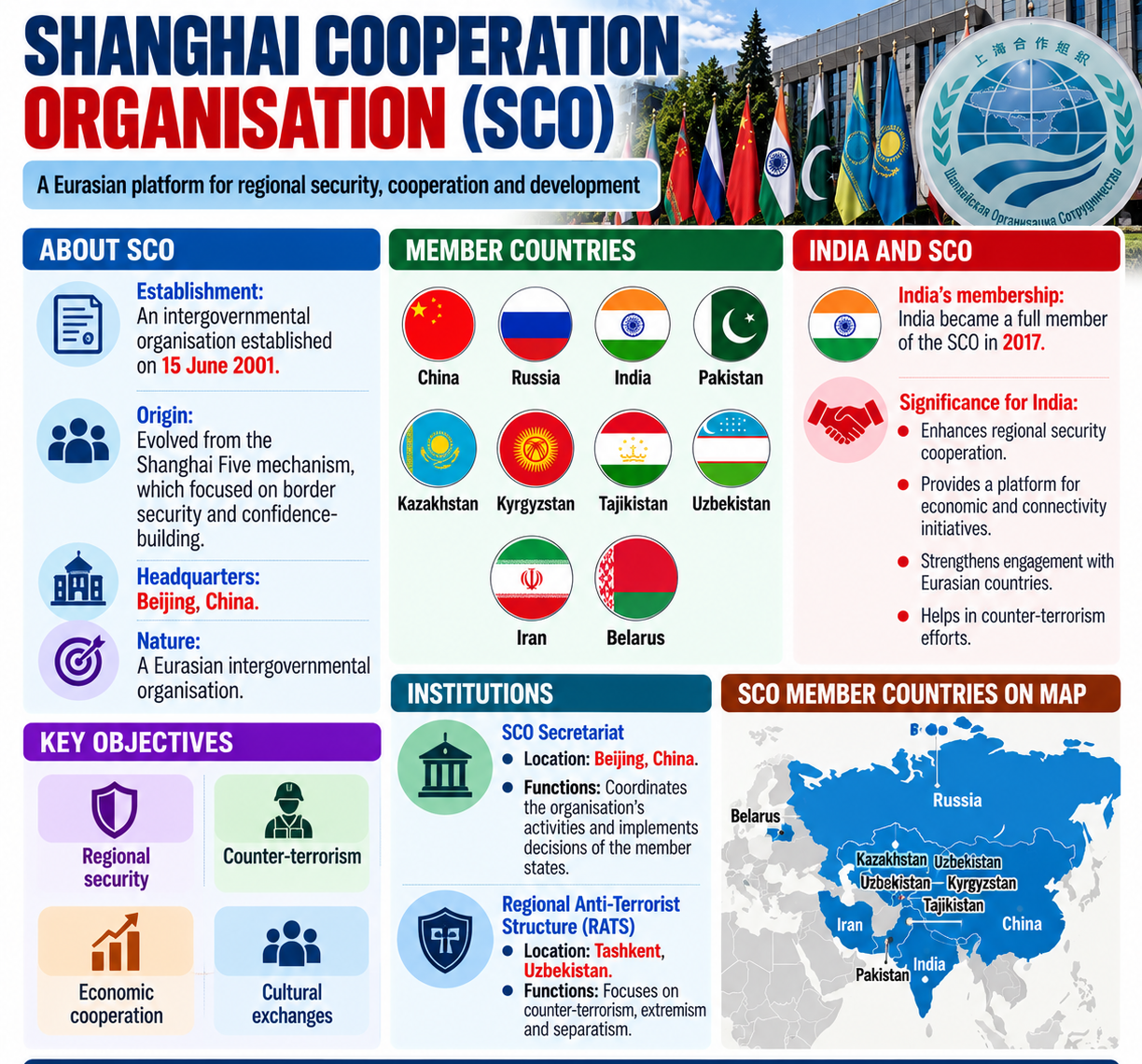
The SCO is a Eurasian regional organisation established in 2001 to promote regional security, economic cooperation and political and cultural engagement. Its current 10 members are China, India, Iran, Kazakhstan, Kyrgyzstan, Pakistan, Russia, Tajikistan, Uzbekistan and Belarus. Its cooperation extends to counterterrorism, connectivity, trade, energy and cultural exchanges.
Significance for India:
The invitation demonstrates India’s continued participation in multilateral diplomacy despite limited bilateral engagement with Pakistan. The forum provides an opportunity to strengthen cultural diplomacy, promote shared civilisational heritage and maintain communication through regional institutions. It also enables India to engage with Central Asian countries and other Eurasian partners on issues of common interest.
Challenges in India–Pakistan Relations:
Bilateral relations remain strained by cross-border terrorism, security concerns and the suspension of substantive dialogue. Participation in an SCO event does not necessarily indicate a breakthrough in bilateral relations. India must therefore balance multilateral engagement with its security priorities and stated position on terrorism. Pakistan’s participation in the forum also remains unconfirmed.
Way Forward:
India should utilise multilateral platforms such as the SCO to promote cultural exchanges, regional connectivity and cooperation on shared challenges. Constructive engagement must remain consistent with national security interests. Cultural diplomacy, academic exchanges and people-to-people contacts can complement formal diplomacy, while sustained improvement in bilateral relations would require addressing outstanding security and political concerns.
Conclusion:
India’s invitation to Pakistan for the SCO Civilisational Dialogue Forum illustrates the role of multilateral institutions in sustaining limited engagement amid bilateral tensions. While cultural diplomacy can create opportunities for mutual understanding, lasting regional stability requires sustained cooperation, respect for sovereignty and effective action against terrorism.