
Growing Ambit of India’s Online Censorship Mechanism
Context:
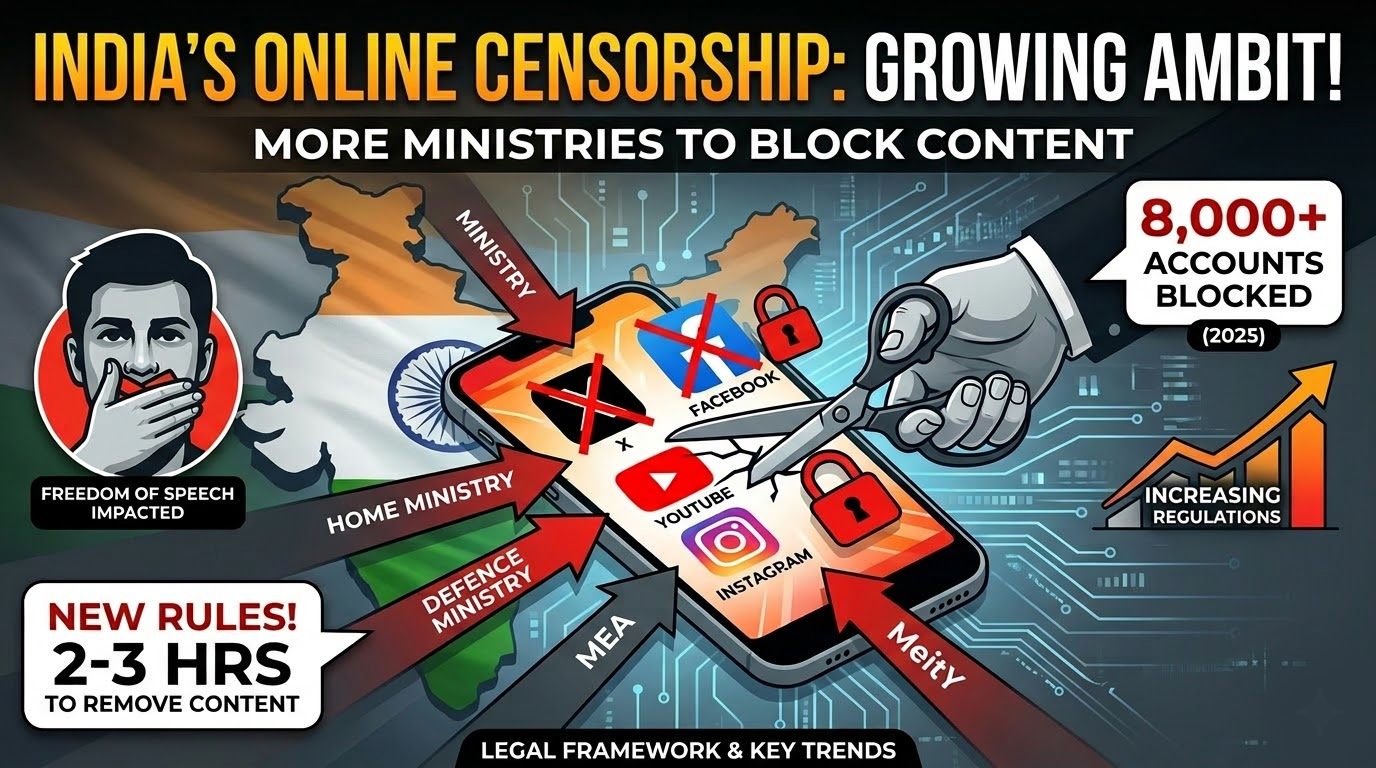
India is planning to decentralise its online content blocking system by allowing multiple ministries like Home, Defence, and External Affairs to issue takedown orders under the IT Act. At present, such powers are mainly with the Ministry of Electronics and IT. This move has raised concerns about the expanding scope of online censorship and its impact on freedom of speech.
About Online censorship:
Online censorship in India is primarily executed through legal mandates under the Information Technology (IT) Act, 2000, enabling central and state governments to block websites, URLs, and social media content to ensure national security, sovereignty, and public order
Legal Framework and Mechanism:
-
-
- India regulates online content mainly through the Information Technology Act, 2000.
- Section 69A allows the government to block online content for reasons like sovereignty, security, and public order.
- The blocking process is governed by the 2009 rules with a committee-based system.
- Another mechanism under Section 79(3)(b) allows various agencies to issue takedown notices, especially through the Sahyog portal.
- Section 69A allows the government to block online content for reasons like sovereignty, security, and public order.
- The Supreme Court in the Shreya Singhal v. Union of India case upheld Section 69A but emphasised safeguards for free speech.
- India regulates online content mainly through the Information Technology Act, 2000.
-
Key Trends and Statistics:
-
-
- Over 2,300 blocking orders were issued to online platforms in one year through the Sahyog portal.
- Around 8,000 accounts were blocked during security-related operations in 2025.
- Social media platforms must now remove content within 2–3 hours, reduced from 36 hours earlier.
- Companies like X have complied with up to 91% of takedown requests, showing rising regulatory pressure.
- Users have reported that even satirical or critical content is being removed due to strict compliance requirements.
- Over 2,300 blocking orders were issued to online platforms in one year through the Sahyog portal.
-
Key Issues:
To ensure balanced online censorship, it is essential to establish a clear and limited definition of illegal content. Also, judicial oversight and review mechanisms should be strengthened. Transparency in blocking orders must be increased and a balance must be maintained between national security and freedom of expression.
Way Forward:
-
-
- Ensure clear and narrow definitions of unlawful content
- Strengthen judicial oversight and review mechanisms
- Improve transparency in blocking orders
- Balance national security with Article 19(1)(a) (freedom of speech)
- Ensure clear and narrow definitions of unlawful content
-
Conclusion:
India’s online censorship framework is expanding to tackle misinformation, AI content, and security threats. However, it must maintain a balance between effective regulation and democratic freedoms to ensure a fair digital ecosystem.



