
Context:
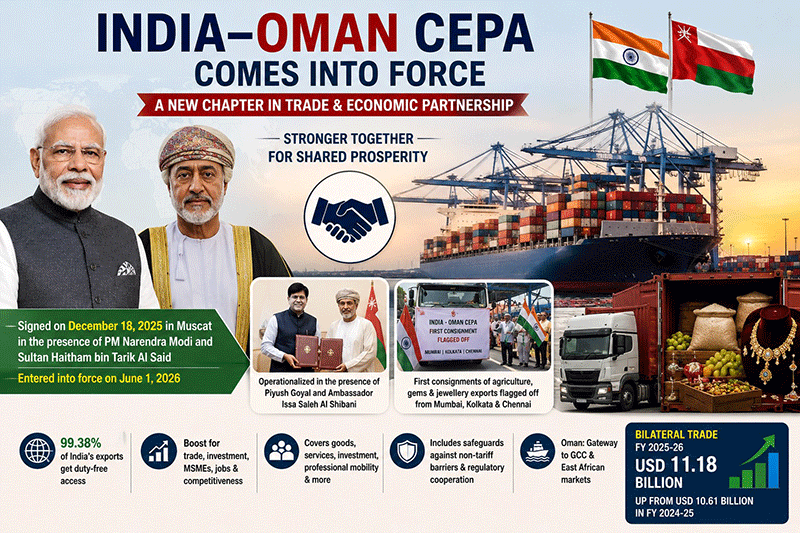
Recently, the India–Oman Comprehensive Economic Partnership Agreement (CEPA), signed in December 2025, has officially come into force from 1 June 2026. The agreement marks a major step in strengthening bilateral economic relations, trade integration, and strategic cooperation between India and Oman.
Background:
The CEPA was signed on 18 December 2025 in Muscat in the presence of the Hon’ble Prime Minister of India and the Sultan of Oman. After completing all domestic approval processes, it has now been operationalised.
-
- Oman is India’s second-largest trading partner in the Gulf region
- Bilateral trade stood at around USD 11.18 billion (FY 2025–26)
- India exported $4.06 billion worth of goods to Oman in 2024–25, while imports stood at $6.5 billion
- The agreement reflects India’s strategy of building diversified, resilient, and strategic trade partnerships
- Oman is India’s second-largest trading partner in the Gulf region
Key Features of the CEPA:
Trade Liberalisation and Duty-Free Access
-
-
- Oman will provide India duty-free access to 98.08% of its tariff lines, covering 99.38% of India’s exports to Oman
- India has offered liberalised tariffs on 77.79% of its tariff lines, covering 94.81% of imports from Oman
- Oman will provide India duty-free access to 98.08% of its tariff lines, covering 99.38% of India’s exports to Oman
-
Sectoral and Services Benefits:
The agreement provides strong gains for India’s services sector with emphasis on professional mobility and market access.
However, certain sensitive products remain excluded, including:
-
-
- Dairy products
- Tea and coffee
- Rubber and tobacco
- Gold and silver bullion
- Jewellery
- Select footwear and sports goods
- Dairy products
-
Enhanced Labour Mobility:
Oman has significantly liberalised movement of skilled professionals under Mode 4 commitments:
-
-
- Intra-Corporate Transferees (ICTs) quota increased from 20% to 50%
- Contractual Service Suppliers allowed stay up to 2 years, extendable by 2 years
- Easier entry and stay conditions for professionals in:
- IT services
- Healthcare
- Engineering
- Professional services
- IT services
- Intra-Corporate Transferees (ICTs) quota increased from 20% to 50%
-
Economic and Strategic Significance:
-
- The CEPA provides India with a strategic gateway to the GCC region, as well as access to East Africa, Central Asia, and Eastern Europe
- It enhances trade diversification and global supply chain integration
- It marks:
- Oman’s first bilateral trade agreement since its FTA with the United States (2006)
- India’s second CEPA with a GCC country, after the India–UAE CEPA (2022)
- Oman’s first bilateral trade agreement since its FTA with the United States (2006)
- The CEPA provides India with a strategic gateway to the GCC region, as well as access to East Africa, Central Asia, and Eastern Europe
Sectoral Gains for India:
Marine Products
-
-
- Immediate duty-free access for seafood exports
- Strong export potential in coastal states like Tamil Nadu, Kerala, Andhra Pradesh, and Gujarat
- Immediate duty-free access for seafood exports
-
Gems and Jewellery
-
-
- Tariffs up to 5% eliminated
- Strong growth potential for hubs like Surat, Jaipur, Mumbai, and Kolkata
- Tariffs up to 5% eliminated
-
Agriculture and Food Products
-
-
- Better access for basmati rice, onions, cashews, processed foods
- Strengthened position in Oman’s meat and egg import market
- Better access for basmati rice, onions, cashews, processed foods
-
Pharmaceuticals
-
-
- Zero-duty access for medicines and APIs
- Fast-track approvals (up to 90 days) for globally regulated products
- Mutual recognition of standards improves ease of trade
- Zero-duty access for medicines and APIs
-
Engineering and Electronics
-
-
- Zero-duty access for machinery, steel, automobiles
- Expansion opportunity in Oman’s electronics import market (~USD 1.7 billion)
- Boost to India’s PLI manufacturing ecosystem
- Zero-duty access for machinery, steel, automobiles
-
Services and Skilled Mobility:
Services Access
Oman has opened 127 services sub-sectors, including:
-
-
- IT and computer services
- Healthcare and engineering
- Education and finance
- Construction and tourism
- IT and computer services
-
Mobility Provisions
-
-
- Business visitors: up to 90 days
- Professionals: up to 180 days
- ICT transfers: up to 4 years
- Business visitors: up to 90 days
-
Why It Matters Beyond Trade:
Oman holds strategic importance due to:
-
- Location outside the Strait of Hormuz chokepoint
- Operational ports like Salalah and Duqm during maritime disruptions
- Role as a stable logistics hub in West Asia
- Location outside the Strait of Hormuz chokepoint
This makes Oman a critical diversification partner amid geopolitical tensions affecting regional trade routes.
Conclusion:
The India–Oman CEPA represents a transformative milestone in India’s economic diplomacy. By combining deep tariff liberalisation, services access, and labour mobility with strategic trade advantages, the agreement strengthens India’s integration with the Gulf region. It is expected to boost exports, employment, innovation, and supply chain resilience, while aligning with India’s vision of Viksit Bharat @2047.



