
India–New Zealand Strategic Partnership
Why in News?
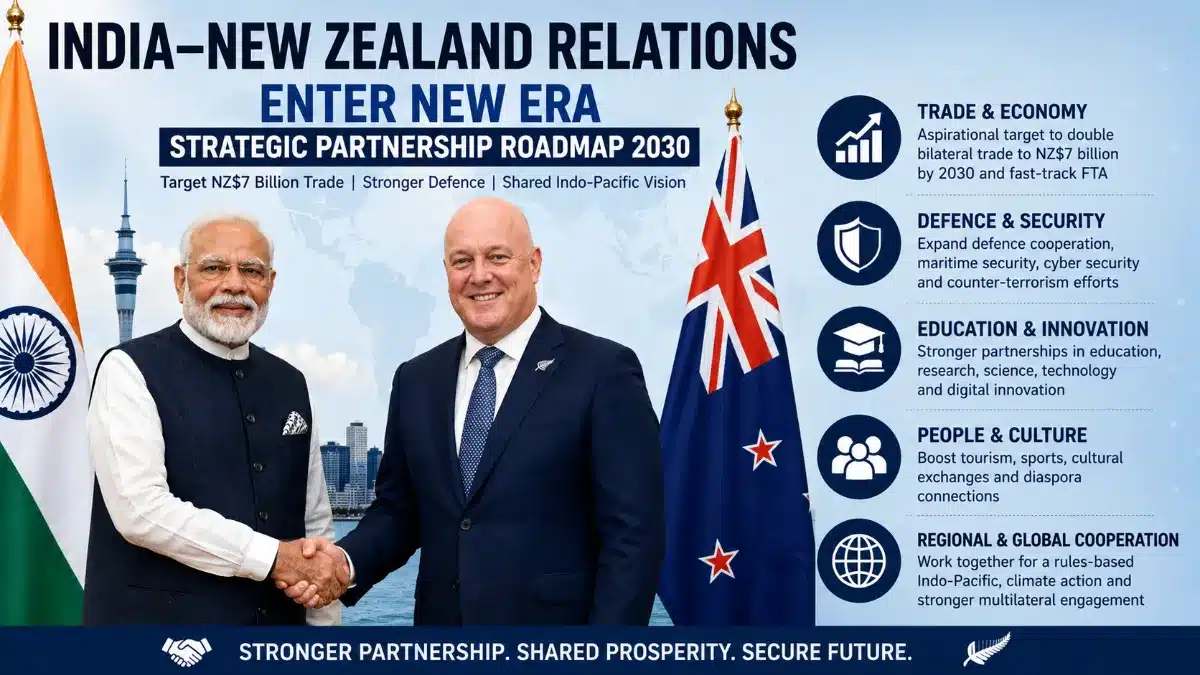
Recently, India and New Zealand upgraded their bilateral relations to a Strategic Partnership and signed 10 mou during Prime Minister Narendra Modi’s visit to Auckland. Both countries adopted the Roadmap to 2030 to guide cooperation in political, defence, economic, technological and people-to-people areas. They also agreed to double bilateral trade in goods and services to NZ$7 billion by 2030.
Background of India–New Zealand Relations:
-
-
- India and New Zealand established diplomatic relations in 1952 and share democratic values, rule of law and commitment to a rules-based international order.
- The relationship is supported by:
- Indian diaspora of around 2.9 lakh people (nearly 6% of New Zealand’s population).
- Education, cultural and sporting exchanges.
- Cooperation in trade, agriculture and multilateral forums.
- Indian diaspora of around 2.9 lakh people (nearly 6% of New Zealand’s population).
- The Strategic Partnership represents a shift towards deeper cooperation in security, economy and regional affairs.
- India and New Zealand established diplomatic relations in 1952 and share democratic values, rule of law and commitment to a rules-based international order.
-
Key Outcomes of India–New Zealand Partnership:
-
-
- Strategic Partnership Roadmap 2030: Both countries approved the Strategic Partnership Roadmap to 2030 to enhance cooperation in trade, investment, defence, technology, agriculture, education, culture, and maritime security.
- Trade and Investment: The two sides have set a target of doubling bilateral trade by 2030 through the Free Trade Agreement (FTA). New Zealand has also announced plans to invest US$20 billion in India.
- Defence and Maritime Security: The two countries agreed to enhance cooperation under the Indo-Pacific Oceans Initiative (IPOI) to strengthen peace, stability, and maritime security in the Indo-Pacific region. They will promote naval exercises, military exchanges, defence dialogue, hydrography, logistics support, and cooperation in maritime operations.
- Counter-Terrorism, Cyber Security and Global Cooperation: Both sides will activate the Joint Working Group on Counter Terrorism, strengthen cyber security cooperation, and intensify joint efforts against international terrorism and transnational organised crime. New Zealand also reaffirmed its support for India’s aspiration for permanent membership of the United Nations Security Council (UNSC).
- Clean Energy and Global Vision: Both countries will enhance cooperation in low-carbon development, clean energy, sustainable energy transition, and biofuels. They also reaffirmed their commitment to a free, open, and peaceful Indo-Pacific and agreed to strengthen cooperation on global issues such as UN reforms and counter-terrorism.
- Strategic Partnership Roadmap 2030: Both countries approved the Strategic Partnership Roadmap to 2030 to enhance cooperation in trade, investment, defence, technology, agriculture, education, culture, and maritime security.
-
Significance:
The Strategic Partnership strengthens India’s engagement in the Pacific region and supports a free, open and stable Indo-Pacific. It creates opportunities for greater trade, investment, technology sharing and innovation. Cooperation with New Zealand also contributes to India’s economic development goals, including the vision of Viksit Bharat 2047, while enhancing collaboration in maritime security and global forums.
Challenges:
The partnership faces challenges such as differences in approaches towards China and regional security issues, limited trade volumes, agricultural market access concerns and geographical distance. Effective implementation of agreements and improving connectivity will be important for achieving the goals of the Roadmap to 2030.
Conclusion:
The India–New Zealand Strategic Partnership marks a new phase in bilateral relations by expanding cooperation in defence, trade, technology, education and regional security. Successful implementation of the Roadmap to 2030 can strengthen mutual prosperity and contribute to peace and stability in the Indo-Pacific region.



