
Context:
Recently, India and New Zealand concluded negotiations on the Financial Services Annex of the India–New Zealand Free Trade Agreement (FTA), marking a significant milestone in strengthening bilateral economic and strategic cooperation.
Background:
-
-
- Formal FTA negotiations were launched in March 2025, reflecting strong political commitment on both sides to deepen economic engagement.
- The agreement was concluded in a record nine months, underscoring decisive leadership and sustained diplomatic momentum.
- Two-way trade between India and New Zealand has been steadily expanding, though it remains well below its potential compared to India’s trade with larger partners.
- Formal FTA negotiations were launched in March 2025, reflecting strong political commitment on both sides to deepen economic engagement.
-
Key Provisions of the FTA:
-
-
- Market Access and Tariff Liberalisation
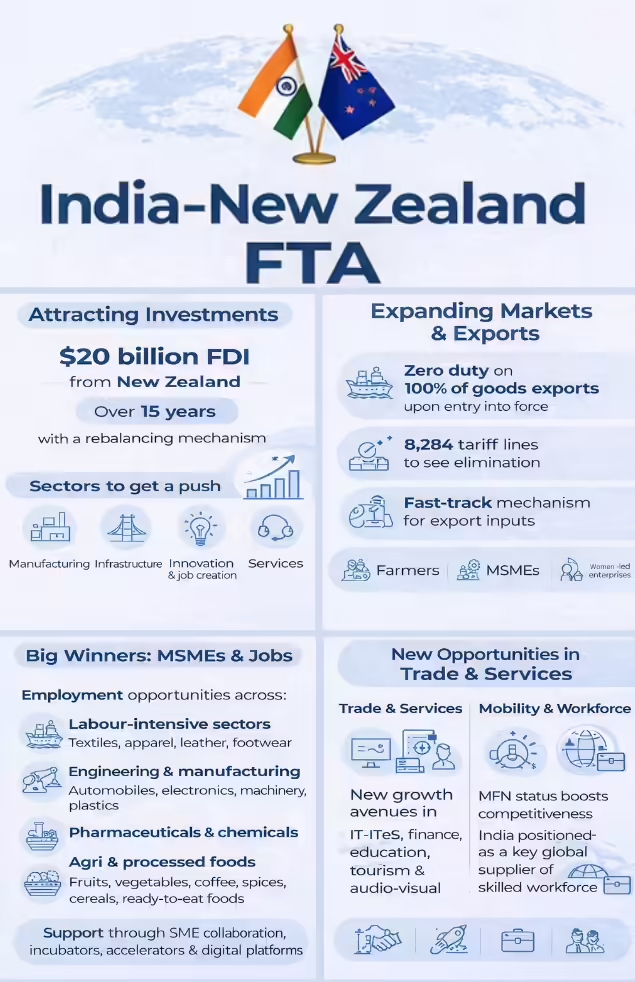
- Zero-duty access for Indian exports: New Zealand has agreed to eliminate tariffs on 100 per cent of Indian export tariff lines, significantly enhancing the competitiveness of Indian goods.
- India’s tariff liberalisation: India will reduce or eliminate duties on approximately 70 per cent of New Zealand exports, covering nearly 95 per cent of bilateral trade value.
- Sectors likely to benefit include textiles, leather, footwear, engineering goods, pharmaceuticals, marine products, and gems and jewellery.
- Zero-duty access for Indian exports: New Zealand has agreed to eliminate tariffs on 100 per cent of Indian export tariff lines, significantly enhancing the competitiveness of Indian goods.
- Services Trade and Mobility
- The FTA provides market access across 118 services sectors, including information technology, education, finance, tourism, and construction.
- Visa and mobility facilitation measures include:
- Temporary employment entry visas for up to 5,000 professionals.
- Work and holiday visas for around 1,000 individuals annually.
- Expanded opportunities for students, including post-study work rights of up to four years for doctoral scholars.
- Temporary employment entry visas for up to 5,000 professionals.
- The FTA provides market access across 118 services sectors, including information technology, education, finance, tourism, and construction.
- Investment and Economic Cooperation
- New Zealand has committed to facilitating up to USD 20 billion in investments into India over a 15-year period, particularly in manufacturing, infrastructure, and innovation.
- The agreement establishes cooperation frameworks in agriculture, technology, MSMEs, and services, aiming to align trade expansion with sustainable and inclusive growth.
- New Zealand has committed to facilitating up to USD 20 billion in investments into India over a 15-year period, particularly in manufacturing, infrastructure, and innovation.
- Agriculture and Sensitive Sectors
- India has retained safeguards for import-sensitive domestic sectors, particularly dairy, sugar, and select agricultural commodities.
- Special provisions permit New Zealand firms to import dairy inputs for processing and re-export from India, without allowing finished dairy imports into the Indian domestic market—thereby protecting the interests of local farmers.
- India has retained safeguards for import-sensitive domestic sectors, particularly dairy, sugar, and select agricultural commodities.
- Market Access and Tariff Liberalisation
-

Significance for India:
-
-
- Economic Benefits
- Export growth: Duty-free access improves market opportunities for Indian exporters, especially in labour-intensive and value-added sectors.
- Services and employment: Enhanced services access and mobility provisions strengthen India’s role in global services trade and generate new employment avenues.
- Investment inflows: Expected New Zealand FDI can augment infrastructure development and industrial capacity.
- Export growth: Duty-free access improves market opportunities for Indian exporters, especially in labour-intensive and value-added sectors.
- Strategic and Diplomatic Gains
- Strengthens India’s economic footprint in Oceania, reinforcing engagement with smaller yet dynamic regional partners.
- Signals India’s commitment to open, rules-based trade, aligning with its broader trade and Indo-Pacific strategies.
- Strengthens India’s economic footprint in Oceania, reinforcing engagement with smaller yet dynamic regional partners.
- Economic Benefits
-
Conclusion:
The India–New Zealand Free Trade Agreement represents a historic and comprehensive economic partnership, encompassing trade in goods and services, investment, and mobility. It reflects India’s evolving trade strategy—promoting export competitiveness, expanding services access, safeguarding domestic sensitivities, and deepening strategic partnerships in the Indo-Pacific era. Effective implementation of the agreement could substantially advance India’s economic objectives and strengthen its integration into global trade networks.



