
India’s New Climate Targets 2035
Context:
Recently, the Government of India approved the update of its Nationally Determined Contributions (NDC) for the period 2031–2035. This step further strengthens India’s international commitments under the Paris Agreement and marks an important milestone toward achieving the vision of ‘net-zero’ emissions by 2070.
Key Updated Targets (By 2035):
India’s revised NDC focuses on three major pillars, balancing the country’s energy security with environmental sustainability:
-
-
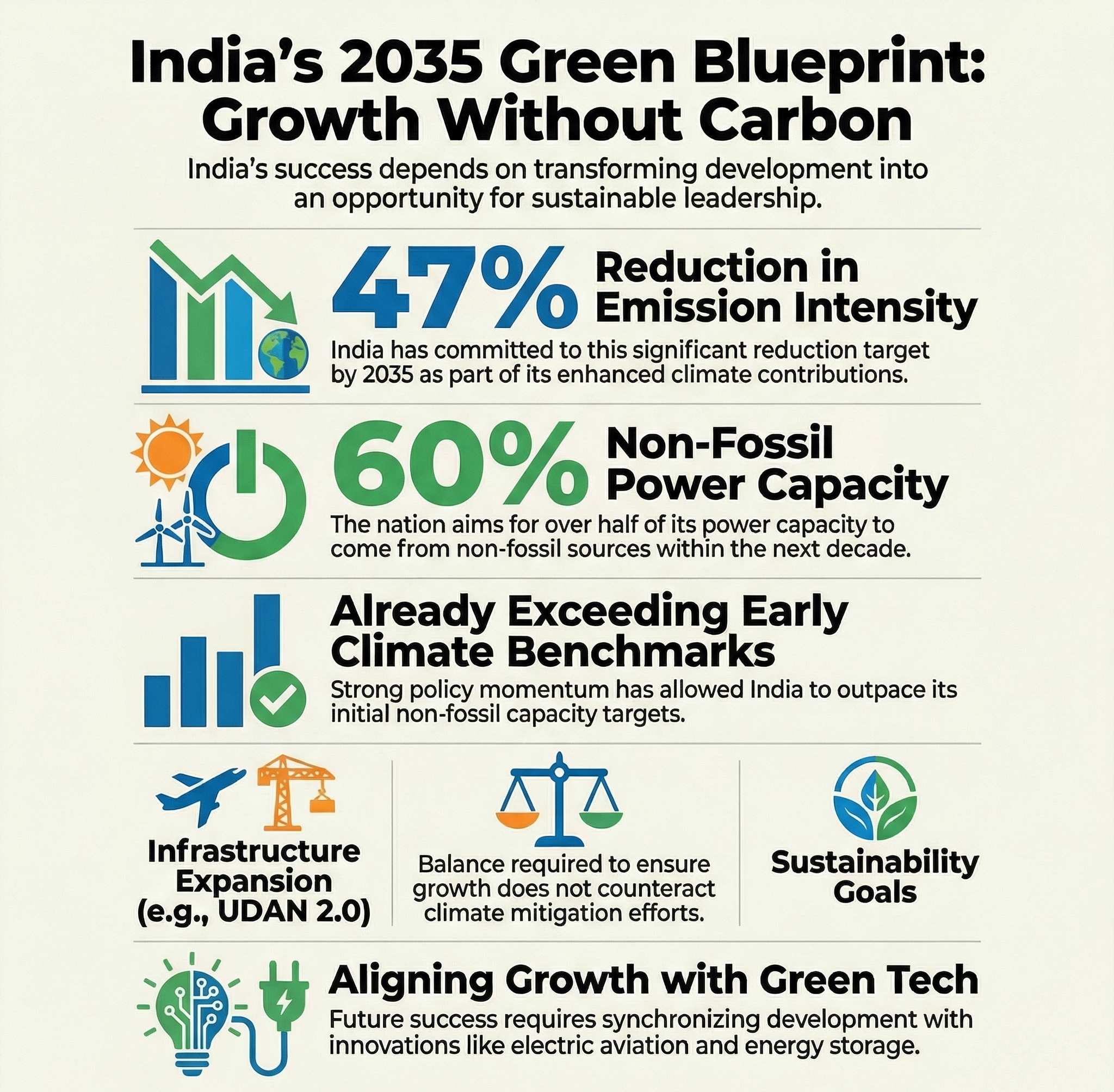
- Non-fossil fuel-based capacity: India has set a target to derive 60% of its total installed electricity capacity from non-fossil sources (solar, wind, hydropower, nuclear, and bio-energy) by 2035.
This is a significant increase from the earlier target of 50% by 2030. Notably, India achieved its previous 2030 target five years ahead of schedule, in 2025. - Reduction in emission intensity: India has pledged to reduce the emissions intensity of its GDP by 47% compared to 2005 levels.
This reflects India’s leadership in decoupling economic growth from carbon emissions at the global level. - Expansion of carbon sink: The target for creating additional carbon sinks through forest and tree cover has been increased to 3.5–4 billion tonnes of CO₂ equivalent. This highlights India’s growing emphasis on ecosystem restoration and large-scale afforestation.
- Non-fossil fuel-based capacity: India has set a target to derive 60% of its total installed electricity capacity from non-fossil sources (solar, wind, hydropower, nuclear, and bio-energy) by 2035.
-
Key Government Initiatives for Implementation:
To achieve these ambitious targets, the government has launched several mission-mode projects:
-
-
- PM Surya Ghar: Muft Bijli Yojana: Aims to install rooftop solar panels in 1 crore households.
- National Green Hydrogen Mission: To make India a global hub for green hydrogen.
- Energy Storage Mission: Focus on battery storage and pumped hydro projects to address the intermittency of solar and wind energy.
- Expansion of Nuclear Energy: Increasing nuclear capacity to ensure a stable ‘base load’ of clean energy.
- PM Surya Ghar: Muft Bijli Yojana: Aims to install rooftop solar panels in 1 crore households.
-
Challenges:
-
-
- Gap between capacity and generation: While India has increased its non-fossil capacity target to 60%, coal still accounts for 70–75% of actual electricity generation. Renewable energy (solar/wind) is not always available, leading to continued dependence on coal for base load requirements.
- Grid stability and storage: The intermittency of renewable energy makes grid management difficult. This necessitates large-scale battery storage (BESS) and pumped hydro projects, which are currently quite expensive.
- Financial constraints: Achieving the 2035 targets will require substantial investment. Climate finance from developed countries remains significantly below expectations.
- Gap between capacity and generation: While India has increased its non-fossil capacity target to 60%, coal still accounts for 70–75% of actual electricity generation. Renewable energy (solar/wind) is not always available, leading to continued dependence on coal for base load requirements.
-
Conclusion:
India’s new targets submitted to the UNFCCC not only reflect its commitment to climate justice but also align the vision of “Developed India @2047” with green growth. Despite being a developing country, this step by India will increase pressure on developed nations to fulfill their historical responsibilities and provide adequate climate finance to developing countries.



