
India–Nepal Boundary Dispute
Context:
Recently, Nepal objected to the use of the Lipulekh Pass for the Kailash Mansarovar Yatra, reiterating its claim over the Lipulekh–Kalapani–Limpiyadhura region. India rejected the claim, stating that it lacks historical and cartographic basis and reaffirming that the route has been used for decades.
Historical Basis of the Dispute:
-
-
-
- The dispute originates from the Treaty of Sugauli (1816) signed between the British East India Company and Nepal after the Anglo-Nepalese War. The treaty defined the boundary along the Mahakali (Kali) River, with Nepal retaining territory east of it and British India retaining land to the west.
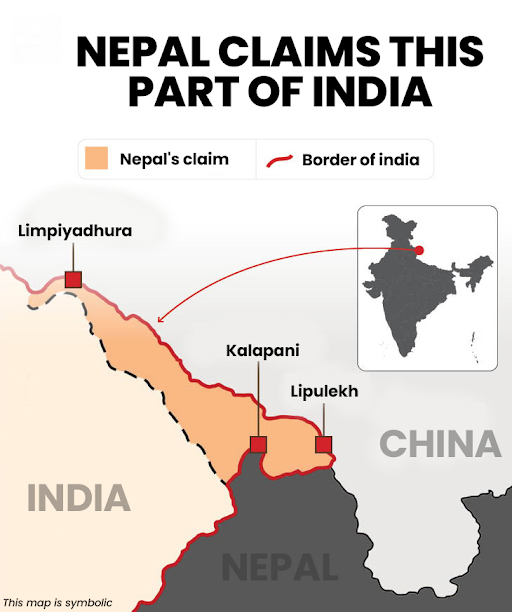
- However, the treaty did not clearly identify the river’s exact source, creating ambiguity. Nepal claims the river originates at Limpiyadhura, placing Kalapani and Lipulekh within its territory, while India identifies the source closer to the Kalapani–Lipulekh area, making it part of Uttarakhand. This difference in interpretation forms the core of the dispute.
- The dispute originates from the Treaty of Sugauli (1816) signed between the British East India Company and Nepal after the Anglo-Nepalese War. The treaty defined the boundary along the Mahakali (Kali) River, with Nepal retaining territory east of it and British India retaining land to the west.
-
-
Nepal’s Stand:
Nepal asserts that Limpiyadhura, Lipulekh and Kalapani lie east of the Mahakali River and are part of Nepal based on the Treaty of Sugauli, historical maps, and administrative records. It argues that the river’s true source is Limpiyadhura, shifting the boundary eastwards. Nepal has also opposed infrastructure projects and agreements made without its consent, including India–China understandings on the Lipulekh route. In 2020, Nepal issued a revised political map including these territories and later incorporated it into its constitution, making it a sovereignty issue.
India’s Stand:
India maintains that the region is an integral part of Uttarakhand and has been under its administrative control. It highlights the use of the Lipulekh route for the Kailash Mansarovar Yatra since 1954, reinforcing historical usage. India views Nepal’s claim as unilateral and unsupported by strong evidence, while stating that the boundary is largely settled in practice. It supports resolution through bilateral dialogue and peaceful negotiations.
Strategic and Geopolitical Importance:
The region lies near the India–Nepal–China tri-junction, making it strategically significant for border security and Himalayan military logistics. It also holds religious importance due to the Kailash Mansarovar Yatra, with Lipulekh offering a shorter route to Tibet. India–China coordination on this route has increased Nepal’s concerns about exclusion from trilateral decisions.
Why the Problem Persists:
The dispute persists due to ambiguous geography, as the Mahakali river system has multiple tributaries and no clearly defined source. Colonial-era maps provide conflicting interpretations, while political nationalism in Nepal and strategic interests linked to infrastructure and China connectivity further complicate resolution.
Proposed Solution:
A solution lies in strengthening the India–Nepal Joint Boundary Working Group and using GIS mapping, satellite imagery, and hydrological studies for scientific demarcation. A joint survey commission with experts can help resolve differences. Diplomatic engagement must continue while avoiding unilateral actions. Confidence-building measures and people-to-people ties should be strengthened, and geopolitical factors, especially China-related issues, should be kept separate.
Conclusion:
The dispute reflects how historical treaties, river ambiguity, and strategic geography combine to create enduring boundary tensions, requiring careful diplomacy and scientific resolution.



