
Context:
In recent times, The Government of India is promoting makhana as a high-value agricultural and export commodity. The establishment of the National Makhana Board and the Central Sector Scheme for Development of Makhana aim to modernise cultivation, improve farmer incomes, promote value addition and expand exports.
What is Makhana?
-
-
- Makhana, scientifically known as Euryale ferox, is an aquatic crop grown mainly in shallow ponds, lakes and wetlands. Its edible seeds are roasted and popped to produce the familiar fox nut snack.
- India is the world's largest producer of makhana, with Bihar accounting for nearly three-fourths of domestic production and around 80–85% of global supply. Cultivation is concentrated mainly in North Bihar, particularly the Kosi basin districts such as Supaul, Saharsa and Madhepura.
- Makhana, scientifically known as Euryale ferox, is an aquatic crop grown mainly in shallow ponds, lakes and wetlands. Its edible seeds are roasted and popped to produce the familiar fox nut snack.
-
Government Initiatives:
-
-
- The National Makhana Board was announced in the Union Budget 2025-26 and launched in Bihar in September 2025. It seeks to strengthen the entire makhana value chain.
- The Government has also approved a Central Sector Scheme for Development of Makhana with an outlay of ₹476.03 crore for 2025-26 to 2030–31. It focuses on:
- Quality seeds and research
- Farmer training and capacity building
- Improved harvesting and post-harvest management
- Value addition and branding
- Marketing and exports
- Quality control
- Quality seeds and research
- The National Makhana Board was announced in the Union Budget 2025-26 and launched in Bihar in September 2025. It seeks to strengthen the entire makhana value chain.
-
Production and Market Trends:
-
-
- India produced 63,910 MT of makhana in 2024–25, while the second advance estimate for 2025–26 is 80,590 MT. Bihar alone is estimated to produce 60,000 MT in 2025–26.
- Domestic demand has grown rapidly due to increasing health awareness, premiumisation and expansion of branded food products. The domestic market is projected to reach ₹11,000–12,000 crore by 2029–30.
- India produced 63,910 MT of makhana in 2024–25, while the second advance estimate for 2025–26 is 80,590 MT. Bihar alone is estimated to produce 60,000 MT in 2025–26.
-
Export Potential:
-
-
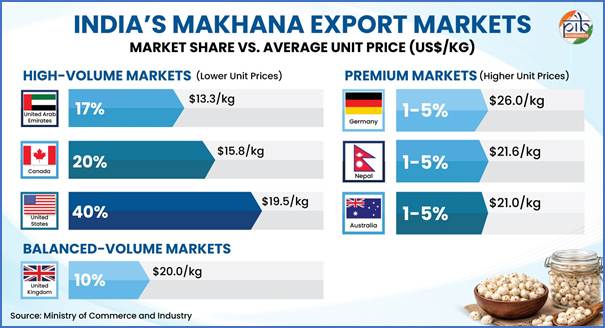
- India exported 7,264.89 MT of makhana products in 2025–26, valued at about ₹192.96 crore. Major markets include the United States, Canada and UAE.
- However, export concentration creates vulnerability. Premium markets such as Germany, Australia and Nepal offer higher unit prices, indicating scope for market diversification and greater value realisation.
- India exported 7,264.89 MT of makhana products in 2025–26, valued at about ₹192.96 crore. Major markets include the United States, Canada and UAE.
-
Nutritional Significance:
Makhana contains protein, dietary fibre, carbohydrates, magnesium, potassium, phosphorus and iron. It is low in fat and sodium and contains no cholesterol. Its low glycaemic load and high protein digestibility have contributed to its growing image as a health and plant-based superfood.
Value Chain and Technology:
-
-
- The makhana value chain includes cultivation, harvesting, drying, cleaning, roasting, popping, grading, polishing, packaging and value addition. Traditional cultivation remains labour-intensive, particularly because harvesting is often done manually underwater.
- The National Research Centre for Makhana (NRCM) is supporting modernisation through improved varieties, farmer training, machinery and technologies such as seed washers, graders, roasting machines and popping machines.
- The makhana value chain includes cultivation, harvesting, drying, cleaning, roasting, popping, grading, polishing, packaging and value addition. Traditional cultivation remains labour-intensive, particularly because harvesting is often done manually underwater.
-
Challenges:
Despite its potential, the sector faces challenges such as:
-
-
- Labour-intensive cultivation and harvesting
- Limited mechanisation
- Traditional processing methods
- Quality and grading issues
- Limited cold-chain and processing infrastructure
- Concentration of exports in a few markets
- Need for stronger branding and international standards
- Labour-intensive cultivation and harvesting
-
Conclusion:
Makhana represents the transition from a traditional regional crop to a globally marketable superfood. With Bihar at the centre of production, government support, technological innovation and rising demand for healthy plant-based foods can transform the sector into an important source of rural employment, farmer income, value addition and agricultural exports.



