
About India–Japan 16th Annual Summit:
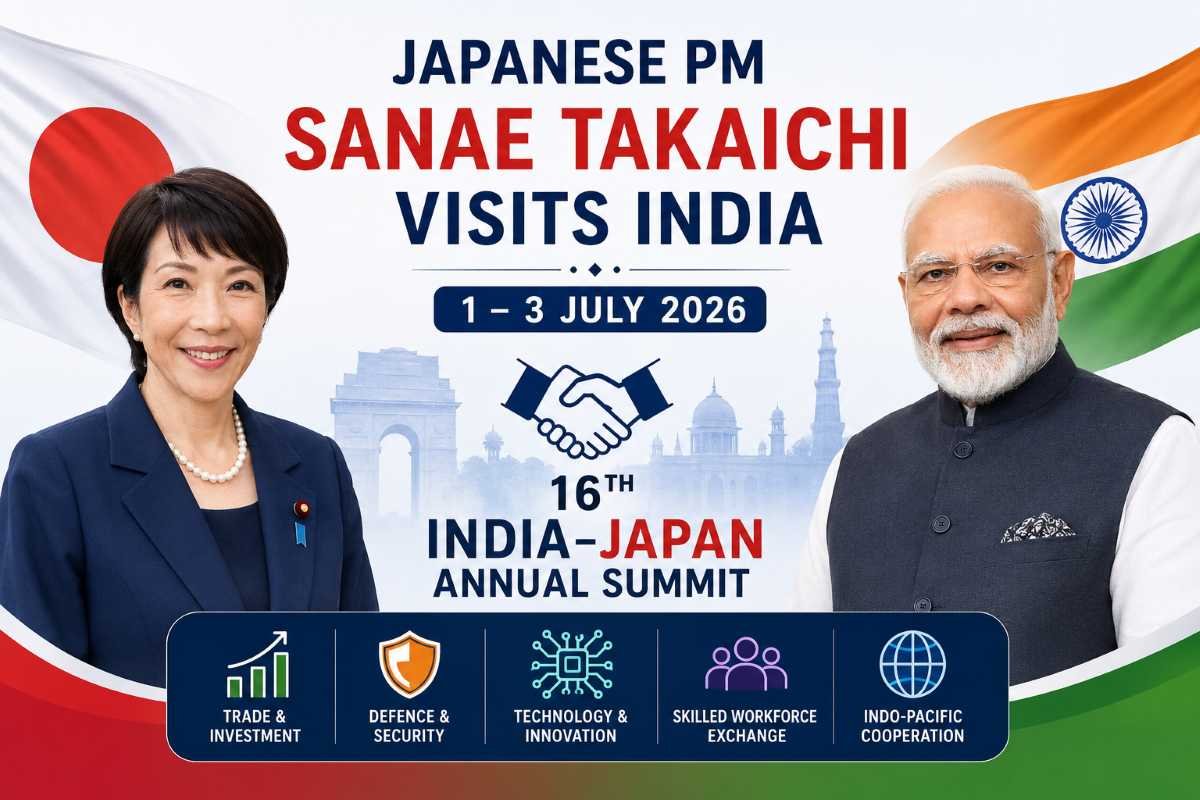
Recently, the Prime Minister of Japan Sanae Takaichi visited India (1–3 July 2026) for the 16th India–Japan Annual Summit. Leaders of India and Japan adopted a shared vision of “Strategic Convergence and Trust for Shared Growth, Prosperity and Resilience”, strengthening the India–Japan Special Strategic and Global Partnership.
Key Outcomes of the Summit:
-
-
- Defence and Security Cooperation
- Strengthening of 2+2 ministerial dialogue framework
- Expansion of naval cooperation through exercises like JIMEX, Malabar, Dharma Guardian
- Progress in defence technology cooperation, including UNICORN system project
- Enhanced maritime domain awareness and logistics cooperation
Aim: strengthen Indo-Pacific maritime security
- Strengthening of 2+2 ministerial dialogue framework
- Economic and Economic Security Cooperation
- Adoption of India–Japan Joint Declaration on Economic Security Cooperation
- Focus on semiconductors, critical minerals, ICT, pharmaceuticals, clean energy
- Commitment to resilient and diversified global supply chains
- Review and expansion of Comprehensive Economic Partnership Agreement (CEPA) Shift towards strategic economic resilience
- Adoption of India–Japan Joint Declaration on Economic Security Cooperation
- Trade, Investment and Infrastructure
- Progress towards 10 trillion yen investment target
- Expansion of Japanese Industrial Townships in India
- Cooperation in metro rail, freight corridors, and smart cities
- Support for India–Japan High Speed Rail (Mumbai–Ahmedabad corridor)
Strengthening India’s industrial and connectivity base
- Progress towards 10 trillion yen investment target
- Technology, AI and Innovation
- Launch of India–Japan AI Strategic Dialogue
- Cooperation in quantum technologies, space (LUPEX mission), and digital infrastructure
- Alignment with Hiroshima AI Process and responsible AI governance
Focus on trusted and secure technology ecosystems
- Launch of India–Japan AI Strategic Dialogue
- Energy and Climate Cooperation
- Expansion of cooperation in hydrogen, ammonia, solar, and biogas projects
- Joint efforts on energy security and strategic petroleum reserves
- Promotion of clean energy transition and supply chain resilience
- Expansion of cooperation in hydrogen, ammonia, solar, and biogas projects
- Global and Regional Cooperation
- Strong alignment on Free and Open Indo-Pacific (FOIP)
- Cooperation within Quad framework
- Shared concerns over maritime security in South China Sea and East China Sea
- Coordination on UN reforms (G4 framework) and global governance
- Strong alignment on Free and Open Indo-Pacific (FOIP)
- Defence and Security Cooperation
-
About India–Japan Relations:
-
-
- India–Japan relations are among the most stable and forward-looking partnerships in Asia, often described as the “most natural strategic partnership in the Indo-Pacific.” The relationship is rooted in shared democratic values, rule of law, and convergence on maintaining a Free and Open Indo-Pacific (FOIP).
- Historically, ties evolved from ancient civilizational links through Buddhism to a modern strategic partnership. Key milestones include the 1952 Peace Treaty, 2000 Global Partnership, and 2014 Special Strategic and Global Partnership, further deepened through Annual Summits.
- Cooperation spans defence, economics, and technology. Both countries engage in joint military exercises like JIMEX and Malabar, and cooperate on defence technology and maritime security. Japan is a major investor in India, supporting infrastructure projects such as the Mumbai–Ahmedabad High-Speed Rail and metro systems. Emerging areas include semiconductors, AI, clean energy, and critical minerals.
- Both also collaborate in the Quad, UN reforms, and Indo-Pacific initiatives.
- Despite trade barriers and project delays, the partnership continues to deepen, driven by strategic trust and shared regional goals.
- India–Japan relations are among the most stable and forward-looking partnerships in Asia, often described as the “most natural strategic partnership in the Indo-Pacific.” The relationship is rooted in shared democratic values, rule of law, and convergence on maintaining a Free and Open Indo-Pacific (FOIP).
-
Conclusion:
The 16th India–Japan Summit marks a decisive shift from a traditional development partnership to a future-oriented strategic alliance. With deepening cooperation in defence, technology, infrastructure, energy, and Indo-Pacific security, both countries are emerging as key architects of a stable, rules-based, and multipolar regional order.



