
Context:
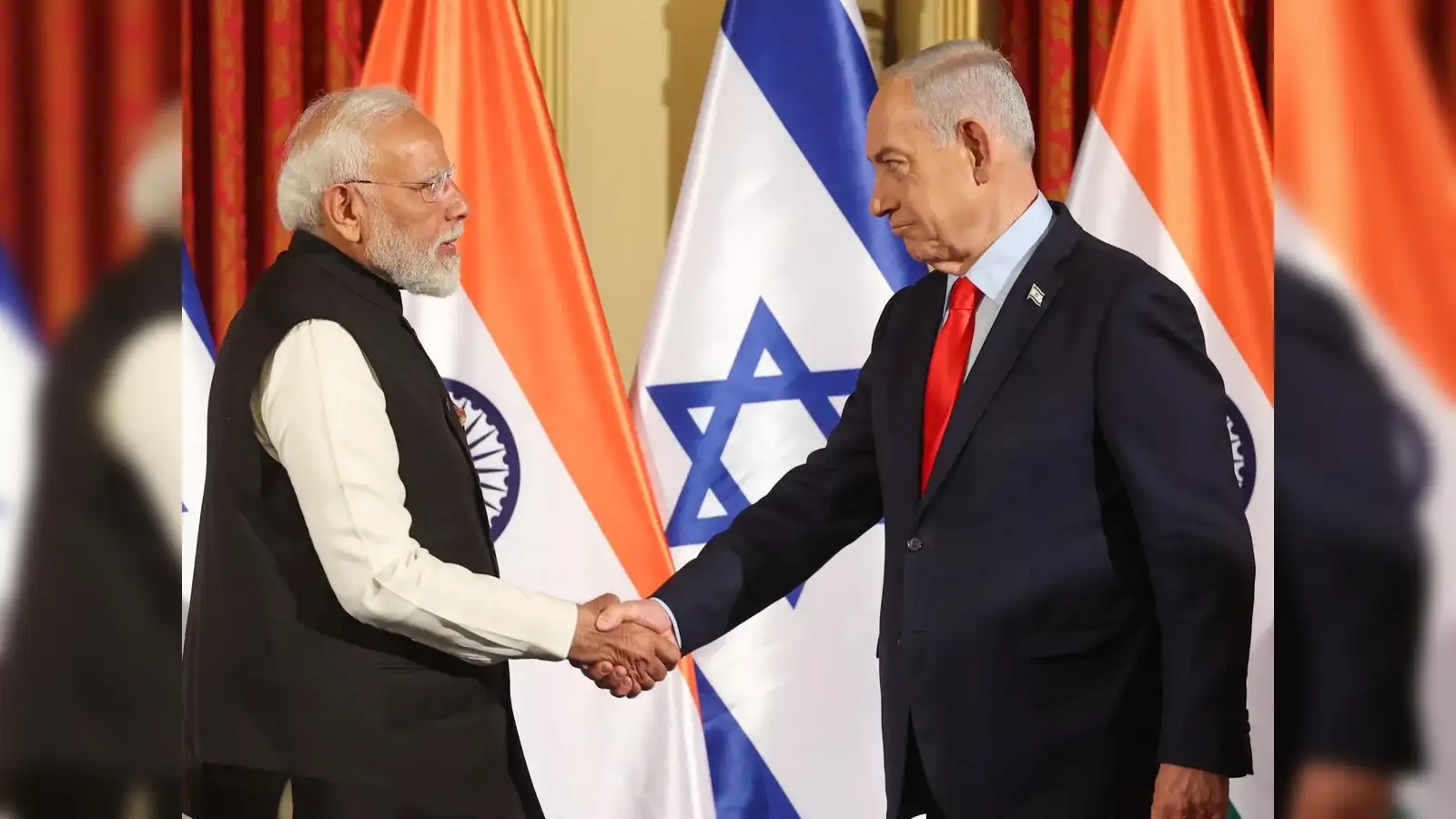
Recently, on 25–26 February, Prime Minister Narendra Modi was on a State Visit to Israel. During this visit, it was announced that bilateral ties between the two countries would be elevated to a Special Strategic Partnership for Peace, Innovation and Prosperity. This step signifies a qualitative transformation in India–Israel relations, moving beyond a defence-centric framework toward a broader technology-driven alliance.
Key Highlights of the Visit:
1. Strategic and Security Cooperation
• Both countries reaffirmed their strong partnership in defence and security, including enhanced defence collaboration, joint development and production, and technology transfer.
• They reiterated their shared stance against terrorism, emphasizing that it has “no place in the world.”
2. Critical and Emerging Technologies
• A partnership was established in critical and emerging technologies to cooperate in areas such as Artificial Intelligence (AI), quantum computing, critical minerals, cybersecurity, and digital innovation.
3. Economic and Trade Cooperation
• India and Israel agreed to work toward finalizing a Free Trade Agreement (FTA) by the end of the year, which would significantly boost economic engagement.
• Expansion of digital payment cooperation, including the possible linkage of UPI systems to promote cross-border financial integration.
4. Agriculture and Rural Development
• Agricultural cooperation, historically a key pillar of India–Israel relations, will be expanded. This includes scaling up Centres of Excellence and establishing “Villages of Excellence” to transfer Israeli agricultural technologies to Indian farms.
5. People-to-People Contact and Labour Mobility
• Both sides agreed to strengthen cooperation in education, culture, research, and academic exchanges.
• Israel agreed to allow up to 50,000 additional Indian workers by 2030, enhancing employment and livelihood opportunities.
6. Regional Initiatives and Multilateral Engagement
• Both leaders emphasized collaboration under frameworks such as I2U2 (India–Israel–UAE–USA) and the India–Middle East–Europe Economic Corridor (IMEC) to support connectivity and economic integration.
Evolution of India–Israel Relations:
-
-
- India recognized Israel in 1950; however, full diplomatic relations were established only in 1992. The geopolitical realities of the Cold War, India’s leading role in the Non-Aligned Movement, and its moral-political commitment to the Palestinian cause limited the relationship for decades.
- After 1992, the global order changed. The collapse of the Soviet Union, economic liberalization, and emerging security challenges pushed India toward pragmatic diplomacy. During the 1999 Kargil War, Israel supplied critical defence equipment at short notice. That moment of crisis laid the foundation of trust.
- In 2017, Prime Minister Modi’s visit to Israel formalized the “de-hyphenation” policy, meaning India would view its relations with Israel independently of the Palestinian issue. This allowed India to adopt a balanced triangular strategy, such as deepening technological and defence cooperation with Israel, maintaining energy and diaspora ties with Arab states, and continuing its historical support for Palestine.
- At present, India–Israel relations have evolved from a limited defence-import relationship into a multidimensional strategic partnership, including:
- India recognized Israel in 1950; however, full diplomatic relations were established only in 1992. The geopolitical realities of the Cold War, India’s leading role in the Non-Aligned Movement, and its moral-political commitment to the Palestinian cause limited the relationship for decades.
-
• High-technology cooperation
• Defence co-development
• Trade expansion
• Water and agricultural innovation
• Minilateral frameworks such as I2U2
• The India–Middle East–Europe Economic Corridor (IMEC)
Defence and Technology-Based Alliance:
-
-
-
- Defence cooperation has been the backbone of India–Israel relations. Platforms such as Phalcon AWACS, Heron and Searcher drones, Spyder air defence systems, and electronic warfare equipment have significantly enhanced the capabilities of the Indian armed forces. The co-development of the Barak-8 missile system symbolizes India’s transition from a mere buyer to a co-developer.
- However, the significance of the current elevation lies in the fact that the relationship is no longer confined to defence. Through the “Critical and Emerging Technologies Partnership,” cooperation has expanded into Artificial Intelligence, quantum computing, cybersecurity, critical minerals, and semiconductors. This collaboration could provide India with a strategic edge in an era of global technological competition.
- Israel’s startup ecosystem is considered among the most advanced in the world. On the other hand, India possesses a vast digital base, skilled human resources, and manufacturing capacity. The complementarity between the two can create a technological partnership that influences not only bilateral gains but also global value chains.
- Defence cooperation has been the backbone of India–Israel relations. Platforms such as Phalcon AWACS, Heron and Searcher drones, Spyder air defence systems, and electronic warfare equipment have significantly enhanced the capabilities of the Indian armed forces. The co-development of the Barak-8 missile system symbolizes India’s transition from a mere buyer to a co-developer.
-
-
Economic Dimension:
-
-
-
- Bilateral trade has grown from approximately USD 200 million in 1992 to USD 3.75 billion in 2024–25. However, it remains below its full potential. The proposed Free Trade Agreement (FTA) can convert this potential into tangible outcomes.
- Beyond diamonds and chemicals, cooperation in agri-technology, water management, defence co-production, cybersecurity, and digital payments can elevate economic ties to new heights. The possible linkage of UPI systems would facilitate cross-border payment mechanisms, forming the backbone of a future digital economy.
- Bilateral trade has grown from approximately USD 200 million in 1992 to USD 3.75 billion in 2024–25. However, it remains below its full potential. The proposed Free Trade Agreement (FTA) can convert this potential into tangible outcomes.
-
-
Agriculture and Water Cooperation:
-
-
-
- An extremely practical dimension of India–Israel cooperation lies in agriculture and water management. The 43 Centres of Excellence established in India are transferring Israeli precision farming, drip irrigation, and protected cultivation technologies adapted to Indian conditions.
- Amid the challenges of climate change and water scarcity, cooperation in desalination, wastewater recycling, and integrated water management could prove vital for India’s water-stressed western and peninsular regions. Thus, the partnership encompasses not only strategic and economic aspects but also social and environmental dimensions.
- An extremely practical dimension of India–Israel cooperation lies in agriculture and water management. The 43 Centres of Excellence established in India are transferring Israeli precision farming, drip irrigation, and protected cultivation technologies adapted to Indian conditions.
-
-
Regional and Global Perspective:
-
-
-
- The elevation of India–Israel ties cannot be viewed separately from West Asia’s broader geopolitics. Platforms such as I2U2 (India–Israel–UAE–USA) and IMEC indicate that India is expanding its geo-economic influence through multilateral, minilateral, and connectivity-based diplomacy.
- Projects like IMEC can provide India with alternative routes to Europe, promoting maritime trade, energy security, and supply chain diversification.
- The elevation of India–Israel ties cannot be viewed separately from West Asia’s broader geopolitics. Platforms such as I2U2 (India–Israel–UAE–USA) and IMEC indicate that India is expanding its geo-economic influence through multilateral, minilateral, and connectivity-based diplomacy.
-
-
Challenges:
Despite strong momentum, several structural challenges persist-
The Iran Dilemma
Israel considers Iran an existential threat. For India, however, Iran is crucial for energy security and connectivity through the Chabahar Port. Balancing these interests is complex.
The Palestinian Question
India officially supports a two-state solution. During Middle East escalations, sustaining the de-hyphenation policy may become difficult.
The China Factor
China is Israel’s largest trading partner in Asia. Chinese investments in Israeli infrastructure and technology sectors create strategic sensitivities for India.
Intellectual Property Concerns
Israeli firms express concerns about India’s relatively lenient IPR regime. Reluctance to transfer source codes and deep technological know-how may slow defence indigenization.
Risks to Megaprojects
Connectivity initiatives like IMEC rely on infrastructure such as the Port of Haifa. Regional conflicts may affect their security and viability.
Way Forward:
To transform the Special Strategic Partnership into concrete outcomes, certain steps are necessary. First, there is a need to move toward defence co-production and joint intellectual property ownership to strengthen Atmanirbhar Bharat. Second, platforms such as I2U2 and IMEC should be institutionalized to ensure the steady progress of connectivity and energy projects. Third, innovation ecosystems must be expanded through joint research in AI, semiconductors, green technologies, and water management. Finally, academic and Track-2 diplomacy should be strengthened to deepen people-to-people trust and promote long-term cooperation.
Conclusion:
The elevation of India-Israel relations to a Special Strategic Partnership symbolizes 21st-century diplomacy, where defence, technology, economy, and geopolitics are deeply interconnected. This partnership offers India the opportunity to play a balanced, autonomous, and influential role in West Asia.
| UPSC/PCS Main Examination Practice Question: How are India–Israel relations transforming from defence cooperation to a technology-based partnership? Explain with suitable examples. |



