
Context:
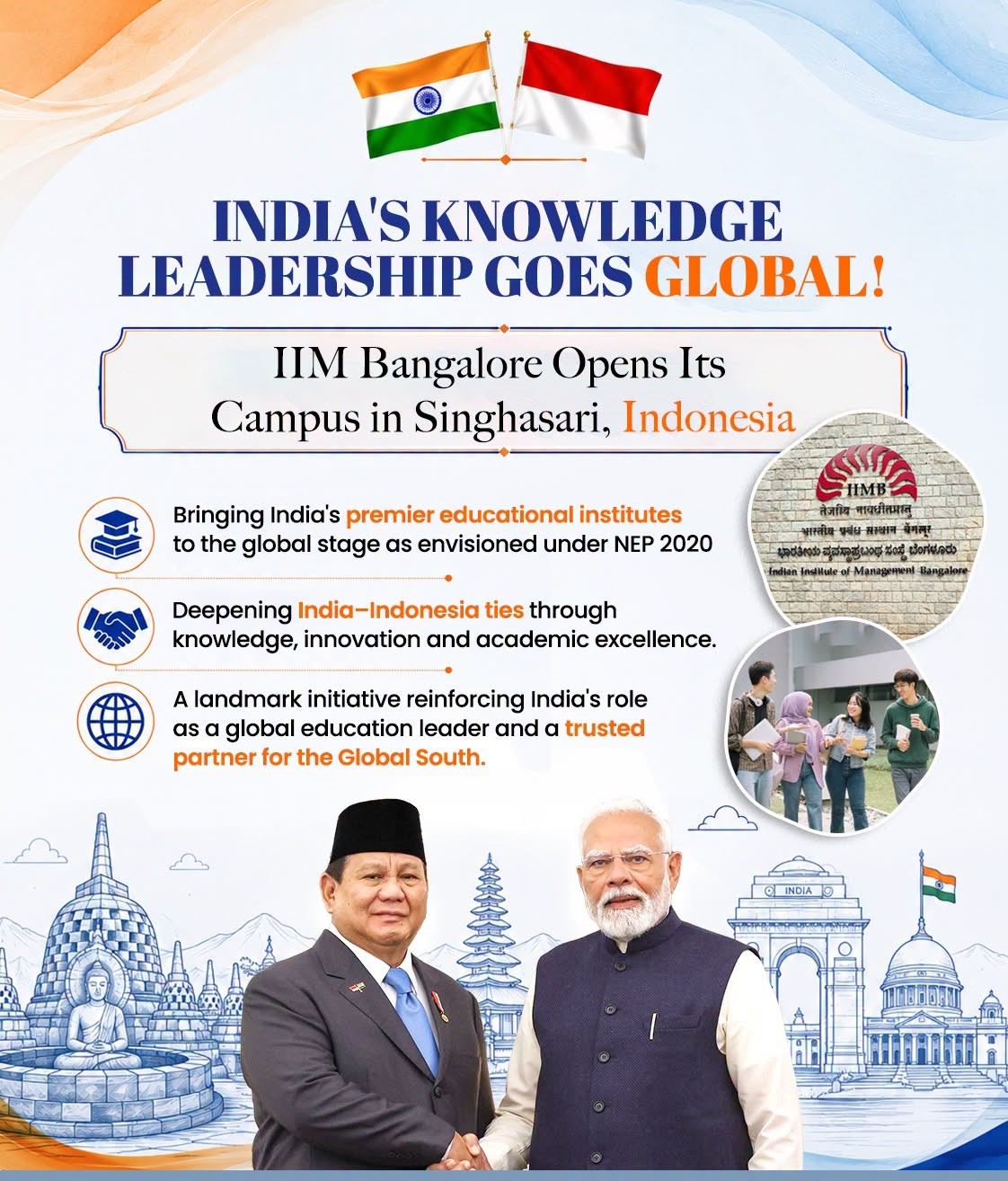
Recently, The Prime Minister of India paid a State Visit to Indonesia, during which both countries adopted a Joint Statement to deepen their Comprehensive Strategic Partnership (CSP).
India–Indonesia Bilateral Relations:
India and Indonesia share a Comprehensive Strategic Partnership established in 2018, based on centuries-old civilizational, cultural, and maritime linkages. The relationship covers political dialogue, defence cooperation, maritime security, trade, investment, digital economy, energy, space, education, culture, and regional cooperation.
Key Outcomes of India–Indonesia Summit:
Political and Strategic Cooperation: Both countries agreed to institutionalise regular summit meetings and strengthen existing mechanisms such as the Joint Commission Meeting, Foreign Office Consultations, and parliamentary exchanges. Cooperation among think tanks, academic institutions, and policy experts will also be enhanced for better strategic coordination.
Defence and Maritime Security
India and Indonesia expanded defence cooperation in areas including:
-
- BrahMos missile system
- Air-to-Air Missiles
- Joint military exercises
- Defence technology cooperation
- Hydrography and Maritime Domain Awareness (MDA)
- BrahMos missile system
Indonesia will station an International Liaison Officer at India's IFC-IOR, Gurugram, improving maritime information sharing and Indo-Pacific security.
Counter-Terrorism and Cyber Security
Both nations adopted a zero-tolerance approach towards terrorism and agreed to cooperate against terror financing, violent extremism, and online radicalisation. Cyber cooperation will focus on digital forensics, CERT cooperation, and protection of critical information infrastructure.
Trade, Investment and Critical Minerals
-
-
- India and Indonesia committed to concluding the ASEAN–India Trade in Goods Agreement (AITIGA) Review to improve market access and reduce trade barriers. They also promoted Local Currency Transactions between RBI and Bank Indonesia.
- Cooperation in critical minerals, rare earths, and steel supply chains was strengthened. A joint venture between SAIL and PT Krakatau Steel will explore stainless steel production and technology transfer.
- India and Indonesia committed to concluding the ASEAN–India Trade in Goods Agreement (AITIGA) Review to improve market access and reduce trade barriers. They also promoted Local Currency Transactions between RBI and Bank Indonesia.
-
Energy, Agriculture and Digital Connectivity
-
-
- The two countries agreed to cooperate in green hydrogen, LNG, solar energy, bioenergy, agriculture, food security, and fertilizer sectors. India will support the development of Sabang Port, while both nations will enhance Andaman–Aceh connectivity.
- Digital cooperation includes the launch of Indonesia Open Network (ION) based on India's ONDC framework and progress on cross-border QR payments.
- The two countries agreed to cooperate in green hydrogen, LNG, solar energy, bioenergy, agriculture, food security, and fertilizer sectors. India will support the development of Sabang Port, while both nations will enhance Andaman–Aceh connectivity.
-
Science, Culture and Education
India and Indonesia expanded cooperation between ISRO and BRIN, including support for the Gaganyaan Mission through Indonesia’s Biak tracking facilities. Collaboration will also continue in AI, nuclear energy, and scientific research.
India will support restoration of the UNESCO-listed Prambanan Temple Complex, and 2026–27 will be celebrated as the Tagore–Dewantara Year.
Strategic Importance for India:
The partnership strengthens India's Act East Policy and Indo-Pacific vision. Sabang Port enhances India's maritime presence near the Strait of Malacca, while BrahMos exports boost defence manufacturing. Indonesia’s nickel reserves support India's EV and battery industries. Expansion of UPI and ONDC promotes India’s digital leadership.
Challenges:
-
-
- Indonesia maintains strategic autonomy and avoids direct confrontation with China.
- Trade imbalance persists due to market access barriers.
- Infrastructure projects face regulatory and environmental delays.
- Defence technology integration requires careful handling of security concerns.
- Indonesia maintains strategic autonomy and avoids direct confrontation with China.
-
Conclusion:
India–Indonesia relations represent a key pillar of Indo-Pacific stability. By combining maritime cooperation, defence partnerships, critical mineral security, and digital innovation, both countries can contribute to a secure and prosperous regional order aligned with India’s Viksit Bharat 2047 vision and Indonesia’s Indonesia Emas 2045 roadmap.



