
Decline in India’s Ranking in IMF
Context:
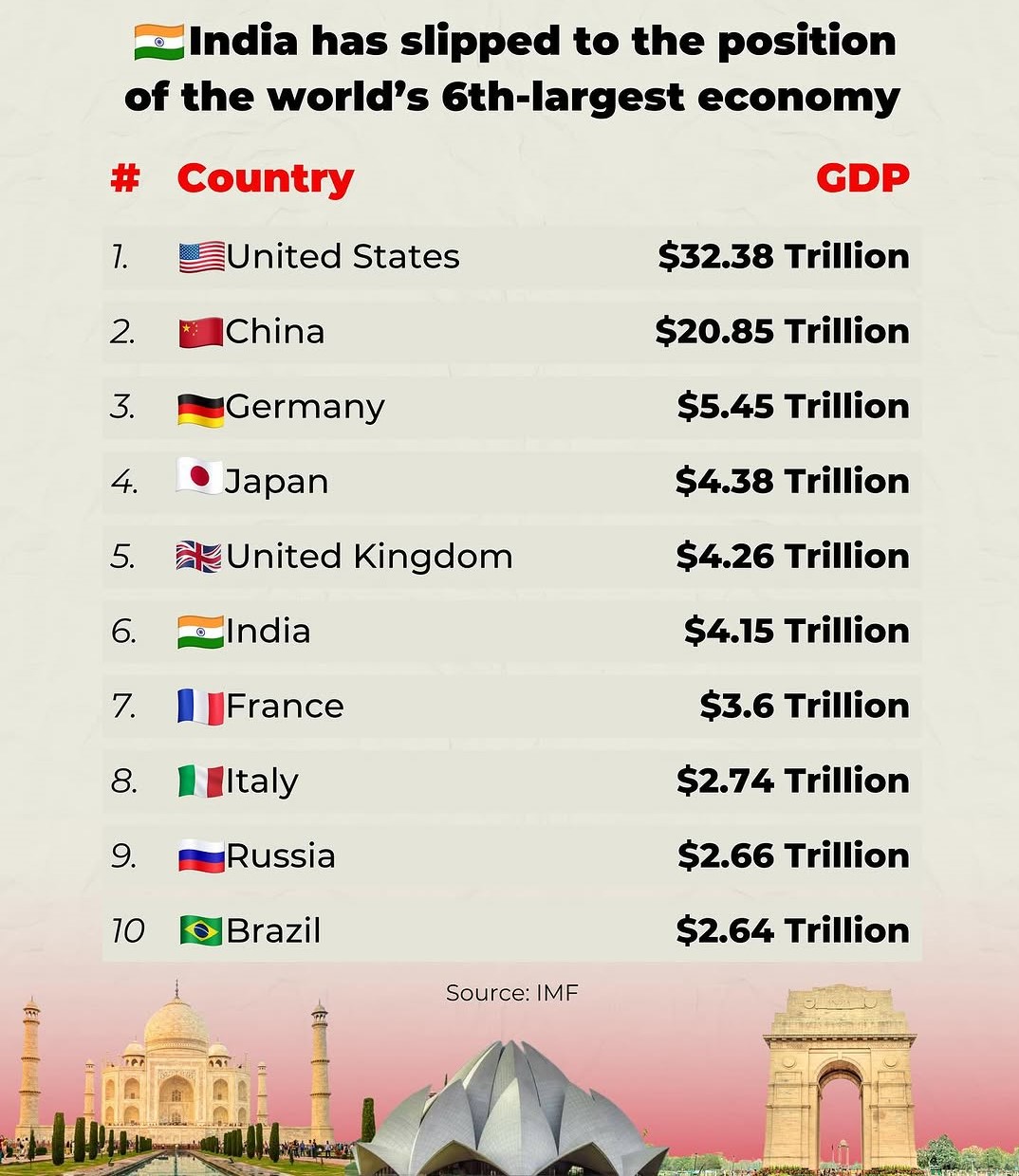
Recently, according to the World Economic Outlook released by the International Monetary Fund (IMF), India has slipped from being the fourth largest economy in the world to the sixth position in terms of nominal GDP. India now stands sixth after the United States, China, Germany, Japan, and the United Kingdom. However, this decline is more a result of statistical adjustments and exchange rate movements than any fundamental weakness in the Indian economy.
Major Factors Behind the Decline:
-
-
- Exchange Rate and Depreciation of the Rupee: Since the IMF compares economies based on nominal GDP in US dollar terms, the exchange rate plays a decisive role. The significant depreciation of the Indian rupee against the US dollar has reduced the dollar value of India’s GDP in global markets, thereby affecting its ranking.
- Base Year Revision: In February 2026, India revised the base year for GDP calculation from 2011–12 to 2022–23. This change was necessary to reflect current consumption and production patterns more accurately. However, due to this statistical revision, a downward correction of around 3.5% in nominal GDP estimates was observed, which temporarily impacted the ranking.
- Impact of Global Demand and Inflation: Higher inflation levels in developed countries (especially the UK and Germany) have increased their nominal GDP. In contrast, India has managed to keep inflation relatively under control. Since nominal GDP includes inflation, European economies gained a relative advantage in rankings.
- Global Economic Slowdown: At the global level, supply chain disruptions and geopolitical tensions (such as the Ukraine conflict and crises in West Asia) have led to a rise in crude oil prices. This has put pressure on India’s fiscal deficit and inflation.
- Exchange Rate and Depreciation of the Rupee: Since the IMF compares economies based on nominal GDP in US dollar terms, the exchange rate plays a decisive role. The significant depreciation of the Indian rupee against the US dollar has reduced the dollar value of India’s GDP in global markets, thereby affecting its ranking.
-
Resilience Structure of the Indian Economy:
Despite the decline in ranking, India possesses several strengths that make it a “global bright spot”:
-
-
- Growth Rate: With a growth rate of around 6.5%, India remains the fastest-growing major economy in the world.
- Purchasing Power Parity (PPP): When GDP is measured in terms of PPP, India continues to be the third-largest economy globally.
- Infrastructure and Digital Reforms: Investments in initiatives like Gati Shakti and Digital Public Infrastructure (DPI) have helped reduce production costs and improve efficiency.
- Growth Rate: With a growth rate of around 6.5%, India remains the fastest-growing major economy in the world.
-
Way Forward:
To improve its ranking and ensure sustainable growth, India needs to focus on the following areas:
-
-
- Stability of the Rupee: Effective management of foreign exchange reserves and attracting foreign portfolio investment (FPI).
- Export Promotion: Moving beyond domestic consumption and promoting export-led growth.
- Manufacturing Sector (PLI Scheme): Increasing the share of manufacturing in GDP to 25%.
- Skill Development: Leveraging the demographic dividend by enhancing the skills of the youth.
- Stability of the Rupee: Effective management of foreign exchange reserves and attracting foreign portfolio investment (FPI).
-
Conclusion:
The decline in IMF ranking does not indicate any real economic weakness but is rather the result of exchange rate effects and statistical measurement factors. IMF projections suggest that India is likely to regain the fourth position by 2027 and reach the third position by 2031. Therefore, India’s goal should not merely be to climb the GDP rankings, but to achieve inclusive growth and realize the vision of a $5 trillion economy.



